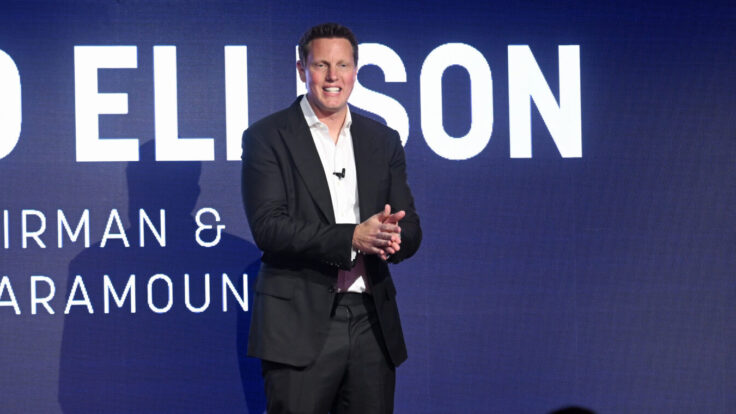
Welcome back to What I’m Hearing. Like David Ellison, I’m skipping Sun Valley, so
get the thrilling play-by-play from Puck’s Dylan Byers. Our fashion expert Lauren Sherman has already declared Michael Eisner (!) best dressed of the moguls, so of course I asked
her for an assessment of David Zaslav’s latest denim-on-denim getup. “You have to give him credit for consistency,” she wrote back.
💫💫 Anyway, the Edinburgh TV Festival, the only global industry event that takes place in the shadow
of a Harry Potter castle, announced today that I’m doing a special crossover podcast event with Richard Osman of The Rest Is Entertainment. Join us for “The Rest Is The Town” on August 28!
Tonight, it’s the YouTube-ification of Netflix, featuring a special back-and-forth between me and Puck’s streaming analyst, Julia Alexander. No punches pulled! Plus,
the auction of Letterboxd heats up, and I bestow my own Emmy nomination awards.
Discussed in this issue: Ted Sarandos, Lena Dunham, John Ternus, Barry Diller, Guillermo del Toro, Michelle Pfeiffer, Rick Ellis, Jamie Erlicht, Stephen A. Smith, Casey Bloys, Mark Rober, Alexis
Ohanian, Brittany Allen, Joe Rogan, Sean Evans, Zack Van Amburg, Hernan Lopez, Billy Bob Thornton, Jennifer Lopez, Greg Peters, Adam Mosseri, Taylor Sheridan, Gwendoline Christie, Jeff Kober, Matthew Buchanan, Bill Simmons, Laurent
Yoon, and… choking on Junior Mints.
Not a Puck member yet? Just click
here. Got a news tip or an idea for me? Just reply to
this email, text me, or message me on Signal at 310-804-3198.
Let’s begin… |
- Six
awards from yesterday’s Emmy nominations that say something about Hollywood in 2026…
Golf Clap Award
To the stunt team for Tulsa King, the lone nominee among Paramount+ shows. Yes, that includes the Taylor Sheridan contenders Landman and The Madison, which—call me naive—seemed noisy enough this year to finally break the curse.
At this point it’s kinda hilarious: Sheridan shows are often the most watched and
biggest-budgeted on TV, they’re well-reviewed, and they feature Oscar-nominated talent like Billy Bob Thornton and Michelle Pfeiffer in meaty roles… yet nothing. I don’t buy that the bicoastal TV Academy just isn’t watching; I know tons of voters, and they’re definitely watching. They’re just refusing to endorse a creator who constantly craps on Hollywood, gleefully shoots his shows elsewhere (often on his own property), and declares in
interviews that he purposely writes dialogue to trigger his haters. This is broader than Sheridan, too. Emmy voters are powerless to stop Paramount from absorbing Warner Bros., but beyond the legacy stuff like Survivor and South Park, they can refuse to honor the Paramount shows.
Achievement in Leverage
Casey Bloys at HBO Max. Not that Paramount owner David Ellison cares much about Emmys, but the nearly total
shutout for his streamer adds heft to Casey’s case that he should be left alone and his team intact once Paramount ingests HBO Max. “We’ll just have to see how things play out,” Bloys teased in a trade interview. “I’ve had very nice conversations and meals with David and we’ll have to see after close what everything’s looking like.” My translation: “I’ll be programming everything or I’m out.”
Cringiest Celebration
Our guy Zaz at Warner Discovery, for firing off a
companywide email from Sun Valley taking credit for HBO Max leading the nominations and Warner Bros. TV scoring 52 noms. “We’ve said consistently that one of Warner Bros. Discovery’s proudest and most important achievements has been the creative renaissance of our film & television studios and their return to industry leadership,” Zaslav wrote (emphasis mine).
Uh… HBO was dominating the Emmys way back when Zaslav was still the grossly overpaid C.E.O. of
Discovery Communications—22 times total, in fact. In the couple years leading up to Zaslav’s “creative renaissance,” HBO and HBO Max earned 130 noms (in 2021) and 140 noms (in 2022)—far more than this year. In that same two-year period, Warner Bros. Television picked up 79 and 44 nominations, respectively, which averages to a lot more than the 52 described as a “return” to leadership. But sure, call it a renaissance. I guess it’s impossible to celebrate without spinning your own
legacy.
Best-Timed Nominations
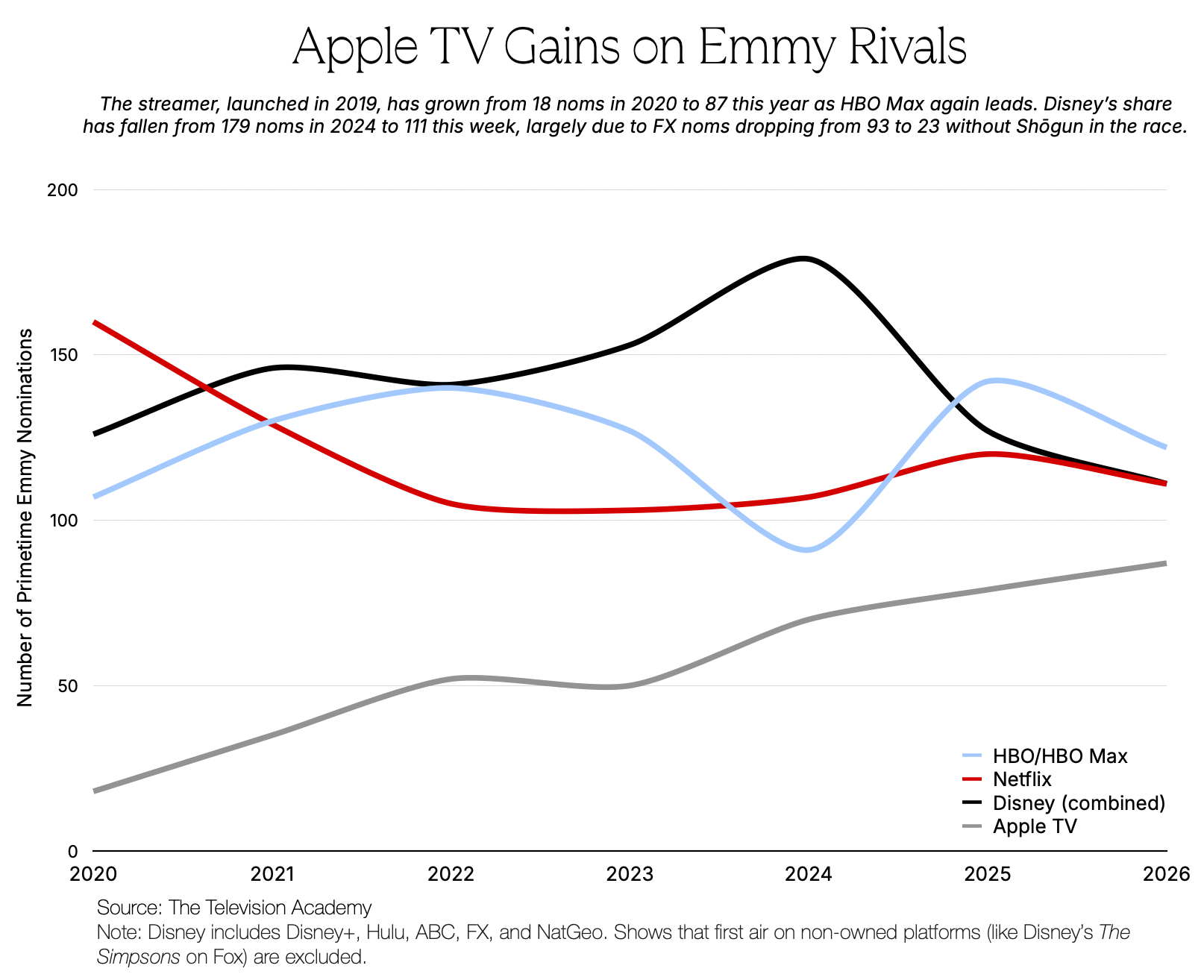
The business case for Apple TV may still remain a mystery, but if the goal is to convince incoming C.E.O. John Ternus to continue to fund an L.A. operation that makes “quality” television, mission accomplished. Apple’s best-ever showing of 87 noms (I don’t count commercials), plus a platform-leading three separate series nominations for comedy (Margot’s Got Money Troubles, Shrinking, and Widow’s
Bay) and drama (Pluribus, Slow Horses, and Your Friends and Neighbors), more than delivers on the “new HBO” message that studio heads Zack Van Amburg and Jamie Erlicht have been preaching to the town for years.
|
- It
didn’t come cheap. During the Emmy-eligible year, Apple TV released 30 scripted originals, double the series output from HBO Max (not including licensed shows). But Apple submits far fewer shows for Emmy consideration, leading to a much higher conversion rate than rivals. And its output is still a fraction of what Netflix and Amazon are pumping out to score their Emmy nom totals of 111 and 68, respectively.
Most Surprising Flex
This one goes to ABC. FX is the Disney
“prestige” brand, right? Followed by Hulu, Disney+, and then the lowly broadcast network. But ABC—boosted by Abbott Elementary, Jimmy Kimmel Live!, and Dancing With the Stars—topped all linear networks and generated 38 Emmy nominations, more than FX (23) or Hulu (22).
The Gwendoline Christie “Going Rogue” Honorees
To Brittany Allen and Jeff Kober, who scored guest actor noms after boldly self-submitting for
The Pitt. (Actually, about a dozen guest players in the sprawling cast did so after HBO Max declined to pay their submission fees.) Allen and Kober brought the show’s acting nomination total to 13 and further evidenced the extent to which voters simply check the boxes for everyone involved in the shows they love. God bless the Emmys.
|
|
|
|
A MESSAGE FROM OUR SPONSOR |
LALO Tequila is a gateway to modern Mexico and a celebration of life’s greatest moments shared with friends and family. For those who
value culture, connection, wellness, and good living, LALO is a way of life. |
|
|
|
- Letterboxd
suitors lining up: Management meet-and-greets have begun in the sales process for Letterboxd, the cinephile social network that has amassed more than 26 million users and become a powerful platform for marketing movies. Semafor reported back in April that Versant, the Comcast spinoff that is already home to Fandango and Rotten Tomatoes, was interested. Now,
among those participating in meetings at the initial stage are Hollywood suitors including Sony Pictures, Paramount, and Netflix; private equity players TPG and RedBird; and media investor Alexis Ohanian.
It’s still early, and while Netflix buying Letterboxd might cause the cinephile community to collectively choke on their Junior Mints, any traditional studio or streamer owner would likely cause alarm among fickle film-nerds. So I doubt co-founder and C.E.O.
Matthew Buchanan would go that path.
Someone like Versant, which could leverage the community to sell tickets and platform movies from all distributors, or a P.E. firm, or Barry Diller’s People Inc., or The New York Times Co. would make more sense to me. The Canadian holding company Tiny, which took a 60 percent stake in Letterboxd in a 2023 deal valuing it at $50 million, began a sales process earlier this year run by LionTree. The bankers are said to be
floating a $250 million valuation, which seems high for a platform without a ton of revenue. But Letterboxd is the rare digital-media success story that also doubles as an influential film platform. (Disclosure: TPG and RedBird are investors in Puck.) - Box office over/under: Disney’s Moana retread has been dropping on tracking services. It’s now between $50 million and $60 million domestic, so let’s set the line at $55 million, and I’ll sadly
take the under.
|
Now to my back-and-forth with Julia… |
|
|
|
With its fast pivot to podcasters and digital creators, the streamer that upended premium TV
is feeling its own angst of late. As the engagement wars ratchet up, are leaders Ted Sarandos and Greg Peters charting a savvy new path or running on nerves? |
|
|
|
As with its move into original content and the rollout of advertising, it’s kinda shocking how
quickly Netflix is pivoting to include more lower-cost, YouTube-style podcasts and short vertical video. Facing a slowdown in engagement on the platform and a stock price that has dropped 40 percent since October, the usual firehose of film and TV announcements now includes creator deals and, just this week, broad partnerships with legacy media brands for the kind of low-effort video they typically dump on YouTube.
Ahead of next week’s reveal of second-quarter earnings and the
much anticipated Engagement Report for the first half of 2026, I asked streaming expert Julia Alexander to debate what’s actually going on at Netflix, and how much they truly want to be YouTube now… |
The Pivot to Cheap Filler
|
Matt: Am I right to feel sad that Netflix seems to be going full YouTube? I know
Neal Mohan & Co. are eating Netflix’s lunch when it comes to engagement, regularly generating more than 13 percent of viewing on smart TVs in the U.S., compared to just 7.8 percent for Netflix in May. Still, podcasts from big names are one thing, but now they’re luring creators like food influencer Meredith Hayden and my guy Sean Evans and Hot Ones, and repurposing annoying pop-up videos from legacy media brands like Travel +
Leisure and Billboard. I asked a smart analyst why YouTube seems to be living rent-free in the head of Netflix co-C.E.O. Ted Sarandos, and he shot back: “He had to do this. YouTube will be so dominant in five years, he will be forced to put their shows there to sell ads.”
Julia: I don’t fully buy that Netflix is becoming YouTube.
Matt: They announced a deal today with the
Stokes twins, who have 140 million followers on YouTube.
Julia: But this isn’t the old “become HBO before HBO becomes us” mantra. It’s a pretty upfront admission from Sarandos and co-C.E.O. Greg Peters that premium content alone won’t increase engagement. To wit, analyst Hernan Lopez found viewing hours for Netflix’s top 10 fell 4 percent
in the first half of 2026—a wrinkle that matters given the company’s ad business is expected to hit $3 billion this year, double last year’s number.
Matt: True. Significant ad growth is the narrative they want, and that’s basically impossible without engagement growth. If that engagement is not coming from the hits, they need more volume.
Julia: Part of the YouTube-style content shift is just diversification. Netflix leans on pricey originals for
engagement more than any rival, per Luminate, and its recent pursuit of Warner Bros. Discovery was as much for library content as I.P. So call this a pivot to cheap filler, potentially freeing money for more international shows and sports. Remember, Netflix content spend grew by approximately 7 percent year over year in 2025, per Bernstein’s Laurent Yoon, and is expected to grow another 10 percent in 2026. Though Netflix still has some of the strongest revenue growth and
margins, engagement must increase to justify the additional spending.
Matt: And they’re not at user-generated content… yet.
Julia: Outside of the fact that it’s all but impossible, there’s no reason for Netflix to truly become YouTube. Think about it this way: If YouTube (via Shorts) and Instagram (via Reels on TV) end up looking mostly the same with a similar batch of non-exclusive creators, then what’s the differentiation? This is where Netflix’s
differentiation and exclusivity and brand matter most in the long run.
Matt: But there’s a hit to the brand. The TV journalist Rick Ellis recently called Netflix the “Costco of streamers,” meaning it’s got something premium for everyone and doesn’t care about any individual title as
long as the platform is “increasing revenue from subscribers, lowering new customer acquisition costs, preventing subscriber churn and building the overall brand.” I’d argue that all the global streamers have employed a version of that model, it’s just that Netflix is the only one that is reliant solely on its streaming business. Amazon sells stuff, and even within Prime Video, it makes money from third-party channels and owns a majority of the movie rental business. Apple is Apple,
Disney is Disney, and YouTube is attached to Google.
Now, with the importance placed on the advertising tier, Netflix is trying to maintain its Costco-style, curated brand while increasingly resembling Walmart or Kroger. On The Town on Monday, we discussed Netflix’s interest in adding outside services like Peacock as tiles to generate engagement. With
podcasts and other low-value videos, Netflix is letting everyone into the store. Well, not everyone—but content that would never have been considered for Netflix is now there alongside Adolescence and Guillermo del Toro movies. Does the brand not suffer? |
|
|
|
A MESSAGE FROM OUR SPONSOR |
LALO Tequila is a gateway to modern Mexico and a celebration of life’s greatest moments shared with friends and family. For those who
value culture, connection, wellness, and good living, LALO is a way of life. |
|
|
|
Julia: One of my original arguments when Netflix started acquiring podcasts is that its
platform isn’t built for what makes video podcasts work on YouTube. YouTube is a platform of related videos across different formats (longform, shorts, podcasts) that leans into viewer obsession by feeding consumers compulsively without any action needed from the user. Someone who watches a two-hour Bill Simmons podcast may get a five-minute Stephen A. Smith ESPN video about the same Celtics trade. Or a Joe Rogan podcast fan gets
a 45-second short on aliens.
For video podcasts or creator content to work on Netflix, that content can’t compete with other premium shows and films—the things that define Netflix. Consumers are never going to come specifically for YouTube content because… YouTube exists! Sarandos and Peters love two words on earnings calls: “engagement” and “fandom.” Originals and licensed premium content (less Mark Rober, more The West Wing) serve the former; podcasts and
digital-partner content serve the latter. Take Vogue’s “73 Questions,” which racks up millions of views on YouTube with guests like Lena Dunham and Jennifer Lopez promoting their projects. Now, after the J.Lo movie ends on Netflix, the fandom can be fed her “73 Questions” episode before they ever leave the app. It’s the same with Simmons after an NFL game on Netflix. Basically, Netflix is trying to increase engagement around its top properties
through supporting that fandom. |
Matt: I’m convinced now that there will be a free tier of Netflix within a year. They’re
loading up on low-value video and inning-eater podcasts. They’ve got all these older shows and movies that could be deployed to generate ad inventory and help funnel users into a paid ad tier, much like Pluto TV has done for Paramount+. The Journal reported
today that execs have discussed adding live “channels” to the service, just like the free platforms Tubi and Roku. This would strip the increasingly thin pretense of Netflix as a fully walled garden and hopefully juice the ads business.
Julia: Oh, absolutely. What advertisers need from Netflix is simple: more places to put commercials. Just under half of subscribers to streaming services with ad tiers in the U.S. are on those ad plans, according to Antenna. And nearly 80
percent of all new net customers have chosen ads over the past four years. As the platforms have raised prices relentlessly, people are willing to watch ads to pay less. More ad impressions lead to higher revenue, but impressions come from time spent.
Matt: Lucas Shaw
highlighted in stark terms this week how some Netflix shows like Running Point, Beef, and The Four Seasons can drop 50 percent in viewership between seasons one and two. Netflix was quick
to note that the declines are happening to varying degrees on other platforms, too, but it has sparked a whole discussion about what’s causing the drop-offs. I think it’s probably not one cause but many. The binge model leads to the TV equivalent of take-out Chinese food: The shows are delicious, if not entirely nutritious, and you gobble them all immediately, even if you’re hungry again soon after and have forgotten a lot of what you just consumed. Plus there’s the long periods between seasons
and the perception that quality may be lower on Netflix, thanks to the relative lack of marketing and the firehose nature of the service. (Netflix has not shared completion rates, which indicate whether a user is inclined to watch more.) Netflix also doesn’t tend to market the second seasons of all but the biggest hits, like Wednesday and Bridgerton, preferring to rely on the algorithm to serve shows to those who watched that first season. HBO Max and Prime Video do a
much better job of reminding viewers that their show is back and why it was good in the first place.
Julia: A couple of theories: First, TV’s great unbundling. Ironically, what made Netflix a success in a declining cable era is now coming for Netflix itself. There’s simply way more competition than ever, and the theory that the first-mover advantage would continue giving Netflix an edge is beginning to waver. Netflix has something for everyone, but it isn’t home to
everything, so attention scatters across YouTube, TikTok, Tubi, Roku Channel, and niche plays like Crunchyroll for anime devotees. Netflix’s low 2 percent average churn rate means its subscribers aren’t leaving, but they’re not necessarily as invested in every big new show.
Then on the zeitgeist point: Weekly drops from HBO Max or Paramount+—The Pitt, anything Taylor Sheridan—stretch over a couple months. Audiences become more invested and likelier to
return for another season. While weekly releases in the linear era used to fill time for advertisers, they have a different goal now: to keep engagement high, churn low, and brand front and center. Love Island’s success for Peacock owes, in part, to the fact that it airs nearly every day, giving fans something to obsess over together in real time.
Matt: More episodes per show might help. Netflix has long stuck to the theory that longer seasons don’t make sense
because users crave new new new. The old model from linear TV, where you deficit finance long seasons and end up making money on the long tail of syndication, doesn’t pencil out with an on-demand audience. But with its focus on ads, I’m wondering why Netflix isn’t doing more programming like The Pitt, which generates 15 hours a season and turns those seasons around quickly?
Julia: Two-fold problem. First, Netflix’s big swings—Bridgerton, One
Piece, Wednesday—are expensive. Part of the reason The Pitt works is because it’s relatively inexpensive and there’s nothing else like it among streaming originals. But The Pitt is a fresh version of what works on Hulu, Paramount+, and Peacock, where decades-old broadcast procedurals still pull massive numbers. Law & Order: SVU, Grey’s Anatomy, and Noah Wyle’s other medical drama, ER, all perform strongly. Yet, Netflix’s
own broadcast-style experiments have proven tepid at best. Pulse, its first medical procedural, was canceled after one season despite cracking the company’s top 30 at premiere.
Second, several of Netflix’s biggest hits lately are limited series (Adolescence) or anthologies (Monster), with no continuing storyline to sustain investment. The strategy works, but it positions Netflix as an occasional stop for what’s new, rather than a weekly
habit.
Matt: In many ways, Netflix created the industry’s obsession with engagement. Now, it feels like the company would very much like us not to focus on this metric. A Netflix exec was recently pushing the notion to me that “not all engagement is created equal,” meaning the passive, scrolling viewership of a YouTube or Instagram should be considered less valuable than the more traditional viewership of Netflix. The linear TV networks have long preached this
line, with some success (after all, there’s still advertising on NBC and ABC, even though YouTube and Meta claim to measure ad impacts much more effectively).
Julia: It’s funny you’re mentioning this now. Meta executives keep pushing the idea that human storytelling will become more important to audiences as generative A.I. appears more frequently in shortform videos. Instagram C.E.O. Adam Mosseri theorized at the beginning of the year that
low-effort, conversational videos will continue to grow in popularity as Instagram users seek out real people. I actually think some of that thinking should be applied internally at Netflix.
Matt: How so?
Julia: The worst thing Netflix could do is chase YouTube as a primary strategy. Obviously engagement needs to grow, but the value of Netflix a decade from now, when we’re all drowning in slop and questioning what’s real and not, is being one of
the few places left where a great TV show or movie is still the main offering. People just want good TV. The distribution may change, the players may shift, but what audiences want hasn’t really evolved over the past several decades.
Matt: You sure about that? Gen Z is spending nearly an hour a day on Instagram, and they’re not watching great TV shows or movies there.
Julia: But they’re watching Reels at the same time that Outer Banks
plays in the background. It’s not an either/or equation anymore; it’s improv rules. “Yes, and” is key. Even as engagement slows, Netflix’s low churn rate suggests there’s still a lot of room to play. |
See you Monday,
Matt
Got a question, comment, complaint, or a last-minute Spain–Belgium invite?
Email me at Matt@puck.news or call/text me at 310-804-3198. |
|
|
|
The ultimate fashion industry bible, offering incisive reportage on all aspects of the business and its biggest players.
Anchored by preeminent fashion journalist Lauren Sherman, Line Sheet also features Rachel Strugatz, who delivers unparalleled intel on what’s happening in the beauty industry, as well as Malique Morris on retail, D.T.C., and more. |
|
|
|
Puck sports correspondent John Ourand and a rotating cast of industry insiders take you inside the executive suites and owners
boxes where the decisions that shape the entire sports business are made. You’ll hear interviews with players, network execs, and everyone in between. The Varsity is an extension of John’s private email for Puck by the same name. New episodes publish every Wednesday and Sunday. |
|
|
|
Need help? Review our
FAQ page or contact us for assistance. For brand partnerships, email ads@puck.news.
You received this email because you signed up to receive emails from Puck, or as part of your Puck account associated with {{customer.email}}. To stop receiving this newsletter and/or manage all your email preferences, click here. |
Puck is published by Heat Media LLC. 107 Greenwich St., New York, NY 10006 |
|
|
|
|