Welcome back to The Varsity. Tonight’s U.S. World Cup game is about to start, so
let’s just jump right into it!
Pod alert: Steven Cahall, a top media analyst from Wells Fargo Securities, joins The Varsity this week to handicap the NFL media rights situation, explain why Fox really bought Roku, and predict what happens to NBC once Comcast spins it off. Also, make sure to listen to yesterday’s
episode, where tennis sage Jon Wertheim offers his state of the sport.
Before we get started: The 42–49 Orioles are giving season-ticket holders until August 7 to renew their plans for next season, according to a bunch of friends who forwarded the emails they received this afternoon. In case you’re wondering, there was no mention of the looming lockout or how refunds will be handled if games are canceled next spring.
In tonight’s issue,
Eriq Gardner is here with fresh reporting on what had been—at least until Donald Trump put his finger on FIFA’s red-card scale—the great controversy of this year’s World Cup: so-called “ghost tickets” on StubHub. Several would-be tournament attendees bought coveted and lucrative tickets through the platform, which was not an official FIFA partner, only to see them evaporate on game day. With those plaintiffs now predictably seeking legal
recourse, Eriq is here to explain how we got here and what the episode indicates about the market.
Also mentioned in this issue: Charlie Baker, Mark Lazarus, Matt Hong, Taylor Swift, Ken Paxton, and more.
This issue was created with contributions from Curtis Rowser. |
|
|
|
A MESSAGE FROM OUR SPONSOR |
MLB All-Star Week in Philadelphia will continue the celebration of America’s 250th birthday with a schedule
that includes fan events, a free drone show, themed merchandise and uniforms, and the continuation of a national volunteerism effort. Prior to the Midsummer Classic, baseball’s best will walk the Red Carpet at Independence Mall, footsteps from where the Declaration of Independence was signed 250 years ago. Fans can catch all the action when Netflix hosts its first T-Mobile Home Run Derby on Monday, July 13, and the MLB All-Star Game presented by Mastercard will take
place on Tuesday, July 14 on FOX. For more information, visit AllStarGame.com. |
|
|
|
- To comp
and comp not: We’re deep into the Wimbledon fortnight, and some of the most notable competition has occurred off the courts. To wit: Players staged a protest over their share of tournament revenue shortly before play commenced—not pay equity, which has long been settled, but their slice of gross earnings. The timing was notable since Wimbledon had recently increased prize money by 20 percent. Naturally, tournament organizers were pissed.
So last Sunday, just as the
tournament was getting underway, the Wimbledon brass reciprocated the brutality. “They yanked the players’ comp tickets,” Sports Illustrated’s Jon Wertheim told me on yesterday’s episode of The Varsity. That was no trivial maneuver, especially considering that 256 players make up Wimbledon’s singles draw. Wertheim said that the
move “caused chaos” as people showed up to claim tickets that weren’t there. By Sunday night, the players had released a statement calling the protest off, citing productive negotiations.
Was there really a peace treaty, or did they just want their tickets back? Wertheim told me that the gesture “won’t go unnoticed by other tournaments” should similar issues arise in the future. “They found the pain point,” he said. - More college chaos: During an
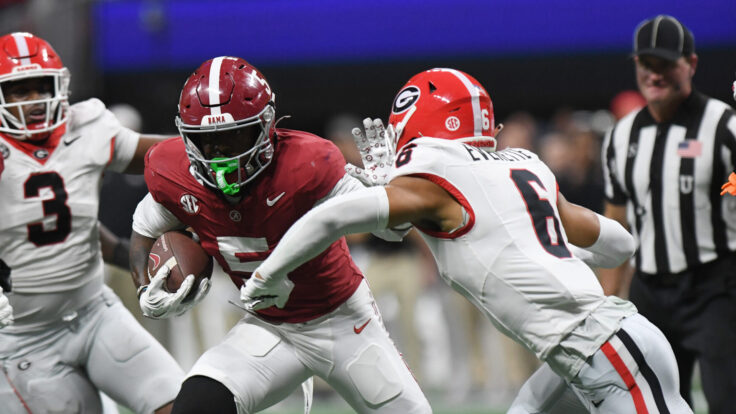
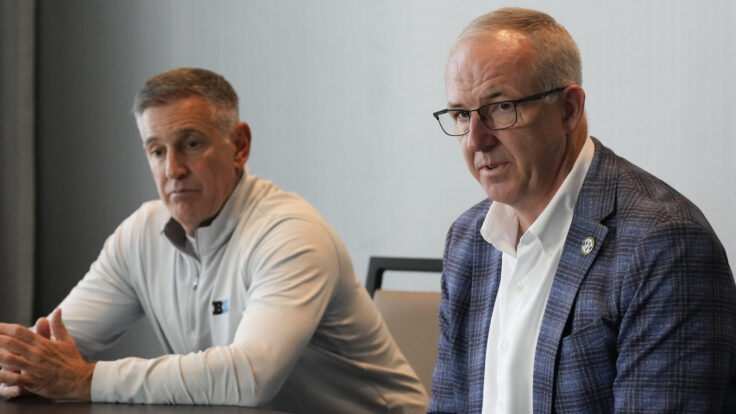
appearance on Face the Nation on Sunday, NCAA president Charlie Baker singled out the biggest impediment to transformation in college sports: the longitudinal asynchronicity of various conferences’ media deals. “The real question is, when does everybody’s TV contracts come up, and what will that mean with respect to how they get negotiated at that point in time?”
The guy has a point. The SEC’s deal with ESPN runs through 2034, and the Big Ten’s deals with Fox,
CBS, and NBC last until 2030. The Big 12’s deal with ESPN and Fox goes through 2031, and the ACC’s ESPN deal runs through 2036. The networks have little interest in getting out of these deals early, which renders more substantive changes virtually impossible.
One potential solution that Baker discussed on the show: “Most of the conversations I've heard among schools, at least at the Division I level, is whether they should try and figure out some way to create a more regional approach to
sports other than football.” The full interview is worth watching. - Versant’s new driver: If you’ve spent any time with Mark Lazarus or Matt Hong over the past couple of months, you’ve heard them talk about the need to develop business outside of cable TV—their core business, of course, but a rapidly
depreciating asset class. This morning, they put their money to work: Versant paid Bruin Capital $530 million for Full Swing, a golf simulator business, which it will manage alongside GolfNow (its tee-booking site) and GolfPass (an instructional video platform). Is this orthogonal thinking or insane? At the very least, Laz and Matt have created a golf business that is becoming less and less dependent on the 31-year-old Golf Channel.
|
And now, here’s Eriq on the World Cup ghost ticket controversy… |
|
|
|
Fans who’ve strayed from the FIFA-sanctioned resale channels have seen
their seats—and cash—disappear. Predictably, a new lawsuit is looking for remedy. |
|
|
|
Imagine spending a couple thousand dollars at an otherwise trustworthy ticket resale
platform to see Mexico play South Korea in the first round of this year’s World Cup, and travelling internationally for the match, only to discover that your order had been canceled. Or splurging on seats for Switzerland vs. Bosnia and Herzegovina at SoFi Stadium, arriving an hour before kickoff, and learning your tickets don’t exist. These are two of the horror stories that fans have shared about the increasingly fraught and fragile business of getting into this World Cup—the subject
of a new lawsuit filed a few days ago. The twist is that FIFA, which was roundly criticized this spring for ticketing chaos at the tournament, isn’t the defendant. Instead, it’s StubHub, which dared to sell tickets outside FIFA’s official resale system while promising fans they would still get in.
In another universe, this might have become FIFA’s version of the Taylor Swift Eras Tour fiasco: another scarce, wildly over-demanded event that, after a presale meltdown,
produced consumer rage, litigation, and eventually a monopoly verdict against Live Nation and Ticketmaster. The World Cup is unlikely to follow that path, of course. For all the fury over prices, fees, cancellations, and resale chaos, FIFA will likely regard this tournament as a roaring commercial success. So how has FIFA stood so firm at a moment when ticketing practices are under attack everywhere else? Because it has turned scarcity into sovereignty. |
|
|
|
A MESSAGE FROM OUR SPONSOR |
MLB All-Star Week in Philadelphia will continue the celebration of America’s 250th birthday with a schedule
that includes fan events, a free drone show, themed merchandise and uniforms, and the continuation of a national volunteerism effort. Prior to the Midsummer Classic, baseball’s best will walk the Red Carpet at Independence Mall, footsteps from where the Declaration of Independence was signed 250 years ago. Fans can catch all the action when Netflix hosts its first T-Mobile Home Run Derby on Monday, July 13, and the MLB All-Star Game presented by Mastercard will take
place on Tuesday, July 14 on FOX. For more information, visit AllStarGame.com. |
|
|
|
Ticketmaster’s sin was making itself unavoidable in the broader live-events market.
FIFA, on the other hand, has simply made the World Cup wildly unaffordable. That may be capitalism at its most shameless, but it doesn’t amount to obvious antitrust problems. From FIFA’s perspective, the system is performing as designed. Every complaint about dynamic pricing, constrained inventory, and artificial scarcity merely describes the mechanics of extracting maximum value from the world’s most coveted sporting event.
And yet that hasn’t stopped critics from searching for an angle.
In March, a coalition of European fan groups filed a complaint with the European Commission alleging bait advertising and opaque seat-allocation practices. The attorneys general of New York and New Jersey subpoenaed FIFA over ticketing at MetLife Stadium, including for the final match, examining whether fans were misled about seat locations and whether dynamic pricing inflated costs. Now comes litigation over the World Cup’s “ghost ticket” problem. But FIFA is reasonably well positioned to
withstand a legal attack. |
Since American Needle v. NFL in 2010, sports bodies haven’t been able to avoid
antitrust scrutiny simply by calling themselves a single enterprise—the ruling decided that cooperation among separately controlled members can still amount to concerted action. But the harder question has always been: Concerted action over what? It’s difficult to imagine a court treating U.S. Soccer, the Mexican Football Association, the French Football Federation, and FIFA’s 208 other member associations as independent sellers of World Cup inventory the same way NFL teams have been
accused of jointly restricting separately valuable media rights. The World Cup, after all, looks like a single event product administered by its organizer, not a bundle of competing resale rights. There is only one World Cup, and FIFA controls access to it—a “lawful monopoly,” as the new consumer lawsuit itself concedes.
So FIFA gets to run a walled garden. But what about the argument that it has extended that lawful control too far into resale, where it takes a 30 percent cut—15 percent
from the seller, 15 percent from the buyer? An aftermarket lock-in theory would make for an interesting case against FIFA. It would also be a difficult one, given that tickets are licenses, transfer restrictions are disclosed, and U.S. antitrust law is generally more comfortable punishing exclusionary conduct than high prices alone.
The StubHub plaintiffs gesture in the more ambitious direction, calling FIFA’s cut a “supracompetitive tax” before choosing the cleaner target: a platform
that sold tickets outside FIFA’s walled garden while vouching for their authenticity. As the complaint tells it, StubHub sold tickets that, for thousands of fans, simply failed to materialize on match day. That framing is useful for FIFA. The lawsuit may end up bolstering the association’s preferred narrative that fans must stay inside its official marketplace in exchange for certainty, however costly and maddening that may be.
If FIFA is going to get clipped, in other words, it may not
be for owning the marketplace—but for what it sold fans inside it. Last month, Texas Attorney General Ken Paxton announced an investigation into FIFA’s ticketing practices, after a fan who bought “Category 1” seats found FIFA had later redrawn its seat maps and moved those seats into what had originally been “Category 2”—worse views, same receipt. That’s a more conventional legal problem than high prices. If fans paid for one thing and got something materially worse, the claim
starts to sound like fraud.
FIFA’s best defense, ironically, may be that it’s fairly upfront about the unpleasantness of the whole arrangement. Fans may hate dynamic pricing, constrained inventory, official resale fees, and warnings that third-party tickets can vanish without notice. But disclosure matters. That may be why the World Cup hasn’t had its Eras Tour moment. In that scenario, Ticketmaster promised order and delivered chaos. For its part, FIFA promised something much closer to
chaos—and delivered exactly that. |
Thanks, Eriq. See you all tomorrow. Let’s go, USA!
John |
|
|
|
Ace media reporter Dylan Byers brings readers into the C-suite as he chronicles the biggest stories in the
industry: the future of cable news in the streaming era, the transformation of legacy publishers, the tech giants remaking the market, and all the egos involved. Also featuring a weekly dispatch from Puck’s crack streaming/media analyst, Julia Alexander. |
|
|
|
Join Emmy Award-winning journalist Peter Hamby, along with the team of expert journalists at Puck, as they let you
in on the conversations insiders are having across the four corners of power in America: Wall Street, Washington, Silicon Valley, and Hollywood. Presented in partnership with Audacy, new episodes publish daily, Monday through Friday. |
|
|
|
Need help? Review our FAQ page or contact us for assistance. For brand partnerships, email ads@puck.news. You received this email
because you signed up to receive emails from Puck, or as part of your Puck account associated with {{customer.email}}. To stop receiving this newsletter and/or manage all your email preferences, click here. |
Puck is published by Heat Media LLC. 107 Greenwich St., New York, NY 10006 |
|
|
|
|