I’m Teddy Schleifer, and if it’s Tuesday, I’m usually in your inbox.
Happy Christmas week, and greetings from an absolutely freezing Montreal—who thought that December here was a good idea?
For those of you who have inquired about a corporate subscription to Puck for your company, we now have group rates that we can provide. Feel free to reply directly to this email and I can put you in touch with our membership team.
Teddy

Notes on the latest tech industry gossip, fundraising, and political power plays. Mark Zuckerberg’s political interests are, understandably, the subject of intense scrutiny. Liberals have long suspected that he is a hostage of the right, if not a Republican sympathizer, given the extensive aid that Facebook provided Donald Trump’s presidential campaign in 2016 and Zuckerberg’s subsequent reluctance to boot him from the platform. Conservatives presume he is a hostage of his woke employees, if not a card-carrying progressive himself, given that he did eventually deplatform Trump.
That’s why I was intrigued to hear from a source that Zuckerberg recently hired Brian Baker, a longtime Republican strategist, for a new political project. Baker, as Washington insiders will know, is the well-respected political right hand to the billionaire Ricketts family—which includes Todd Ricketts, the co-owner of the Chicago Cubs and until recently the G.O.P. finance chair, and Pete Ricketts, the Republican governor of Nebraska—as well as a key player in the high-dollar G.O.P. fundraising world more broadly. Baker has run outside groups and super PACs that devised vicious attacks on Barack Obama and was one of the few big-money players to support Trump in 2016. Zuckerberg and the Ricketts family are probably as far apart as any two donors could be.
Hiring Baker doesn’t make Zuckerberg a Republican. What it does make Zuckerberg, however, is smart. The Facebook founder is a fairly conventional Silicon Valley liberal—pro-success, pro-innovation, anti-partisanship—even if his primary political concern is Facebook itself. He takes advice from David Plouffe, the former Obama campaign manager who used to guide the political work of the Chan Zuckerberg Initiative, and his personal political check-writing tends to fund broad, middle-of-the-road issues like criminal justice and immigration reform. Pretty anodyne stuff.
Of course, that’s not how Zuckerberg is perceived by many Republicans these days—which is why he needs Baker. Zuckerberg is now entering his second year of a controversy that just will not die: In the middle of the presidential election last summer, Zuckerberg and his wife, Priscilla Chan, donated a whopping $450 million to the nonprofit Center for Tech and Civic Life, in order to bolster election offices amid the coronavirus pandemic. Conservative media and politicians cried foul, accusing the CTCL and Zuckerberg of a thinly-veiled plot to boost voter turnout in predominantly Democratic counties. In fact, it appears the opposite happened: Zuckerberg and Chan also hired Michael Toner, a former F.E.C. commissioner and now a top G.O.P. campaign-finance lawyer, who put together a formal report showing that it was actually Republican-leaning jurisdictions that accounted for the majority of CTCL grants, even if Democratic counties, by dint of their larger populations, ultimately received the greater number of “Zuckerbucks.”
Zuckerberg’s team would certainly like to neutralize the “Zuckerbucks” narrative, which has resulted in Republican governors passing laws forbidding private philanthropies from funding election administration in the future. Hence the need to add Toner and Baker to balance out a communications team headed by former Obama press secretary Ben LaBolt, who, despite his White House experience, does not have as much credibility with the Murdoch outlets that have covered the CTCL storyline religiously.
The Effective Altruists End Run Around Washington
This past summer, I reported on what I thought was a strategic mistake by some of Silicon Valley’s biggest philanthropists. So-called “effective altruists,” including Facebook co-founder Dustin Moskovitz and crypto entrepreneur Sam Bankman-Fried, lean on randomized controlled trials and academic literature to maximize the social impact of every dollar they donate. Both men, for instance, decided it was of utmost importance for Congress to set aside a bunch of money in the Build Back Better reconciliation bill for preventing future pandemics. And yet neither of them appeared willing to use their considerable political influence, as some of the country’s top Democratic donors, to get their desired earmarks.
Congress eventually set aside just $10 billion of the $30 billion that Moskovitz and Bankman-Fried called for. Moreover, the bill still isn’t law. Still, I had a feeling that would hardly be the last time that the abstract ideals of effective altruism would collide with the rough-and-tumble reality of politics and the art of the possible.
Now it appears Moskovitz and Bankman-Fried are making an end run of sorts around Washington, or at least a back-up plan. Accord to new filings, both of their families are the anchor donors behind a new California ballot initiative that would raise $500 million to $1.5 billion a year in taxes on high-earners for their home state to create a new anti-pandemic outfit focusing on genomic sequencing and K-12 schools safety. (If you’re interested, the full text is here.) Moskovitz’s wife, Cari Tuna, is investing $5 million to support the campaign through their joint philanthropy, Open Phil; another $5 million comes from an LLC affiliated with Bankman-Fried. (The ballot initiative itself was introduced by two politically engaged tech entrepreneurs, Max Henderson and Anna Maybach.)
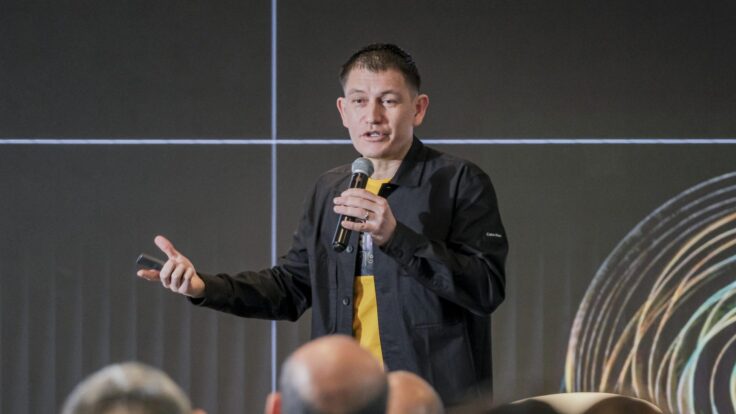
Patrick Collison
One of the most interesting and star-studded philanthropic projects to emerge from the pandemic was a commitment called Fast Grants, a rapid-fire funding program for scientists working on Covid research. It was started by influential economist Tyler Cowen and Stripe C.E.O. and founder Patrick Collison with backing from a Who’s Who of Silicon Valley donors who thought they could move faster than the U.S. government.
Fast Grants has been described to me as a real success, or at least a compelling model—Cowen and Collison credited the program with funding a number of critical Covid-19 interventions that might not have received attention otherwise. Now, a successor Silicon Valley effort is hoping to build on the learnings from Fast Grants with a new research foundation called the Arc Institute. Launched last week with a mission to provide multi-year, project-based grants to researchers—obviating the slower, more piecemeal grant-making process required by government bureaucracies—Arc is partly Collison’s brainchild. Stripe may be a fairly boring payments company, but the Stripe founder is one of Silicon Valley’s most complex, intellectual and policy-oriented entrepreneurs.
He’s a potent operator, too: The group says he’s already helped raise $650 million for Arc from venture capitalist (and Stripe board member) Mike Moritz, Silicon Valley Angel investor Ron Conway, Ethereum founder Vitalik Buterin, and Moskovitz, among others. Pulling together those names gives Arc instant credibility, and shows just how much respect Collison has in the industry at the age of 33.
FOUR STORIES WE'RE TALKING ABOUT 
What to watch, read, gift, drink, and fantasize as we enter 2022. THE EDITORS 
Without a friend in Washington, Russia’s president returns to his usual methods—and threats of violence—to put NATO off balance. JULIA IOFFE 
The line between philanthropy and politics has been obliterated. The upshot is that even more money is moving into the shadows. TEDDY SCHLEIFER 
Notes on the next fiscal crisis, Gorman’s return-to-office pivot, meme SPAC mania, and a ‘Succession’ shout-out. WILLIAM D. COHAN 
You received this message because you signed up to receive emails from Puck.
Was this email forwarded to you?
Sent to {{customer.email}}
Puck is published by Heat Media LLC.
For support, just reply to this e-mail. For brand partnerships, email ads@puck.news |


SHARE