 |
 |
|
Welcome back to The Varsity, my twice-weekly newsletter on all the sotto voce conversations insidiously occuring in the owners’ boxes. As you read this, I should be sipping an Old Fashioned at Puck’s third anniversary party on the lower east side of Manhattan. We’re ringing in the occasion at Nine Orchard, an impossibly chic hotel that would never let Marchand in. Hopefully I’ll be seeing some of you august lettermen and letterwomen tonight…
On yesterday’s episode of The Varsity podcast, WaPo’s Ben Strauss and I went deep on ESPN’s strategy. Meanwhile, be sure to look for my conversation with the Premier Lacrosse League’s Paul Rabil this weekend. Rabil offers a high-level strategic view on how to launch a new league in the era of niche sports.
Let’s get to it…
|
| Player of the Week: Roger Goodell |
|
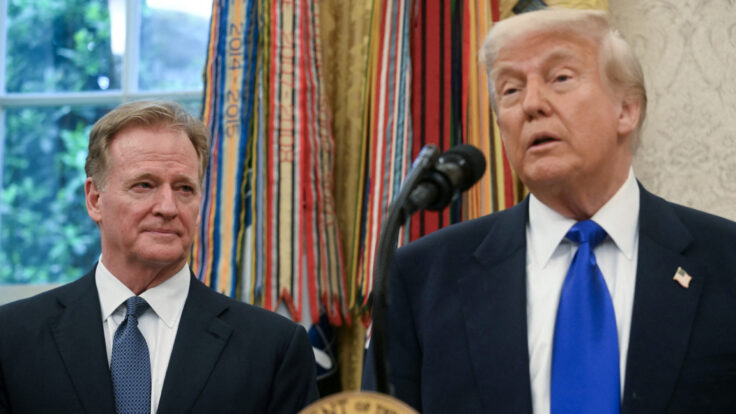
| The NFL commissioner said he wants to expand the league’s slate of international games from eight to 16, thereby creating a lucrative new package to sell to the highest bidder, potentially putting another billion dollars—at least!—into NFL owners’ pockets. Neal Mohan and Ted Sarandos, I know you’re reading this! That’s Roger calling on line two… |
| Down to the J.V.: Justin Connolly & Rob Thun |
|
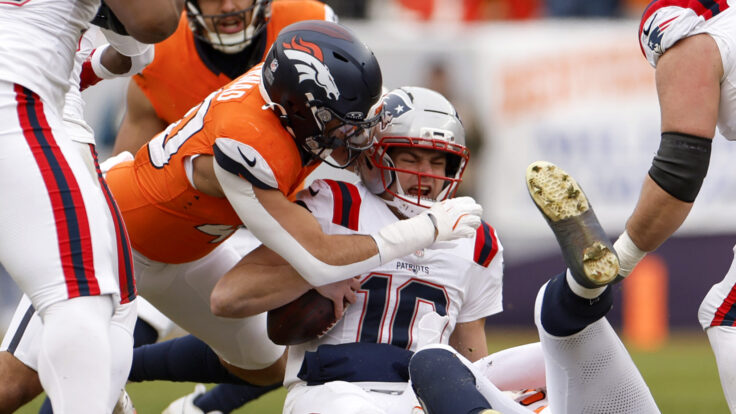
| We all know that Disney and DirecTV are going to reach a deal eventually. The fact that they couldn’t work something out before the Monday Night Football opener? A pox on both houses! Millions of fans were pissed that they couldn’t watch the game at their local watering hole—even if C.M.C. was a late scratch, Aaron Rodgers showed a little rust, and the Jets defense underperformed… |
|
A MESSAGE FROM OUR SPONSOR
|
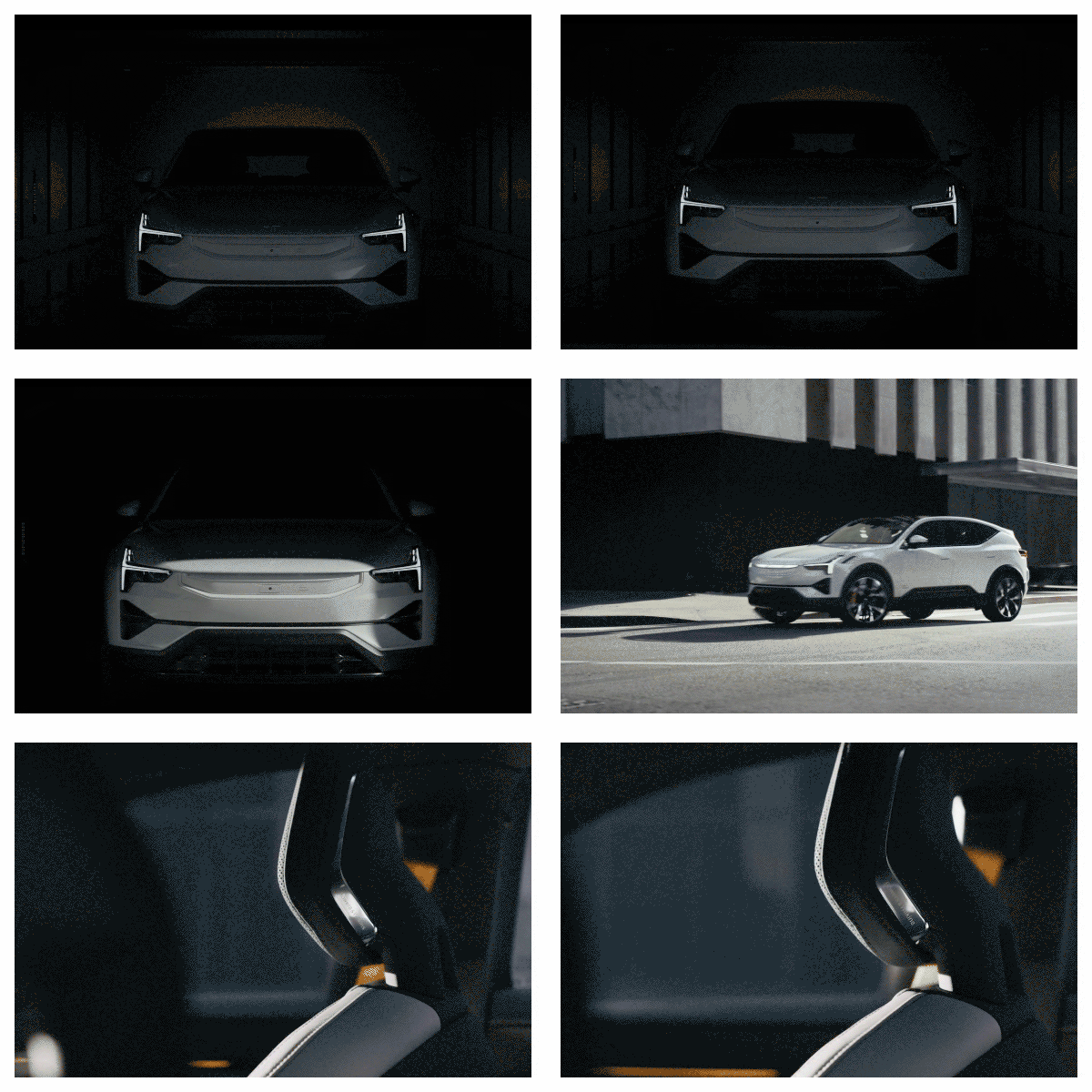 |
The electric SUV that drives like a sports car. Polestar 3. Up to 315 miles of range (EPA). 0-60 in as little as 4.8 seconds. Up to 517 hp. That's Polestar 3. This electric performance SUV delivers the power and torque of a sports car, and the luxury of a spacious interior. Be among the first to experience Polestar 3.
Schedule your test drive today |
|
|
|
|
- The political season: It’s still too early to compare ad buys this election season to the landscape from four or eight years ago—after all, the biggest buys will come in October. But as we ramp up to November 5, we’re starting to see some trends. So far, the Harris campaign has been spending more on the national side, and the Trump campaign has been more focused on local buys, according to several ad sales executives. (Of course, given its enormous fundraising chest, the Harris campaign will likely move money into every conceivable viable market. As one campaign aide told my partner Peter Hamby earlier this week, the plan is to “be everywhere all the time.”) Look for heavy ad buys around the NFL, college football, and the MLB playoffs, particularly with games involving teams from swing states. In baseball, for example, the Harris and Trump campaigns will be falling all over themselves to buy time if the Phillies, Brewers, Braves, and Diamondbacks advance in the playoffs.
When a campaign buys an ad, they pay the lowest fee on the network’s rate card. Political action committees, on the other hand, generally pay the highest rates. Another interesting wrinkle: networks have to make an equal amount of ad time available to each side. But the networks don’t have to tell one side how many spots the other side has bought.
- Diamond moves: The beleaguered R.S.N. owner Diamond Sports Group (glidepath, cliffpath, grinfuck—drink!) is moving closer to deals with FanDuel and Amazon, which will increase its likelihood of emerging from bankruptcy as early as next month. More than two weeks ago, I wrote about how Diamond was inching closer to a deal to have Amazon Prime, whose capital helped rescue it from ruin, sell its direct-to-consumer streams through its Prime Video Channels.
It also appears that Diamond is a couple of weeks away from finalizing a deal with FanDuel that, eventually, will see the R.S.N.s renamed with the FanDuel brand—think of something like FanDuel Sports TV. Diamond’s current deal with Bally Sports expires at the end of the current MLB season, meaning that they could start carrying the FanDuel moniker as soon as the upcoming NHL and NBA seasons.
These moves, which aren’t finalized, but I’m reliably told that they are nearing the finish line—and they are existential for Diamond’s bankruptcy proceedings. In early October, Diamond has a status conference with the bankruptcy judge, during which he’s expected to set a date for a confirmation hearing to determine if Diamond can emerge from bankruptcy. (Before that status conference, Diamond is expected to file a reorg plan.) These expected deals with Amazon and FanDuel will go a long way toward demonstrating that a path forward exists.
- ESPN’s D.T.C. Fox plan: Could ESPN’s planned direct-to-consumer service carry the World Series or Big Ten football? That’s a distinct possibility according to Wells Fargo analyst Steven Cahall, who went on Matt Belloni’s pod, The Town, and predicted that Disney will license Fox content for ESPN Flagship. In fact, Cahall said that Disney had already approached Fox about this arrangement. “Fox’s decision to sublicense content where it’s not part of the ultimate distribution is very different in the eyes of the regulators than ESPN simply licensing-in this content,” Cahall said. “It’s a much easier push for Disney to put that together.”
Cahall predicted that Disney and Fox will move toward this relationship by offering skinnier bundles to distributors. They are naturally aligned, he continued, since they rely so heavily on sports for their affiliate fees. “Warner Bros. and Paramount don’t have that same flexibility because they have so much affiliate fee revenue tied up in non-sports networks,” Cahall said, a reference to CBS and HBO, among other assets. “If they lose their non-sports network carriage, the drop through is far, far greater. They don’t have the ability to price up sports and offset it.” So where does the future of Venu figure in all this? Great question…
- DirecTV’s leverage: The overwhelming consensus among media analysts is that Disney holds all the leverage in its skirmish with DirecTV. The satellite provider may have made it through the opening of the college football and NFL seasons, but week 2 starts in a couple of days. And week 3 comes seven days later. It’s like the tide at the ocean… ESPN’s games keep on coming.
But DirecTV may have slightly more leverage than many appreciate. MoffettNathanson’s Robert Fishman recently suggested that DirecTV, which is privately held, has the advantage of not having to answer to aggrieved and furious shareholders, and may have board permission to dig in a little longer than most expect. (TPG, an investor in DirecTV, is also an investor in Puck.) In a recent note, Fishman hypothesized the financial impact of the dispute as a loss of about $200 million per quarter in revenue for Disney (or about $140 million in EBIT). “That would seem to be DirecTV’s leverage,” Fishman wrote. “DirecTV also benefits from the lessened pressures that comes with being a private company, which has enabled it to enter a number of prolonged blackouts with content providers: Tegna (6 weeks) and Nexstar (11 weeks). As a public company, Disney, obviously, does not share this alleviated time sensitivity, but at the same time won’t enter a deal that hurts its negotiating position for future affiliate deals with its other partners.”
- The push to own content: As part of its new deal with the NBA, ESPN essentially doubled its rights fees. Now, of course, UFC executives are expecting to see a healthy increase in their $300 million per year rights deal with ESPN. These kinds of ever-increasing rights deals are a reason why networks have always looked to own their own content.
As up-and-coming leagues engage with media companies in the next few years, they should be prepared to have the mediacos bring up the idea of buying a piece of the action. That was one of my takeaways from my podcast conversation with Premier Lacrosse League founder Paul Rabil, which posts Sunday. “Your media partner is your most important partner,” Rabil told me. “More media companies will look to have vested interest in pro leagues and teams—the lease versus buy—which is what they're often hearing as the leases get more and more expensive.”
Networks, of course, can’t buy leagues like the NFL or NBA. But there’s a blueprint for emerging leagues, from Endeavor’s 2016 purchase of UFC to Liberty’s 2017 purchase of F1. “Your network partner makes your league better if they're invested and they're promoting it,” Rabil said. “They don't want to be in a place where they generate all this value. Then the term comes up and the property is asking for three or four or five times the amount.”
|
| Now on to the main event… |
 |
| Caitlin Expectations |
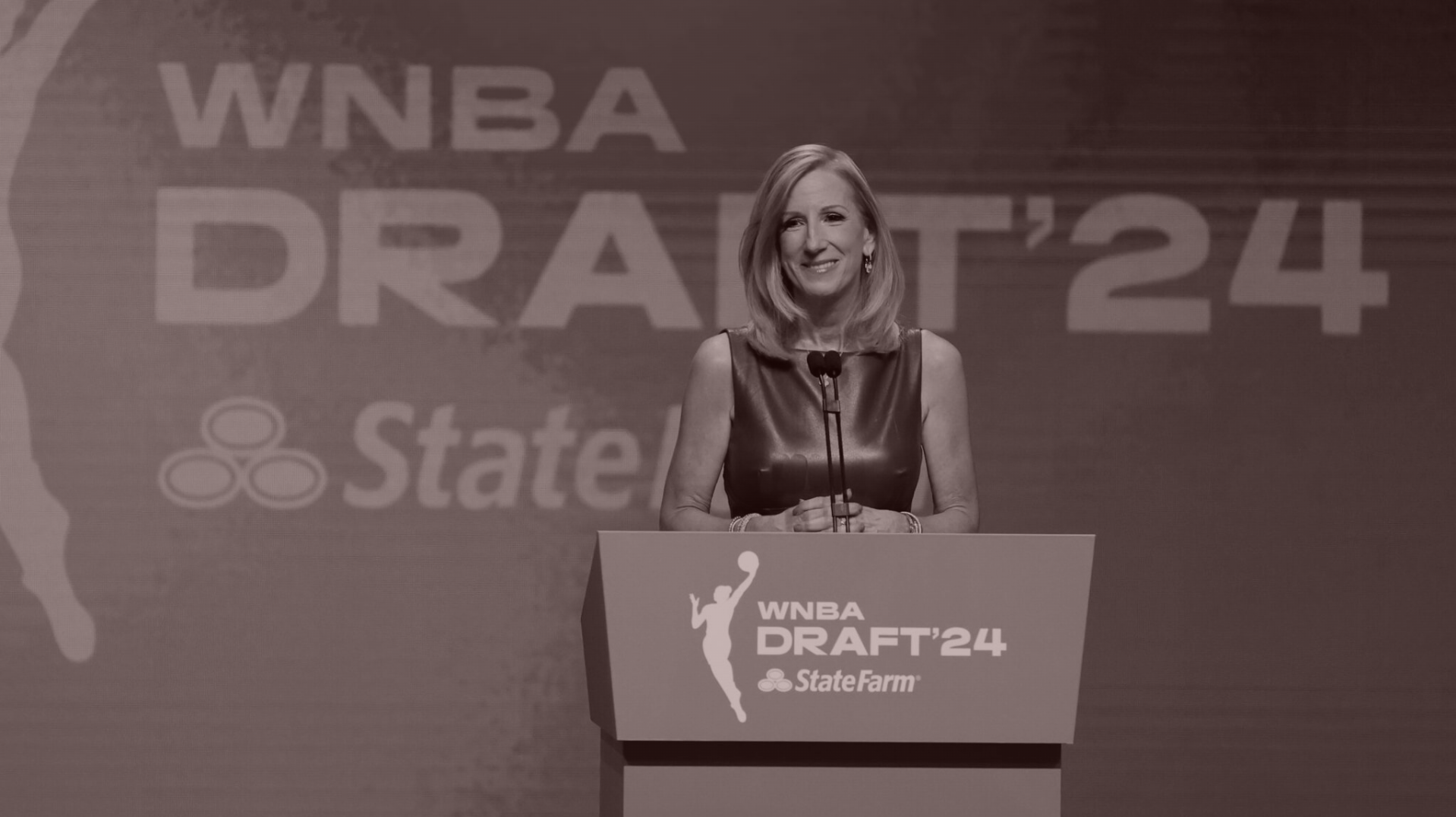
| A candid conversation with WNBA commissioner Cathy Engelbert on the league’s renaissance season and once-unthinkable $200 million per year media rights deal. |
|
|
|
| The WNBA is enjoying a renaissance season. TV ratings and game attendance are both way up, new stars like Caitlin Clark and Angel Reese are firmly planted in the cultural firmament, and perhaps most notably, the league just negotiated a once-unthinkable $200 million per year media rights deal alongside the NBA. In short, if you’re a fan of the league, you’re happy that Cathy Engelbert is at the helm. The former Deloitte C.E.O. has driven a multi-dimensional overhaul of the W—dramatically expanding the league office, savvily capitalizing on the popularity of star rookies and players, and bringing millions of new fans into the fold. In this candid conversation with Cathy, which has been edited and condensed (listen to our full debrief on last Sunday’s episode of The Varsity podcast), we discussed all that and more. |
|
|
| John Ourand: Adam Silver hired you at the W in 2019. When you looked at the league, what did you see?
Cathy Engelbert: I joined six months before the pandemic hit. Four days on the job, someone told me, You’re flying to Las Vegas to be in your first collective bargaining meeting. I didn’t know a single lawyer. I didn’t know one owner. And I didn’t know one player personally. I remember listening to what the players wanted, what the owners wanted, and as a former player [Ed note: Cathy was the captain of the Lehigh basketball team], I was like, I want everything the players want. Then I took a look at the financial statements of the teams and realized that we obviously needed to raise capital.
When you’re doing a multi-dimensional business transformation, you need to hire great people. To hire great people, you need financial capital. So we went out and raised $75 million, and that literally set us on our path to where we are today.
How tenuous was your situation in 2020?
It’s hard to say, because owners would have had to make decisions about whether to stay in or out if they had no revenue that year. But we ended up announcing pretty early in the pandemic that we were going to pay the players at full salaries. Six weeks into planning for the bubble, someone who’d been with the league since the beginning said to me, There’s a two percent chance this is going to work, and none of us are going to have jobs next year. I reflect on that today, and I tell people, What do you do in the face of 98 percent potential failure? The answer is that you do everything in your power to prove them wrong. Tenuous is the right word, but existential is the word I use.
What did you use that capital raise for?
The number one thing was marketing. When I came into the league, we had one marketing person. Now we have 25. It’s just about hiring really good people, and doing a digital transformation—wnba.com was a mess, our app was a mess. We’d made it too hard to be a fan.
When I came in and asked about our strategy, I was met with these long PowerPoint decks. I said nope—our strategy is going to be three things: It’s going to be player first, stakeholder success, and fan engagement. Our marketing budget is like nine times what it was back then. We did more ad buys, national campaigns, created a stronger brand voice, and paid players in the off season to market. But I would say most of the financial capital went to hire human capital—dedicated engineers, social media marketers, data people. Now we have a lot of fan data, and we know what our fan segments are, and we’re bringing in tens of millions of new fans this year.
If there’s one thing I knew from being a sports fanatic my whole life, it’s that you need rivalries, you need household names, you need games of consequence—compelling content—and then you have to make it easy for your fans to find you and follow you. When I came in, we had a really strong brand, but people were following the brand called the WNBA because they liked following it. But they weren’t necessarily following a team or a player, the way you see in men’s sports. And I thought no, no, no, I need you to love the New York Liberty or the Chicago Sky; I need you to love our star players, A’ja Wilson, Stewie, etcetera. So we spent a lot of time deploying that capital to get those names better known, and to build loyalty and a followership and to build out rivalries. All of that was made possible out of our new free agency system as a result of our 2020 CBA.
So who were your fans when you arrived? And how has that changed?
We were about 55 percent men and 45 percent women, which is a higher percentage of women than most sports leagues. On the men’s side, we had an older demographic. But we were, and are, very diverse, not only in terms of our player population but also fan population. This year is going to be interesting, because we’re setting all kinds of viewership and attendance records, and there’s a lot of new fan segments coming in. Sports bettors have come in in a big way, our Hispanic viewership is up 300-plus percent, our African American viewerships is up considerably, triple digits, as well as our younger demographic, and our league pass subscriptions is at an all-time high. But the nice thing is not just that it’s changed, it’s broadened. We needed more people to watch in advance of the media deal, so it all came together, and it was a confluence of everything positive at one time. |
|
|
|
|
| First of all, congratulations on the media deal. Going from $60 million a year to $200 million a year… it’s hard to say that that was a bad deal for the WNBA, but union leader Terry Jackson said that she wants to see how you arrived at that $200 million number. Take us through the deal.
It exceeded all my expectations. It’s a testament not just to the great veterans in our league, but the rookies who have come in, and the next four years of rookies. We’ve got a great rookie class next year with Paige Bueckers and Kiki Iriafen, and Kiki Rice from UCLA, and the following year we have JuJu Watkins. If you’re a media company you want to buy the rights to a league that has a 10, 12, 15-year run of great players, and that’s what we have—that’s what we sold, and that’s what we pitched. With the NCAA having a historic year, with that 18.9 million and 24 million viewership at peak, and then having our highest viewership ever on all of our networks, and averaging over a million on all four of our major networks, including ESPN 2…. all of that factored into the way we were thinking about it.
By the way, we’re not done yet. That $200 million AAV is just what I call our tranche one of media deals. We also have a tranche two, which will be negotiated in the next few months. But going to market on tranche one with the NBA was so important to me, because very quickly I saw that providing only four and a half months of live programming is not as attractive as 12 months. The NBA and WNBA, I believe, are the only two leagues, certainly in America, that have seasons that run counter to each other, so together we can provide together 12 months of live professional basketball programming. That was a huge advantage for us. Someone put out a number with at least $260 million AAV with the tranche two added on, but I think we can even do better than that.
I consider the WNBA a growth stock. At what point are you going to be able to come back in and say, Okay, we’re growing at a different clip than the NBA.
If we keep growing our fan base, we do have an option, three years in, to get additional rights fees if we meet certain metrics. The other thing is when you’re a league of our size and scale, you want to give confidence to your owners that you have a long-term fixed revenue stream, one that’s not variable, and 11 years is amazing. Our owners are feeling so confident that they can invest in their team, invest in practice facilities, and invest in player experience.
I don’t think tranche two will be quite that long, because those deals are typically shorter, but to lock in at least that minimum $200 million AAV for that long is going to be really helpful, especially when you also have a union workforce, let’s call it, through collective bargaining. That also gives you the confidence to sustain paying the players more no matter what happens in the next CBA, so I think it’s a huge victory to have that long term of a deal.
I’m so focused on the money aspect of this, but this was also a big deal for you in terms of just getting these three big media companies to invest in you. What aspects of this deal, outside of the financials, are you most excited about?
Production and promotion. All three of our partners will produce our games, which is a significant additional intangible value to us, as well as promotion. They all want to do shoulder programming, and that’s going to be important. ESPN-Disney is now a longtime partner, and they have done a fabulous job adding shoulder programming, and it has actually worked because people are watching, they’re seeing the storytelling and the summarization of the great play that’s going on on the court. We’re now on Amazon on Thursday nights, and so people are getting used to going there to watch live sports.
The NBA negotiated most of the deal, and as you look at the future, is it important to you to separate from the NBA and operate on your own?
It’s kind of interesting because I get to sit in between the four walls—I’m on the NBA senior leadership team, and there’s a huge advantage to seeing what they’re doing. It was Adam’s idea to make me a commissioner, and he said, We want the W to be viewed as a legitimate sports media and entertainment property, and they have commissioners. So I get to see what they’re investing in, in terms of basketball technology. We actually did the in-season tournament first, the Commissioners Cup, and now obviously the NBA has the NBA Cup, so they learned from us, and we learned from their first year.
Five of our current 12 teams are NBA affiliated, so that gives you a platform around ticket sales, season ticket holders, etcetera. So there’s true advantages. When NBA players sit courtside at our games you see the fans light up when they walk in. So there’s no need to do the kind of split that everybody talks about, because we’re running our own business. We’re our own LLC, owned 42 percent by the NBA teams, 42 percent by the W teams, and now we have an outside capital group of 16 percent.
How much is Adam involved in the WNBA business?
On my first day of work in 2019, I met with Adam, and I said, Adam, how’s this gonna work? He said, You’re a commissioner, I’m a commissioner, just go and if you need me, let me know. So we have a great working relationship. He is cerebrally one of the smartest guys I’ve ever worked with. Expansion has been interesting because he gets a lot of calls from NBA owners and others in his ecosystem that want an WNBA team now, especially coming off our historic draft this year. So there are more weeks where we work together a lot than weeks where we don’t.
There are some great WNBA storylines out there. For example, one is that WNBA players are too mean to Caitlin Clark, and the other one is that Caitlin Clark is too privileged, she’s too protected. What’s your role as commissioner in wading into the weeds on some of those storylines?
Well, it’s an incredible time because nobody’s apathetic anymore about the WNBA. Everybody cares. I joke with people and say that in the four years prior to this year, I probably got 40 emails a week from fans unhappy with officiating or whatever, and now I get like 4,000 a week. So it’s good to be in the conversation. Obviously, we balance the marketing of all of our players, and you never put all your eggs in one basket. I learned that in business a long time ago. So we need to continue to look at our whole player population and advance our stars, and those that our fans want to watch and want to follow and want to buy their merch. It’s funny, we get a lot of criticism about merch, and that’s a good problem to have—our merch is selling out instead of sitting on shelves. |
|
|
| On the Chiefs and Cowboys being the NFL’s top TV draws: “As a football fan who loves to see great matchups, I’m now mad that the league didn’t think to schedule a prime-time regular season game between them. I know their last matchup in 2021 was a real barn burner with the Chiefs winning 19-9, but imagine the viewership numbers if they played now.” —A Varsity subscriber
[Ed note: The Cowboys and Chiefs are scheduled to play next season, and you can be certain that every TV network will be lobbying to carry that game.]
On Tom Brady’s Fox debut: I thought he was tentative, but he had some good moments. It wasn’t a flop, but when you’re the GOAT, the bar is high. If I was Fox, I would get him a vocal coach to help him find consistent energy and keep his voice steady and more baritone, less soprano when he gets excited.” —A cable guy
On Belichick and Brady: “Can we get a return of Who’s Up/Who’s Down? Belichick had a stronger Week 1 outing than Brady!” —A sports media veteran
On an old Irish pub in New York: “Your Langan’s diss made me laugh out loud. I’m SURE you’ve heard from the Fox Sports crew. They loved that place!!” —A former ESPNer
More on that Irish pub: “What the Puck? I must take issue with your description of Langan’s as ‘depressing.’ It was, simply put, a Midtown treasure.” —A former Fox Sports executive
Still more on that Irish pub: “I didn’t think Langan’s was a depressing place!! I spent a lot of fun nights there back in the day. We would go there after work when I was an agate clerk at The New York Post all the time.” —A journalist |
|
|
See you Monday,
John |
|
|
|
| FOUR STORIES WE’RE TALKING ABOUT |
 |
|
 |
|
 |
|
 |
| Legends of the Fall |
| Detailing the fall’s most highly-anticipated art exhibitions. |
| MARION MANEKER |
|
|
|

|
 |
|
|
|
Need help? Review our FAQs
page or contact
us for assistance. For brand partnerships, email ads@puck.news.
|
|
You received this email because you signed up to receive emails from Puck, or as part of your Puck account associated with . To stop receiving this newsletter and/or manage all your email preferences, click here.
|
|
Puck is published by Heat Media LLC. 227 W 17th St New York, NY 10011.
|
|
|
|