 |
 |
|
Welcome back to The Varsity, my twice-weekly private email on everything from the owner’s box to the corner office. Happy Olympics!
My sartorial style has often been described as slightly more Banana Republic than Brunello Cucinelli, and I’ve certainly never donned a David Zaslav-style neckerchief. But that didn’t stop me from appearing on my Puck partner Lauren Sherman’s excellent podcast, Fashion People, this week to dive into what will be happening in Paris over the next fortnight. It posts tomorrow. Give it a listen.
The NBA media rights deal remains the most significant and shapeshifting storyline in the Varsity cinematic universe, of course, and it’s not over yet. Warner Bros. Discovery is preparing a legal suit in response to the NBA’s decision to deny its matching rights. I have much more on this below. But I’ve been struck by Bill Cohan’s masterful observation that WBD’s pending suit is merely a proxy battle in a larger war Zaslav wants to wage against the FAANGs. “He wants to be known as the guy … who saved Hollywood from the tech bros. It’s either going to be Disney, Paramount, Fox, WBD, and Comcast’s world, … or it’s all going to belong to Apple, Amazon, Google, and Netflix.” It’s a modern-day David vs. Goliath story, only this David gets paid ~$50 million a year and lives in Bob Evans’ house.
A final reminder to sign up here if you’re not already a subscriber. The next person we catch forwarding this will be forced to listen to Marchand’s take on the Presumed Innocent finale (while wearing his neckerchief).
Also, I’m doing a Reddit AMA tomorrow, where you can ask me anything and everything about the NBA’s new media rights deals. Submit your questions here and I’ll answer them in real time on Friday at 3:00 p.m. ET.
By the way, we’ve updated our Newsletter Experience questionnaire for Puck subscribers. If you haven’t filled yours out, it takes less than 3 minutes, and your feedback will help us develop new products and services. Click here to complete the brief survey—no need to log in. Thanks!
|
| Player of the Week: Jay Marine |
|
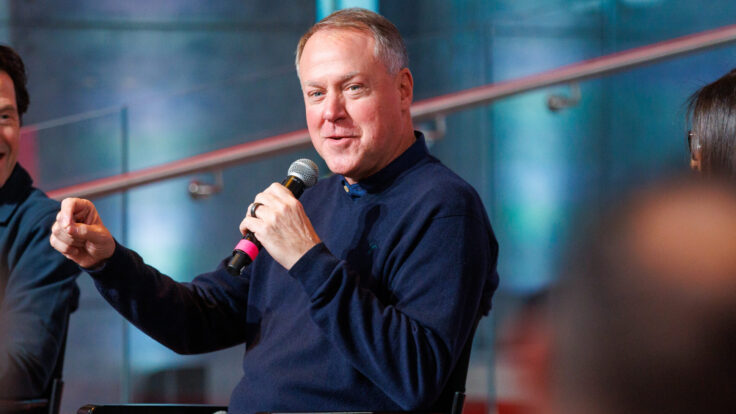
| Amazon has always had to overpay to get a taste of the U.S. sports business—and when it did secure a rights deal, it never got the plum games. But all of that changed with this NBA deal. Jay Marine, the head of Prime Video Sports, negotiated a package that includes a significant number of NBA playoff games, including the conference finals every other year. Best of all, Amazon’s $1.8 billion rights fee is much less than NBCU’s $2.45 billion and ESPN’s $2.6 billion. |
| Down to the J.V.: Jim Dolan |
|
| Congrats to New York Knicks owner Jim Dolan, who’s making Puck history this week by receiving The Varsity’s first-ever back-to-back “Down to the J.V.” nods. Last week, Dolan was sent to the J.V. for not being able to convince any other owner to vote against the NBA’s $77 billion media deal. This week, the thin-skinned musician is being relegated because we’ve learned why he was so ornery in the first place.
The new deal calls for 75 regular season games airing on broadcast TV each season, up from about 15 in the current deal. Many of those games come out of R.S.N. inventory, which will negatively affect the number of games Dolan carries on his MSG Network. “This reduction in available games for R.S.N.s risks rendering the entire R.S.N. model unviable,” he wrote in a recent letter about the deal. |
|
A MESSAGE FROM OUR SPONSOR
|
 |
|
Range Rover Sport. Engineered to meet every challenge.
|
|
|
| The Starting Five: Olympics Edition |
|
- A Diamond update (pour yourself a beer): D-Day for Diamond Sports—The Varsity’s favorite glide path-ed, cliff path-ed, modern media entity of diminishing consequence (drink, drink!)—was supposed to be Monday, when the bankrupt company was supposed to file a business plan that demonstrated a path to profitability. But at Diamond’s request, Judge Christopher Lopez canceled Monday’s hearing, and plans to reschedule it within the next couple of weeks. Indeed, as we’ve reported several times over the past two weeks, Diamond is close to a deal with Comcast, its longtime grinfucking nemesis who has tried to squeeze it onto the cliff path option versus the glide path route (drink, drink, drink!!). I’m told that the two sides still have some unresolved issues, not the least of which pertains to the guaranteed number of exclusive NBA games allowed by the league’s media rights deals.
Judge Lopez’s postponement allows Comcast and Diamond more time to work through those issues. The delay also allows Diamond to advance productive discussions with both the NHL and the NBA. Talks with the latter had cooled in recent months as the league’s executives focused on its national media rights deals, which were announced on Wednesday. Sources tell me that some progress has been made, but no agreement is imminent.
Both the NHL and NBA, which start their seasons within the next three months, would like a quick resolution to the Diamond mess so they are not scrambling to find local media deals in the event that the company does not come out of bankruptcy. Notably, MLB is still nowhere close to a deal with Diamond.
- Liberté, égalité, fraternité : As you sit down to watch the Olympics over the next two weeks, it will be impossible to miss the ubiquitous presence of LVMH, the French luxury goods company, and the largest company in Europe (depending on how the stock of Novo Nordisk, the maker of Ozempic, is trading). Louis Vuitton created the medal trays; Chaumet designed the gold, silver, and bronze medals. Sephora sponsored the torch relay, Berluti designed the French team’s wardrobe… you get the idea. This marks the first time that LVMH has been an official Olympic sponsor, paying around $160 million for the right to hawk their wares to an international audience.
But several sponsorship sources tell me that the International Olympic Committee should not count on LVMH renewing this sponsorship four years from now in Los Angeles. LVMH’s decision to support the Paris Games had as much to do with patriotism as business. And its initial reluctance to get involved resulted in a sweetheart deal, which included certain tax deductions. Perhaps most importantly, the deal allowed LVMH the opportunity to activate internationally, which two sponsorship executives described as unprecedented. Most sponsors, after all, typically have to do separate deals in each country.
- Revisiting Peacock’s NFL playoff game: NBCUniversal chairman Mark Lazarus visited The Town, my partner Matt Belloni’s excellent podcast, this week to discuss the Olympic Games. But my ears perked up the most when he talked about Peacock’s exclusive NFL wild card playoff game. Most of my sources expected that the vast majority of the game’s 23 million viewers would churn out of the platform. But Laz told Matt that retention was significant because the audience stayed for general entertainment content: nine out of the 10 hours that football fans watched over the next month had nothing to do with football. “Once that game is over, how do we make sure we retain those customers?” he asked rhetorically. “Just by having content that they care about or that fits what they might look for.”
Peacock is streaming every Olympic event over the next couple of weeks, and Laz is expecting similar results. “With the Olympics, we anticipate a slightly different audience,” Laz said. “The NFL is a huge and diverse audience. It’s a big tent and everyone comes in. … [The Olympics is] a little more female than other sports. It’s a different kind of audience who search for different types of products. It’s fans of wrestling, archery, track and field, and gymnastics. So we’re going to come after that.”
- White Party down: Michael Rubin’s Fanatics is facing a series of legal headaches, which my partner Eriq Gardner thoroughly reviewed in this excellent piece. This whole story is worth a read, but the part that piqued my interest most doesn’t actually involve Rubin. “Fanatics may also need to navigate fallout from the recent $4.7 billion NFL Sunday Ticket verdict,” Eriq noted. “At first glance, the head-spinning jury verdict last month may seem unrelated, since the trial centered on the NFL’s licensing of an expensive package of out-of-market telecasts, and Fanatics isn’t a TV company. However, the backbone of the case involved the pooling of rights by NFL teams, a practice with which Fanatics is deeply familiar, as its business relies heavily on the legality of group licensing.” Make sure you never miss Eriq’s work by signing up here.
- Ramble on Rose: I knew that Burke Magnus, ESPN’s president of content, was a Deadhead. Still, I was curious about how the upcoming ESPN Films feature with the Dead’s drummer Mickey Hart came about. It should come as a surprise to nobody that the late Bill Walton played a pivotal role in creating the film—in fact, Rhythm Masters: A Mickey Hart Experience, is dedicated to Walton, who attended 869 Grateful Dead shows. Walton introduced Magnus and ESPN writer Wright Thompson to Hart several years ago. The two spent several hours at Hart’s California home and came up with the concept about the connection between sports and music. Joe Montana, Marshawn Lynch, Sheryl Swoopes, and Jack Nicklaus are among the athletes who appear in the film to reflect on the similarities of being in a band and on a team, like how both athletes and musicians can enter “the zone.”
The film debuts August 14 on ESPN, and Hart has said that he plans to develop an album with the original music from the series. (Both Magnus and Thompson are executive producers on the film.)
|
 |
| How Zaz Lost the NBA |
| The inside story of testy dealmaking and re-trading: the missed signals, the Spulu trigger, the Zaz-Silberwasser good-cop-bad-cop routine, and all the slights that now point to a litigious endgame. |
|
|
|
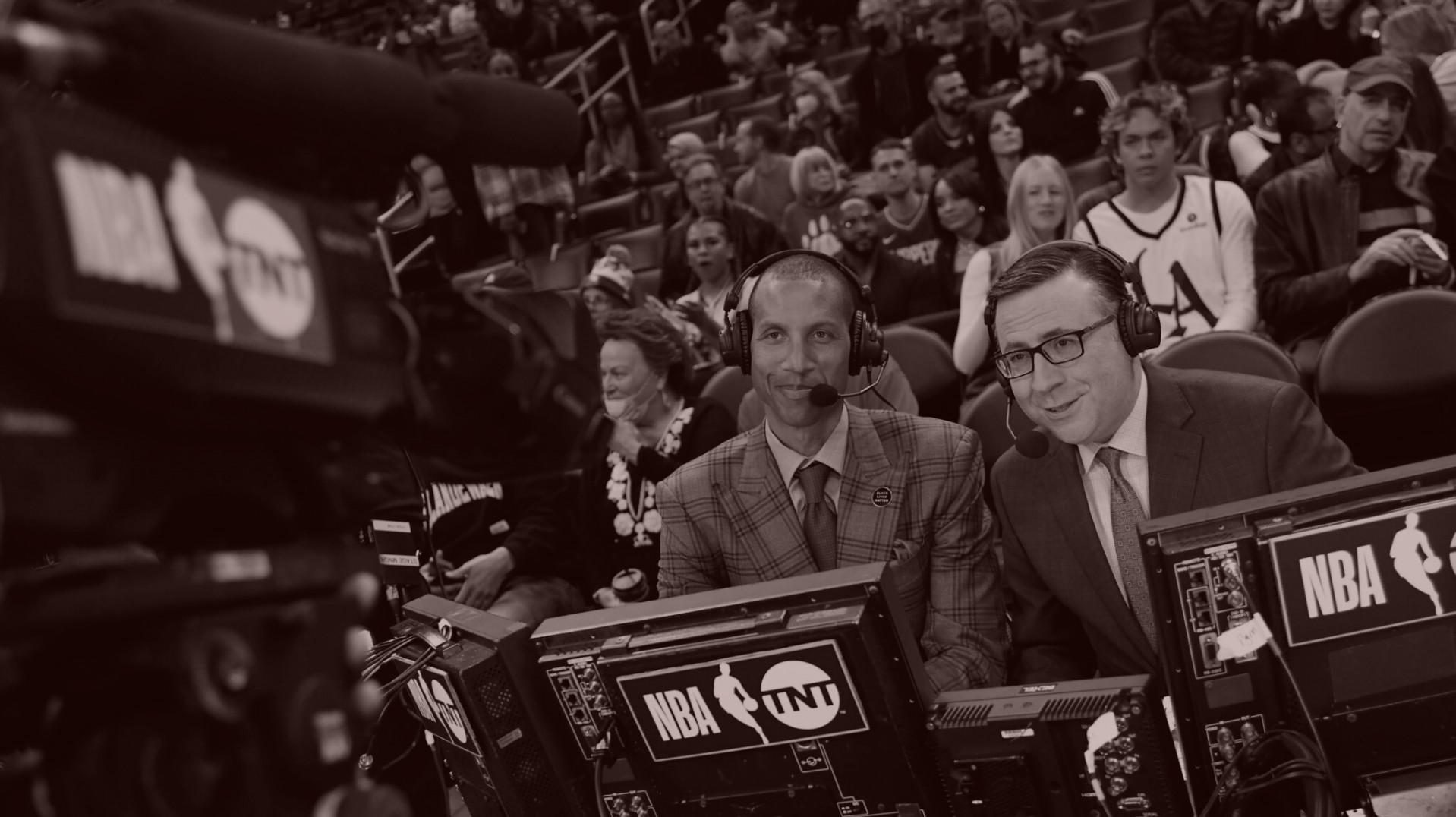
| Around 4 p.m. on Wednesday, the NBA’s media and distribution executive Bill Koenig emailed Warner Bros. Discovery’s Luis Silberwasser to explain exactly why the league wouldn’t allow WBD to use its matching rights for a package of league games that Amazon had successfully bid on. Presumably, of course, WBD C.E.O. David Zaslav and his attorneys were fully prepared for this eventuality. A half-hour later, as the NBA sent out a statement announcing its $77 billion worth of new, 11-year media deals with ESPN, NBCUniversal, and Amazon, WBD’s lawyers were already drafting the lawsuit that the company plans to file against the league, possibly as soon as tomorrow.
The mushrooming legal showdown is, in many ways, the culmination of a subtle breakdown in relations—missed signals, bad communication, frustrated dealmaking, and a couple negotiating misplays—that was, in retrospect, long in the making. Years before negotiations had started in earnest, ESPN and WBD executives had indicated during private conversations that they both wanted to renew their deals with the NBA. And NBA executives reciprocated the fealty… because, well, who wouldn’t want to renew a deal with a long-term partner? After all, WBD’s TNT had been carrying NBA games since the ’80s.
But underneath the bromides and platitudes about partnership, Koenig and NBA commissioner Adam Silver also indicated that they wanted to move from two media partners to three, and design one of those deals for a streamer. That’s when the first fissures in the NBA’s relationship with WBD appeared. |
|
|
| By early fall, the NBA had started exchanging its first re-up proposals with ESPN and WBD. Activity increased just before the exclusive negotiating window started in mid-March. Initially, it looked like deals could be had. A successful renewal negotiation within the exclusivity window wasn’t unprecedented. Back in 2014, ESPN and Turner signed their renewals in the middle of the negotiating window, preventing NBA rights from hitting the open market.
But the NBA’s desire to find that streaming partner—YouTube, Netflix, and Apple were all considered to be in the mix, in addition to Amazon—caused talks to slow down considerably. The league couldn’t officially negotiate with Amazon until the negotiating window ended. So WBD executives made the unusual suggestion that the NBA allow Amazon into the window, per multiple sources. That way, it would be easier to figure out exactly what would be in each package. The NBA readily agreed and reached out to ESPN, which also agreed. (WBD sources insist that the idea to include Amazon came from both ESPN and WBD.)
The NBA already knew who it was dealing with at Disney. Over the years, everyone from Bob Iger to Jimmy Pitaro to media deals E.V.P. Roz Durant had repeatedly expressed to league executives that ABC and ESPN wanted to renew its contract. Amazon, meanwhile, had lusted after the NBA for years, attracted by the league’s demos and international appeal. The streamer had established a relationship by picking up NBA rights for Brazil as well as a WNBA package. At every opportunity in conversation with NBA officials, Amazon Prime executives Mike Hopkins and Jay Marine would emphasize their scale and technical prowess. They also made sure that NBA leadership saw how successfully they’d handled the NFL’s Thursday Night Football. It worked. NBA officials pored over TNF ratings and paid special attention to its production quality. |
|
|
| But they were less familiar with their negotiating partners at WBD. Sure, TNT had been carrying league games for decades, but the network had also transitioned during that time from Turner Entertainment to Time Warner (and, briefly, AOL Time Warner) to WarnerMedia, and now WBD. Meanwhile, the league’s biggest longtime supporters had left the company. David Levy, who orchestrated the last NBA rights deal for TNT, was ousted in mid-2019. Turner Sports president Lenny Daniels, who actually participated in some early renewal talks, left at the end of 2022. Levy and Daniels were well-liked throughout the NBA’s Manhattan office.
Zaz took over after the merger in May 2022 and hired Silberwasser, a former Discovery hand, soon thereafter. While both had decades of experience at the highest levels of the business, they didn’t have strong relationships at the NBA. As talks progressed, inadvertently or not, the two operated in a sort of good-cop, bad-cop routine. After Zaslav would tell Wall Street that WBD didn’t need the NBA and that he would be fiscally prudent in any negotiation, Silberwasser would smooth things over with Koenig and Scott Kaufman-Ross, an NBA senior vice president who reported to Koenig.
ESPN quickly agreed to its package, which prioritized exclusive access to the NBA Finals and a guarantee that the network would be able to stream games via ESPN Flagship, which they plan to launch next year. Amazon also came to a relatively quick agreement for playoff games, including the conference finals, and play-in games. Amazon didn’t prioritize the regular season as much, but it did want the in-season tournament.
WBD, for its part, was left in a position where it would have to pay substantially more money—about $2.1 billion to $2.2 billion per year, according to my source—for a package that was not nearly as good as the one it currently had at around $1.2 billion per year on average. Adding to WBD’s frustration was the sense that the NBA was constantly moving the goalposts during the process. Every time they were close to a deal, WBD executives felt that the NBA would change the offer. For example, as the negotiating window was ending, the NBA told WBD that it was taking five conference finals series away from TNT, which would have left it with six. WBD executives were surprised by this news, since they thought they were getting at least one of them every year. At the end of the window, WBD executives were also surprised to learn that the NBA wanted a universal out after seven years.
WBD executives felt like they were negotiating in good faith, but never came close enough to cut a deal. Zaz and Silberwasser tried to negotiate on price and the contents of the package, but the NBA stalemated them—insisting, among other things, that everyone wanted more and better contests. For what it’s worth, WBD wasn’t the only bidder that felt as if the NBA was constantly tweaking the packages. Disney, for example, was not happy when the NBA told them that they would have 10 conference finals—not 11—during the 11-year deal. Disney was also frustrated about losing exclusive access to the WNBA Finals—it will only carry five over the next 11 years. But those moves didn’t kill their deal.
Ultimately, Zaz and Silberwasser thought they had leverage; they didn’t believe any other media company would pay as much for the package on offer. So on April 22, as the window ended, Zaz and Silberwasser made a startling declaration to Koenig: Moving forward, negotiations would start from scratch—they wouldn’t build off the work from the exclusive window. Their last offer in the negotiating window would be their best one. |
|
|
| As they would quickly find out, they had vastly misjudged the market. NBC was uniquely motivated to get a deal done. Mark Lazarus, who’d been ousted by Turner about 15 years earlier, had especially deep connections with NBA executives. Laz had previously made clear to the league that Comcast—NBC, Peacock, etcetera—was interested, but few took his comments seriously. But NBC was deadly serious: They viewed the NBA as the perfect component to drive the growth of Peacock, their slow-to-take streamer. The company had already learned firsthand how the NFL, Premier League, and college football could drive streaming subscriptions. Laz believed that an NBA deal could add another sport to Peacock and help give it a year-round sports offering.
But there was one more factor at play—well, maybe two. In February, shortly before the negotiating window opened, ESPN, WBD, and Fox had announced plans to launch a sports streaming service that was initially dubbed “Spulu” but was eventually named Venu (not much better, but alas…). Not only had Comcast been kept out of the partnership, but losing out on the NBA would mean that the Venu bundle would contain both Disney and WBD’s putative rights packages. All of a sudden, Comcast became a very motivated bidder, fully cognizant that outbidding an incumbent would be a tall and expensive order. They were also motivated by the fact, as I’ve reported previously, that depriving TNT of the NBA would weaken its leverage in carriage fee negotiations with their Xfinity cable systems.
The day after WBD walked away, NBC approached the league with its blockbuster $2.5 billion per year offer for the package that WBD had been trying to win. The amount blew away WBD, which decided not to get involved in bidding up the number any further. Instead, WBD told the NBA that it would rely on the matching rights in its contract. The NBA thought WBD would have a hard time matching NBC’s bid, which included two primetime windows on broadcast TV. WBD, of course, doesn’t own a broadcast channel. It seemed like a tensely negotiated deal might soon become the province of litigators.
Ultimately, WBD decided that it would bid on the Amazon package instead of the NBC deal it had coveted—a move that caught the NBA off guard. WBD believed that it had the right to bid on the Amazon package because it contained programming (conference finals, playoffs, Thursday night games) that came out of its own current deal. Plus, it could use Max to satisfy the league’s streaming ambitions. On Monday, WBD announced its intention to use its matching rights on Amazon’s package. Two days later, Koenig sent Silberwasser the email saying that WBD’s matching rights weren’t applicable. Koenig told Silberwasser that the package was streaming-only, not the streaming-and-cable package that WBD was counter-proposing. Koenig also outlined that Amazon put its first three years of rights fees in escrow, meaning that payments would be made automatically. WBD offered a letter of credit, which the NBA did not view as equal. Koenig also referenced Prime’s enormous reach vis-à-vis Max—a dig, to be sure.
WBD responded to Koenig’s email with a statement that both encapsulated the months of testy dealmaking and foreshadowed an even more litigious future. “We think they have grossly misinterpreted our contractual rights with respect to the 2025-26 season and beyond, and we will take appropriate action.” |
|
|
| On who will produce Netflix’s NFL Christmas games: “Is there any chance that CBS uses the potential production deal with Netflix as leverage with the NFL to not renegotiate its rights fees when the Skydance deal closes? There are probably reasons that this won’t work, but there’s not a lot of upside to be gained by CBS for doing this other than charging 3x or more what it would cost them to produce for themselves. Why help a competitor who, if successful, will result in you paying even more down the line?” —A Varsity subscriber
On NBCU’s NBA deal: “It was interesting to listen to the comments on Comcast’s earnings call about the rationale for their NBA deal: ‘The nine-month basketball season completes our year-round calendar for sports, which already includes the NFL, Olympics, Premier League, NASCAR, PGA Tour, Big Ten, and World Cup.’ Obviously, World Cup and Olympics are infrequent, but the other leagues mentioned individually cover seasons and collectively cover the whole year. Feels like the allure has a lot to do with tonnage, coverage, duration… or whatever term you want to use for making sure viewers remain paying subscribers… rather than people hopping on and off the subscription multiple times a year.” —A happy Varsity subscriber
On WBD’s financials: “Well someone in your world has to realize that WBD does not have a debt problem. They gushed and gushed cash and have leverage down to very manageable math. That is not their problem.” —A financial analyst
On D.C. high school rivalries: “St. Albans has more NFL Hall of Famers than Gonzaga.” —A streaming executive who obviously couldn’t get into Gonzaga
On The Varsity’s upcoming pod: “When do you plan on announcing details of the podcast you’ll host?” —A Varsity subscriber
[Ed note: Soon.] |
|
|
See you next week,
John |
|
|
|
| FOUR STORIES WE’RE TALKING ABOUT |
 |
|
 |
|
 |
| The Ackman Cometh |
| On the polarizing hedge fund impresario’s latest venture. |
| WILLIAM D. COHAN |
|
 |
|
|
|

|
 |
|
|
|
Need help? Review our FAQs
page or contact
us for assistance. For brand partnerships, email ads@puck.news.
|
|
You received this email because you signed up to receive emails from Puck, or as part of your Puck account associated with . To stop receiving this newsletter and/or manage all your email preferences, click here.
|
|
Puck is published by Heat Media LLC. 227 W 17th St New York, NY 10011.
|
|
|
|