 |
|
Hi, welcome back to Line Sheet, and hope you’re enjoying Florence if you’re still at Pitti Uomo. We’re at the top of yet another fashion week cycle and the news is a-flowing. Yes, I love a tip, but I also love you spreading the word about Puck. An annual subscription makes a great Father’s Day gift. It’s the most affordable luxury gift in history.
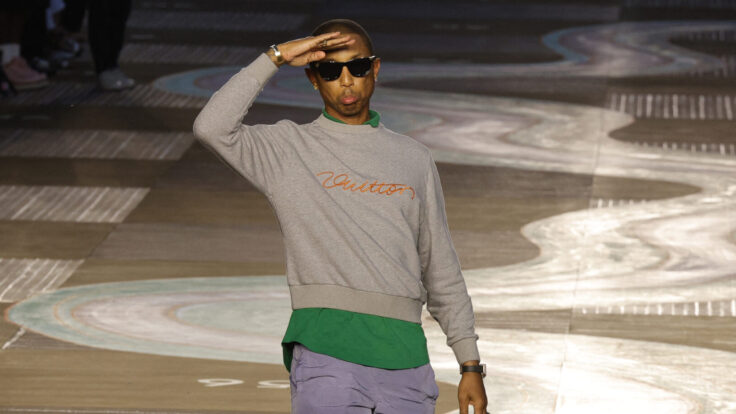
Today, I’ve done some digging into what to expect from Pharrell at Louis Vuitton—and what LVMH expects of him.
Mentioned in this issue: Brooke Wall, Louis Vuitton, Danielle Goldberg, Blackbird Spyplane, Law Roach, Matthew Henson, Cynthia Lu, the Arnaults, Rihanna, Andrew Mukamal, more Thomas Tull, and a dream/nightmare Anna Wintour gig...
But first! The latest Parisian curiosity…
|
Celine vs. Alaïa:
Scheduling Mistake or Act of War? |
|
| Paris has always struck me as a bit more civilized than the rest of fashion when it comes to the runway calendar: scheduling overlaps are rare, even in an industry where “on time” usually means at least 20 minutes late. So I was surprised when I learned that Celine’s show would take place on July 2 at 8:30 p.m.… walking all over the Alaïa show, set for 8 p.m. Of course, 30 minutes is not enough time to get from one show to another in Paris, especially when Celine, designed by Hedi Slimane, typically starts practically on time (20 minutes late, that is).
The discrepancy, however, is surprising, especially given that July 2 is the day before the official start of Couture, and the schedule is otherwise nearly empty. And the Celine team was definitely cognizant of the Alaïa show through the Fédération de la Haute Couture et de la Mode, the acting trade organization. (After all, Sidney Toledano, the president of the Chambre Syndicale de la Haute Couture, also runs the LVMH Fashion Group, which includes Celine.) I reached out to the Fédération to see if they could explain the scheduling conflict, which was also noted by WWD. They had no comment, nor did reps for Celine or Alaïa.
My sense, however, is that this was not some petty tactic—one show is women’s, the other is men’s, and that would be a crazy, weird move—but instead an oversight that is unlikely to be rectified on Celine’s side. (Alaïa had to apply for a special permit to show in its venue, so it can’t change its timing.) However, it could prove semi-detrimental to a smallish brand like Richemont-owned Alaïa, which relies on its off-calendar positioning to attract an outsized amount of attention online. Its namesake, Azzedine Alaïa, eschewed the traditional fashion calendar for years, long before it was en vogue to do so.
Celine commands far more media attention, simply because of sheer size (more than $2 billion a year in global sales) and reach among influencers, but it helps Alaïa that designer Pieter Mulier, who joined in February 2021, has been gaining steam with each presentation. (In January, he showed a collection in his own apartment in Antwerp.) And maybe they’ll receive another inadvertent lucky break: Slimane is famously ruthless, as is his right, when it comes to editor show invites; many of the top names from traditional outlets wouldn’t be going anyway. (You have to respect it.) Who said this wasn’t a cruel business?
And, while I have you, the view from another skirmish… |
| More From the Celebrity Stylist Trenches… |
|
| My recent dispatch on the financial struggles of stylists elicited responses from several different corners of the celebrity industrial complex, with many calling out the Wall Group, the Endeavor-owned agency that represents the majority of prominent wardrobers, as a problem in the whole day-rate saga. The beef: Before it sold to Endeavor in 2015, several people told me that the Wall Group had the opportunity to negotiate a higher day rate for its wardrobe specialists, hair stylists, and makeup artists. Instead, they say that the agency didn’t push back on the studios hard enough when they had the chance.
“They could have acted like a union since they were effectively collective bargaining on the behalf of 75 percent of the working artists,” one producer said. “However, because they were eyeing a sale to Endeavor, it was more important to keep the relationships with the studios and publicists, creating a conflict of interest similar to why the writers fired their agents for packaging and negotiating against them [in 2020].”
The producer went on to use the stylists’ situation as a cautionary tale. “Especially in these times when some writers are questioning why they even need a union when they have an agent to negotiate higher rates for them,” they said. “Well, because the agents don’t work for you, they work for the agency, and the agency has an agenda of its own that can directly work against your best interest.”
It’s a very, very sensitive point to broach, given what founder Brooke Wall and the team currently in place has accomplished for the business of styling. A former agent for superstar hair stylists Oribe and John Frieda, Wall founded the agency in 2000, just as the red carpet business was scaling. The Wall Group now represents more than 90 wardrobe stylists, including known quantities Elizabeth Stewart, Ilaria Urbinati, Kate Young, and Karla Welch, as well as up-and-comers Yashua Simmons, Luci Ellis and Solange Franklin Reed. There is competition—Law Roach is represented by The Only Agency, while Forward represents Rebecca Grice, Wayman + Micah and Wendi & Nicole—although none have amassed such a deep bench.
People at the Wall Group obviously see things differently than their critics, and feel like they’ve done everything they can to collectively up the rates. While that hasn’t happened, they have been able to negotiate better rates in certain cases, which benefits not only their talent, but talent at smaller agencies without so much muscle behind them. (If you know someone got a better rate, at least you can say that in negotiations.) Another key player in this are celebrity publicists, who have to convince the talent to pay for the stylist if the studio won’t cover costs.
“Our job is to ensure that our artists are fairly compensated, and we fight every day, exhausting all avenues and leveraging our reach and relationships in order to get the best possible deal for our stylists,” Kate Stirling, co-head of fashion representation at WME Fashion, said in a statement sent to me. “Any speculation to the contrary is categorically untrue. We are continuing to educate the studios and publicists on the pivotal role our artists play, and the time and effort that goes into styling, and we won’t stop until the rates reflect this reality.”
In short: unless the studio heads agree to raise the base rates, nothing is really going to change.
I talked to a few Wall Group stylists in recent weeks. Most want to continue working with the agency, in part because “they’ve created their own ecosystem” that is, in many ways, beneficial. Unlike writers or actors, stylists don’t currently have a union to back them up. (There are some efforts to bargain collectively in the U.K., as I wrote a couple of weeks ago, but nothing in Los Angeles.) However, there are some stylists—the Wall Group prefers to call them “artists”—who are avoiding celebrity styling specifically, sticking with editorials and commercials. Not only because the celebrity work doesn’t typically pay well, but because the end results—the red carpet photos that end up on Getty—are rarely portfolio-worthy.
Of course, if you’re at the top of your game, there can be magical, career-changing red-carpet collaborations, like Roach’s decade-plus of work with Zendaya. (Recently, it’s been fun to watch stylist Danielle Goldberg help transform Past Lives’ Greta Lee into a certifiable star on the red carpet, in no small part thanks to rubberized pink Loewe and puffy Prada minis.) But those relationships are few and far between. And it all seems at least temporarily unstable as Hollywood moves through its summer of labor unrest. As Roach asked on Twitter, “I wonder if the world really misses me styling?”
And now for the main event… What to expect from the Pharrell-LVMH Royal Wedding! |
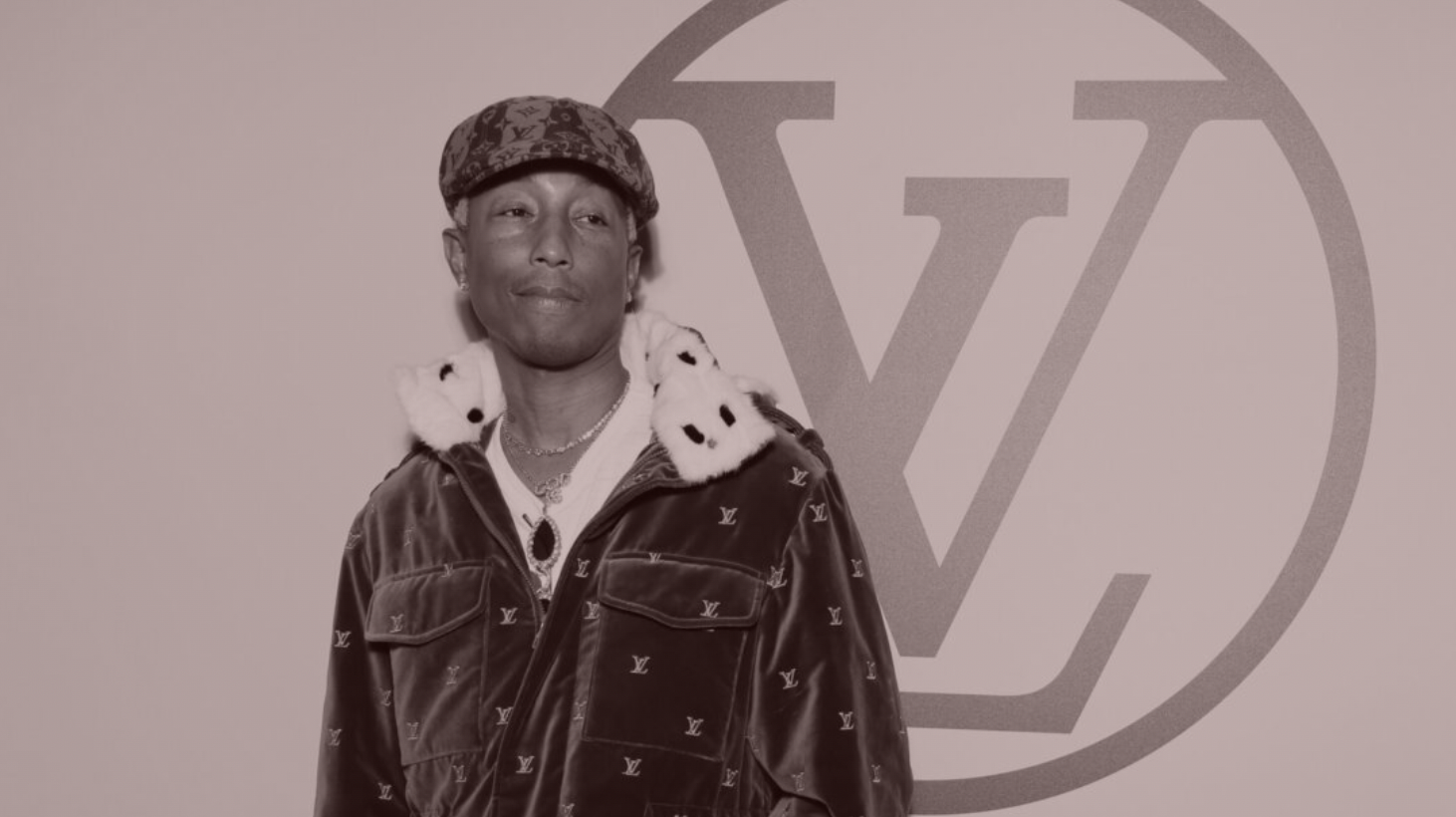 |
| Inside LVMH’s Pharrell Fantasy |
| Williams’ appointment at Louis Vuitton, if successful, could redefine the relationship between fashion and celebrity at a moment when the two industries have never been more intertwined. |
|
|
|
| Next week, at long last, Pharrell Williams will debut his first collection as Louis Vuitton’s men’s creative director. Rest assured, people will fly across the world to see Williams’ vision displayed in a closely kept outdoor location, not only to take in the pomp of the world’s largest luxury brand flexing its largesse, but also just to say that they were there. These days, that’s not common with fashion shows, which are live-streamed on crystal-clear video (god willing), and documented by front-row regulars who have become skilled photographers as a matter of course.
But Williams’ appointment at the LVMH-owned leather goods house, which generates more than $20 billion a year in annual sales, demarcates a new era in fashion. When you’re dealing with an entity of that size, the only way to get bigger is to bring in someone who is as famous (or nearly as famous) as the logo itself. Williams, the groundbreaking hip-hop multihyphenate producer-artist-entrepreneur, is one of the few people in entertainment who rises to that level.
And yet, the choice to appoint Williams was far more nuanced than tallying Instagram followers. Salaries for creative directors at the top luxury groups start at around $1 million, but can reach up to $10 million for top talent at top brands, and Williams’ contract was likely multiples of that, factoring in personal appearances and other marketing requirements that would not typically be a part of the job.
It’s not a small investment, even for a brand like Louis Vuitton, and Williams’ massive reach is only worth its value because he has proven to be a talented purveyor of fashion products, starting with Billionaire Boys Club, which he founded with current Kenzo creative director Nigo in 2003, leading into collaborations with Louis Vuitton and Moncler later in that decade, all the way up to his wildly successful 2019 capsule collection with Chanel, for whom he’d previously starred in campaigns. “I don’t think he would have been a candidate had he not ran a successful fashion company,” said a person who knows more than most about the inner workings of Louis Vuitton.
And he’s done it all with a level of professionalism and organization required to compete at such a high level, consistently displaying a certain humility rare for a celebrity of his caliber. (Williams does not, at least as far as I have experienced, ask news outlets to refer to him by first-name only, a common practice among his peers.) |
|
|
| The all-caps Menswear Opportunity also certainly factored into Williams’ hiring. Over the past few years, men’s fashion weeks have gained steam: the market for men’s clothing may still be smaller than women’s, but it’s faster-growing; the sports stars who show up to the men’s shows are often far more famous globally than the A-list actors; gender is a construct, and so on.
The late Virgil Abloh, who was creative director of Louis Vuitton from 2018 until November 2021, when he died at the age of 41 from cancer, was the leading force in this transformation. People like to forget that Abloh’s collections for Vuitton were far from universally loved. However, the products he created, not to mention the myth around those products, attracted new subsets of customers—in particular, more Black customers—that LVMH is desperate to keep engaging, especially as sales of luxury goods in the U.S. continue dragging.
If successful, Williams’ influence could eventually extend beyond menswear into other categories for LV. No, I’m not saying he’s in line to be the next womenswear designer. But if the brand were to enter color cosmetics, for instance, he could create a range of nail polishes, or star in a fragrance campaign.
In order to see this through, Williams, who moved his family from Miami to Paris in February to oversee the project, has offered clear, high-level creative direction, “giving the strategy and signing off on finished details,” as one person described it. (Longtime associates Matthew Henson, the venerable stylist and brand consultant, and Cynthia Lu, founder of the brand Cactus Plant Flea Market, are in the studio, too.) The atelier reporting to Williams, most of whom were placed there long before his arrival, is one best in the world, with the ability to turn around a sample in as little 48 hours. But he’s also “recasted” external creative partners, showing loyalty to longtime collaborators, including hair stylists, makeup artists, fashion show producers, video producers, and so on. Rihanna, who’s also in business with the Arnaults (through her multi-billion dollar beauty line, Fenty), was announced today as his first advertising campaign star, an image of her bare pregnant belly alongside duffle bags rendered in the pop colors red, yellow, and green, which are also found on the national flags of several African countries.
There are smaller, more cosmetic tweaks that will make a difference, too. Williams’ Instagram account has been nearly wiped clean—no mentions or images of Chanel, only his current projects, with the oldest grid post dating back to Abloh’s memorial service in Miami in December 2021. And of course, the men’s fashion week calendar has been rearranged to lead with Louis Vuitton.
I guess the question is: how much time does Williams have to prove that LVMH made the right bet? As I noted last week, creative directors are more expendable than ever, but that’s truer at smaller, under-resourced brands that can no longer afford to give a designer a few seasons to warm up. LVMH typically plays a longer game. (Like with Hedi Slimane at Celine, which was slow going at first, but then ramped up.) And as I said, Louis Vuitton’s overall success is not totally reliant on Williams—he’s more of an amplifier.
But if Williams is wildly successful—which, I’ve got to say, seems all but guaranteed at this point—it could influence and redefine the relationship between the industry and celebrity. The fashion and entertainment industries have never been more enmeshed, and that relationship is only going to intensify. It’s no longer about starring in a campaign: entertainment wants a piece of fashion, and vice versa. Not only does Francois-Henri Pinault reportedly want to buy CAA, a major talent agency, but I’ve heard from multiple people that talent agencies are interested in incubating and launching brands. It’s all going to be one thing soon enough. |
|
|
| Lots of responses to my recent piece on billionaire Thomas Tull’s ambitions to capitalize on the consumer idealization of the American West, and how fashion factors into it, but one in particular worth highlighting…
“Your point on Western is well taken, but I think you have to give a shout-out to Wrangler. They have been crushing it revenue-wise and critically, they were early onto Yellowstone stuff early, and have to traverse three different audiences (U.S., Asia, Europe) with very different perceptions of the brand.” –A marketer |
|
|
| The brilliant Sarah Miller explains why Hublot is the “world’s most polarizing watch brand.” Read the comments! [Hodinkee]
San Francisco entrepreneurs Brian and Lisa Sugar (founders of Pop Sugar, investors in Everlane, etcetera) raised $33 million to create a “bespoke investment bank” that’ll help startups sell their businesses. If you’re ready to cash out, call them! [Business Insider]
Congrats to Andrew Mukamal, who has transformed Margot Robbie’s red carpet persona with just a couple of appearances. I can’t wait for the Barbie tour to really ramp up. [Red Carpet Fashion Awards]
Ven, the London-based essentials label beloved by influencers across continents, is closing, citing rising costs. [Instagram]
Struggling D.T.C. styling service Stitch Fix hired a new C.E.O. from Macy’s. The stock dropped. [Marketwatch]
AndréLeonTalley’s White Plains home is being sold through an L.L.C. created by Diane Von Furstenberg. [NY Times]
The Westfield Mall in downtown San Francisco is closing. Can someone send me a positive Bay Area retail story? [San Francisco Chronicle]
AnnaWintour is hiring a new assistant. My one piece of advice: don’t wear black to the interview. [Condé Nast]
Vogue’s annual conference, Forces of Fashion, will take place in its offices this year. Scratches that voyeuristic itch, and is cost effective to boot! [Vogue]
Blackbird Spyplane on the death of thrifting as a pastime. I disagree with about 75 percent of this essay, which argues that the quality of Uniqlo today is not as high as Gap in the ’90s (definitely true), and that means there will be less good secondhand stuff to shop for down the road (define “good”). But it’s worth noodling on. [BBSP]
I recently acquired a copy of designer Sander Lak’s Rizzolli book, The Colors of Sies Marjan, a collection of images, essays, and conversations about the short-lived, and yet incredibly collectible, brand, which was designed by Lak and backed by Nancy Marks. Whether or not you were a fan, I suggest seeking it out. [Rizzoli]
Until Monday,
Lauren |
|
|
|
| FOUR STORIES WE'RE TALKING ABOUT |
|
|
|
|
|
 |
|
|
|
Need help? Review our FAQs
page or contact
us for assistance. For brand partnerships, email ads@puck.news.
|
|
You received this email because you signed up to receive emails from Puck, or as part of your Puck account associated with . To stop receiving this newsletter and/or manage all your email preferences, click here.
|
|
Puck is published by Heat Media LLC. 227 W 17th St New York, NY 10011.
|
|
|
|