 |
|
|
|
Forward this email to a friend!
|
|
For our second anniversary, subscribers can share the benefit of Puck with an exclusive code (INSIDEACCESS) that gets your network 30% off.
|
|
|
|
|
|
Welcome back to The Best & The Brightest, I’m Tina Nguyen. In tonight’s edition, the rise of Vivek Ramaswamy as a serious candidate—or, in this singularly odd cycle, a not-unserious candidate.
Also, I wanted to draw your attention to the Puck Second Anniversary sale: current subscribers can share this link with friends, family and colleagues for 30% off their yearly subscription. Think of it as an investment in your interpersonal relationships: they’ll never ask to borrow your Puck password ever again.
…but first, some quick intel from Abby Livingston on Capitol Hill…
|
| McConnell Health Murmurs & D.C. Age Agita |
|
| Earlier today, Senate Minority Leader Mitch McConnell froze mid-sentence while addressing a clutch of reporters in Kentucky, the second time he has done so, publicly, in as many months. His office said he “felt momentarily lightheaded” and would see a physician this afternoon.
Even before those two incidents, McConnell’s age and health have fueled growing speculation about succession plans. A hard fall, in March, kept him off the Senate floor for roughly six weeks. Since then, he’s been seen around the Capitol occasionally using a wheelchair as a precaution. But the Senate Republican insiders and observers I’ve spoken with tell me there’s been no increased urgency to discuss the anticipated leadership race between the three best-positioned candidates: Senators John Barrasso, John Cornyn and John Thune, the presumed frontrunner.
As of now, there’s no evidence that McConnell’s hold over the conference is in jeopardy. That said, political-class Republicans have become increasingly candid—albeit in private—about sharing their discomfort over McConnell’s health, if not his fitness for the job. The next two months are likely to be especially grueling as Congress works to avoid a government shutdown in October.
Naturally, the latest McConnell incident has also revived conversations about the veritable gerontocracy of the federal government. The minority leader is 81, just one year older than Joe Biden. Even older are Senators Charles Grassley (89) and Dianne Feinstein (90), who has been hospitalized multiple times this past year and is currently involved in litigation with her late husband’s estate over “elder abuse.” To put things in perspective, many of these older members aren’t even Baby Boomers—they’re the Silent Generation. World War Two had just ended when Feinstein was in high school.
Anyway, the generational divide hasn’t been sitting well with younger members of the House Democratic caucus, in particular, where the seniority system all but requires decades of service before tasting tangible power. In fact, until Nancy Pelosi (83) stepped down last year, ceding her position to Hakeem Jeffries, Gen X members were mostly boxed out of power. Now they’re feeling pressure from behind via millennials like A.O.C.
Over the last months, I’ve fielded endless complaints about elder members dozing off at public events, confusing colleagues at the Capitol, and lacking even a basic working understanding of the modern technologies they are tasked with regulating. These concerns echo those expressed in my Puck partner Matt Belloni’s excellent interview with young Hollywood interns, who scathingly articulated similar complaints about boomers’ control over agencies and studios that are in desperate need of new thinking.
These conversations are less frequent among my House G.O.P. sources, in part because their committee rules enforce term-limits that force most chairs and ranking members out of committee leadership after three terms. More often than not, these Republican members opt to retire outright rather than face a Flowers for Algernon scenario of returning to lowly rank-and-file status. |
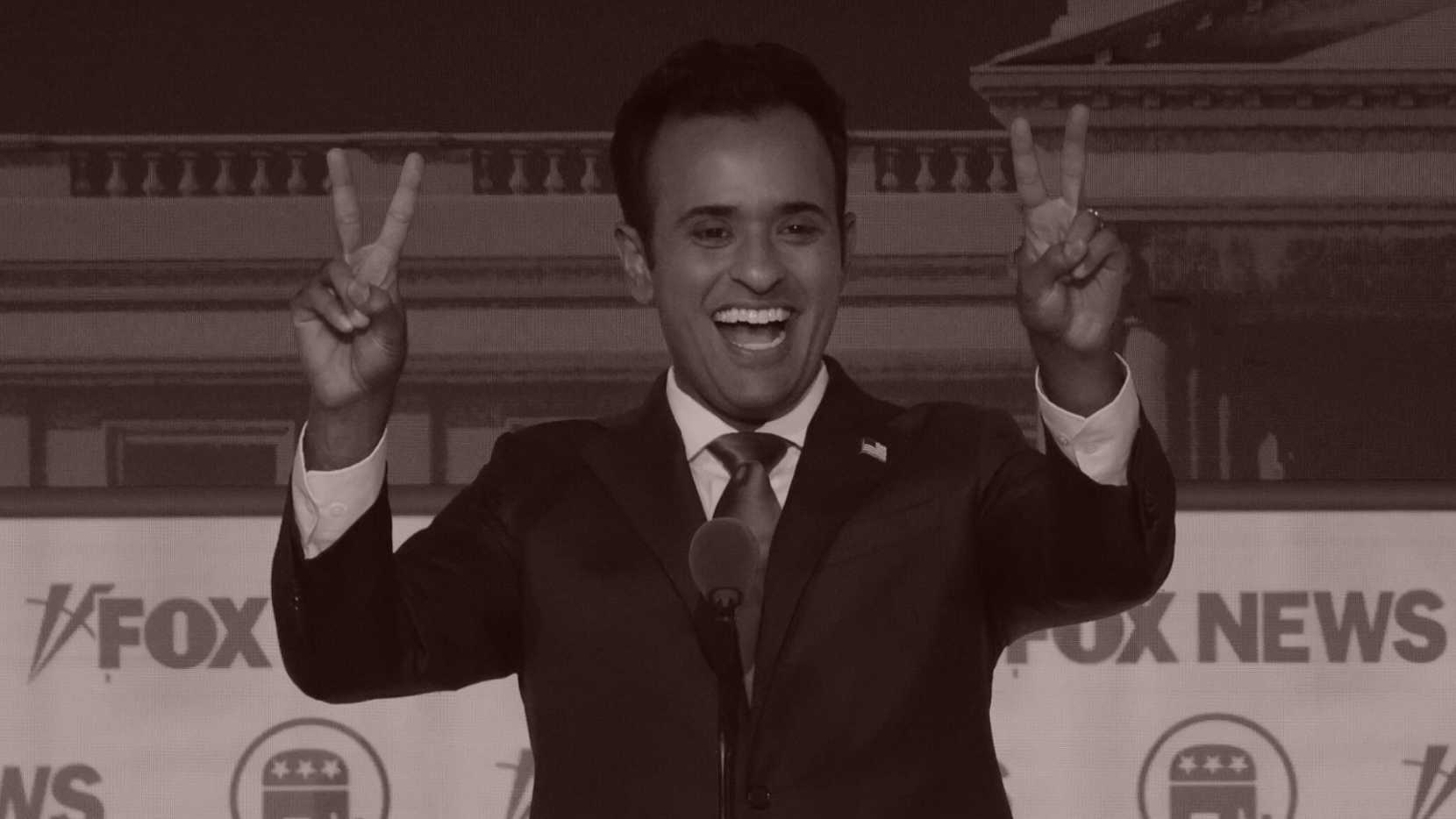 |
| Vivek & Bake |
| The Ramaswamy Show is reconfiguring the essential dynamics of the Republican primary, threatening to push DeSantis out of the right-of-Trump culture warrior lane into the moderate-ish territory occupied by MAGA milquetoasts like Nikki Haley and Tim Scott. |
|
|
|
| Back in June, amid the breathless coverage of Trump’s first arraignment, I was momentarily distracted by an intriguing push alert on my phone: Vivek Ramaswamy, then a mostly unknown dark horse fringe candidate, was holding a press conference outside the Miami courthouse where the former president had appeared. While the rest of the field agonized over how to respond to the spectacle, Vivek called on every other candidate to pledge to pardon Trump if elected—an extreme position that no other candidate has vowed to take. I hurriedly texted a few sources who were plugged into the currents of the MAGA mood to see what they made of this whippersnapper. “Vivek showing the way,” one wrote back, impressed.
Over the next three months, long before his national debut in Milwaukee, Vivek continued to make inroads with the Trump wing of the party that comprises a substantial portion of primary voters. As a culture war correspondent and someone who frequently heads into the field, I had never seen anyone get the reception he regularly enjoyed among diehard Trump fans—applause, veep chants, selfie requests. It was all the more unusual since he was ostensibly challenging Trump for president, an action that’s typically perceived by the base as pure treason.
The qualities that have insulated Ramaswamy from the usual MAGA backlash were all on display during last week’s debate: like Trump, he’s a charismatic and fast-talking political outsider, a businessman and billionaire wannabe, and a gratingly self-confident neophyte with an aptitude for cross-cultural showmanship. (I cannot imagine any other candidate rapping Eminem’s Lose Yourself on the campaign trail and then getting into a feud with Eminem, himself.) Vivek’s debate-night declaration that all of his rivals were bought-and-paid-for “super PAC puppets” was pure 2016-era Trump.
But post-debate polls revealed the limits of this strategy. According to a WaPo/FiveThirtyEight/Ipsos survey of potential Republican voters, more than a quarter of respondents said that Ramaswamy had won the debate, about as many as said DeSantis. And Vivek’s name recognition surged by 29 points. But of the people who formed an opinion about him, more than twice as many walked away with an unfavorable view. Another post-debate poll, commissioned by a pro-DeSantis PAC, found that Vivek’s support in Iowa also dropped 3 points, while DeSantis gained 7. That’s not a massive change, and another poll from Emerson College found that Ramaswamy actually saw a one-point bump upwards, within the margin of error.
It’s not surprising that DeSantis’ super PAC secretly published a pre-debate memo that urged him to attack “Vivek the Fake” as a Trump stooge (even if DeSantis ultimately let Nikki Haley, Chris Christie, and Mike Pence do the dirty work for him). In a campaign where directly criticizing Trump is a surefire way to alienate a plurality of voters, drawing an implicit contrast with a Trump wannabe is the next best thing. On the debate stage, Vivek played the role well, serving at times as a stand-in and stalking horse for Trump. His performance attracted fascination from the political insider class (as my Puck partners Tara Palmeri and Peter Hamby have reported), as well as the checking accounts of the donor class (as Teddy Schleifer wrote about yesterday).
But the mini-me strategy also highlights the dilemma for Ramaswamy if he wants to, you know, actually beat Trump. “[Post-debate], people started knowing about him and looking into him. It also means more people started to find out more about his background,” a Republican insider familiar with the DeSantis and Ramaswamy teams told me. “But also a section of people found out he’s trying to be Trump, and there is only a small amount of ‘not Trump [voters]’ out there.” |
|
|
| Wherefore Art Thou, Ronny-o? |
|
| Until somewhat recently, the conventional wisdom in establishment Republican circles was that a palatable Trump alternative should uphold and execute the Trump agenda—hardening the border, countering China, fighting the deep state, etcetera—without any of Trump’s personal or legal baggage. Hence the early excitement for anti-lockdown warrior Ron Desantis.
But over the last two months, of course, that fantasy has been extinguished, as Trump’s been indicted four times and still retains a healthy polling lead over his nearest rivals. Even now, as Trump faces the very real prospect of ending his campaign in a prison cell, allies and supporters like Jonathan Turley are laying the groundwork for the possibility that federal courts might keep him out of jail, or that he could pardon himself when the time comes.
DeSantis mostly avoided engaging on any of these points during the debate, dodging the question of whether he’d pardon Trump in lieu of a nonspecific pledge to fight the “weaponization” of the Justice Department. “He pulled back in some of the folks who got testy about him saying Trump didn’t need to be extradited and backed him in indictments,” the Republican insider said. “It’s the Rubio vote,” he added, referring to the Florida senator’s half-hearted defense of the former president’s efforts to overturn the election, which rested on the notion that he was simply exercising his free speech. (This is, incidentally, the safest tack a Republican can take on the issue today.)
But it’s not clear how long DeSantis’s elliptical rants about the F.B.I. and “woke” wars in Florida—where he’s already backed away from fighting Disney—can appease MAGA voters who want to see him draw a bold red line in the sand. Especially as Ramaswamy has outflanked him on the pardon question, positioned himself as the true political outsider, and adopted policy ideas more outré than even DeSantis, who wants to send the U.S. military into Mexico, could ever have imagined.
Vivek’s rapid Overton window-shifting has reconfigured the dynamics of the primary race, especially for candidates like DeSantis who previously occupied the right-of-Trump culture warrior lane. Indeed, as Ramaswamy pollster Brock McCleary argued to me, it has essentially pushed DeSantis into the previously unthinkable position of looking like the dreaded moderate in the race, alongside other seeming milquetoasts like Haley and Tim Scott.
“A lot of what I see in early states and nationally among candidates like DeSantis, Scott and Haley, is a lot of just week-to-week shifting around of the electorate's most moderate voters. And so to the degree that one of them may have a better week than the other, they sometimes give it back the following week,” McCleary observed. “And it’s just because that’s kind of the nature of that most ideologically moderate voter in the primary electorate. They date around, if you will.” |
|
|
| General elections might hinge on moderates and independents, but primary elections, especially Republican primaries, are decided by the base. And their preferences since 2016 have shared specific throughlines: they prefer anti-establishment candidates, especially those without a career in politics, with a penchant for flipping over the proverbial tables and a willingness to punch below the belt. (See: the majority of the G.O.P.’s 2022 midterm nominees.) Ramaswamy fits that profile to a T, which is surely why so many respondents across multiple polls identified him as the debate winner. But again, what’s it all for if he won’t fight the frontrunner? As a MAGA-aligned communications consultant dryly observed: “The problem for Vivek is that the same people who think he won [the debate], support Trump.”
That’s fine if Ramaswamy hopes to use the primary and newfound media infamy to raise his political profile for a future run—the Senate, perhaps?—or a position in Trump’s cabinet. But to actually win in 2024, a Trump fanboy clone will not defeat the original model.
McCleary acknowledged the paradox, but also suggested that Ramaswamy can overcome this perception as he improves his visibility, eventually positioning himself as a sort of MAGA coalition consensus candidate—especially if Trump is somehow forced to drop out, although this last point went unstated. “If you look at the different kinds of Republican voters that are out there, the debate helped him get a broader favorability across those different types. By that I mean, there’s some America First, there’s a more traditional kind of Republican, there’s a little bit more Christian conservative,” McCleary said. “And in that way, we’re looking kind of good on all fronts.”
Wishful thinking? Possibly. Something that a candidate with momentum has to say during a presidential race so that he doesn’t lose face? Obviously. But it would be quite easy for Vivek to coast on being a Trump proxy loyalist for the rest of the cycle, and all signs point to him doing the exact opposite: He’s taking meetings with wealthy donors, releasing a list of 200 endorsements in New Hampshire, blasting through events in Iowa over the weekend (ten in two days!), and—in a move that set off my media bait radar—giving an exclusive interview to TMZ.
After all, that’s precisely the sort of outside-the-box interview a regular Republican politician could never land, and perhaps something 2016 Trump might have done. Tellingly, it was in this setting—courting the Us Weekly crowd or the MAGA-curious Joe Rogan Experience listener—where Ramaswamy most firmly drew a line between himself and Trump, vowing that he would not serve as vice president no matter what.
“He and I share something in common: we don’t do well in a number two role,” Vivek told TMZ’s Harvey Levin, adding that he would likely take Trump on as a “mentor” in fighting the deep state. He then proceeded to say something that only someone who actually thinks they can beat the frontrunner, and intends to give it a go, would say: “I think it’s becoming clearer and clearer by the day that I’m the only person that’s going to reach people [in] a scale that’s going to be required to deliver what Reagan did in 1980: a landslide election.” |
|
|
|
| FOUR STORIES WE’RE TALKING ABOUT |
|
|
|
|
|
|
|
 |
|
|
|
Need help? Review our FAQs
page or contact
us for assistance. For brand partnerships, email ads@puck.news.
|
|
You received this email because you signed up to receive emails from Puck, or as part of your Puck account associated with . To stop receiving this newsletter and/or manage all your email preferences, click here.
|
|
Puck is published by Heat Media LLC. 227 W 17th St New York, NY 10011.
|
|
|
|