Hello and welcome back to an extra-special Wednesday edition of What I’m Hearing. I’m in New York,
trying to find the least insufferable bar crowd with whom to watch the Knicks game. And here tonight is a double whammy of Scott Mendelson on the box office implications of the Backrooms/Obsession phenomenon and Julia Alexander with news of which streamers boast the heaviest users. Plus: Jeffrey Katzenberg’s (exciting!) return to the shortform video space.
All yours, Julia and Scott…
Discussed in this
issue: George Clooney, Hernan Lopez, Markiplier, Matt Strauss, Chris Stuckmann, Kane Parsons, Jeffery Katzenberg, Taylor Kitsch, David Caruso, Gabriela Tafur, Marc Andreessen, Curry Barker, Danny Philippou, David Ellison, Michael Philippou,
Taylor Sheridan, Kris Collins, and more. |
|
|
|
A MESSAGE FROM OUR SPONSOR |
Puck sponsors include television’s biggest phenomenon LANDMAN
Billy Bob Thornton, Demi Moore, Andy Garcia, Ali Larter, and Sam Elliott return for the explosive second season of Taylor Sheridan's cultural phenomenon. Actor Award-nominated for Outstanding Performance by an Ensemble in a Drama Series, The Wrap calls it "one of the best TV shows of the year" and Esquire says "this
season is better than ever." For Your Consideration in all categories, including Best Drama Series. Now Streaming on Paramount+ EXPLORE MORE |
|
|
|

| Julia Alexander
|
|
- Katzenberg’s short
return: More than five years after Quibi burned through $1.4 billion, Jeffrey Katzenberg is returning to the shortform mobile content space. Katzenberg’s investment firm, WndrCo, is backing Idilio, a Latin American microdrama app that has generated nearly $1.5 million in revenue, with 93 percent of its user base monetized. The company just raised its first round of seed funding, with Marc Andreessen’s a16z also an investor. Idilio’s C.E.O.,
Gabriela Tafur, a former Latin American TV star turned Stanford M.B.A. media executive, told me Katzenberg is a “visionary” and “the precursor of this whole industry.”
Of course, mobile shortform entertainment has evolved significantly since Katzenberg’s Quibi days way back in 2020. “Vertical video,” analyst Hernan Lopez’s catch-all term for the business that spans microdramas and shortform user-generated content, is reportedly a $100 billion industry,
half of which comes from Meta’s Reels. It’s still unclear whether microdramas will actually become the next big content wave, but Netflix, Disney, and Peacock have all invested in the space. Just yesterday, Versant, the Mark Lazarus-led spinoff of NBCUniversal’s declining cable assets, participated in a funding round for GammaTime, a nascent microdrama platform started by former Miramax head Bill Block.
For her part, Tafur believes each region
will have one major microdrama player, and argues that the Latin American market is particularly ripe because of the culture’s history with telenovelas. Whether that’s true or not, Katzenberg seems ready to make the bet—and it’s a much more modest one this time around. - Peacock and Paramount+’s “diehard” fans: There are a few accepted articles of faith within the streaming community: Netflix and Disney+ will survive this transition period;
YouTube is the ultimate TV competitor; and some kind of Paramount+, Peacock, and HBO Max partnership will have to be consummated for any of those platforms to remain players. David Ellison’s already hard at work on the Paramount+ and HBO Max part of that equation, and NBCU Media Group chairman Matt Strauss is trying to turn Peacock into a distributor of sorts, similar to Amazon Prime Video Channels. But how these three struggling streamers
appeal to their subscribers is always shrouded in mystery.
|
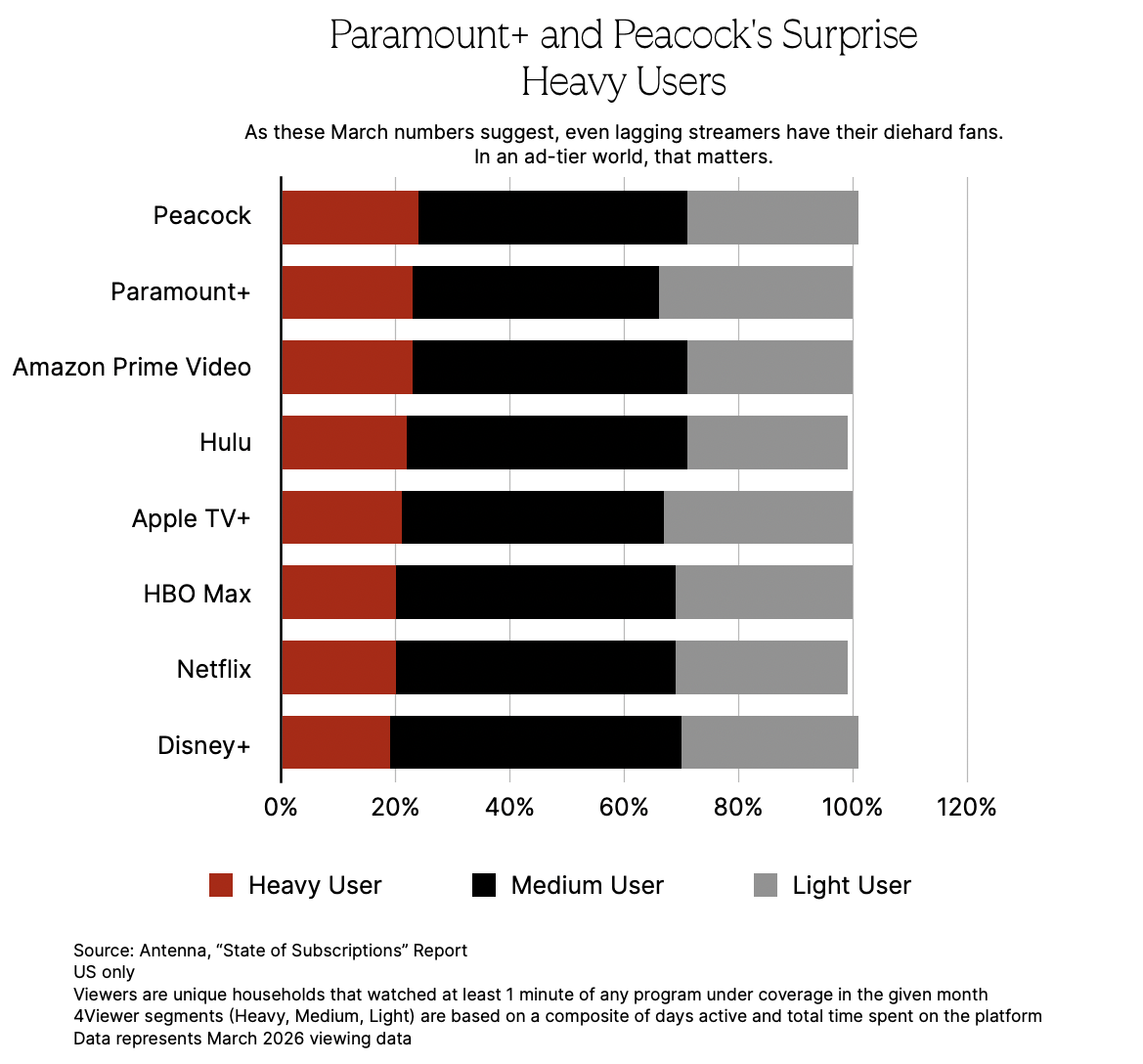
- Turns out, Paramount+ and
Peacock actually have a strong base of diehard fans, per new Antenna data. In fact, they boast the highest percentage of so-called heavy users in March—a period that coincided with big event draws like March Madness. This may partially answer why Par+ also has the highest percentage of light users—viewers who struggle to find titles that appeal to them.
Importantly, Antenna’s data is tailored to each platform’s own audience, not benchmarked to an industry standard. So
while the average heavy user across Peacock and Paramount+ recorded 6.5 days of viewing in March, Disney+ came in at 7.3 days, and Netflix’s diehard base watched the service for at least half the month. Peacock and Paramount+ may be finding their bases through sports, Bravo, and Taylor Sheridan, but they’re still far behind Netflix when it comes to actual time spent and usage. And as we all know, those are quickly becoming some of the most important metrics as ad
tiers become paramount (no pun intended) to streamers’ growth.
|
|
|
|
The breakout weekends for Backrooms and Obsession tell us something real
about the origin of Hollywood’s next generation of talent—and something more complicated about its future. |
|
|
|
After last weekend’s box office results, there is a temptation to declare the dawn of a new world order. Two
low-budget horror movies, directed by young first-time filmmakers with YouTube roots, dominated the domestic multiplex, while The Mandalorian and Grogu stumbled. Matt covered the seismic implications earlier this week, but before Hollywood fully commits to the HollyTube thesis, it’s worth looking closer
at the success of each film, as well as Markiplier’s (real name: Mark Fischbach) recent Iron Lung, to determine what practical lessons the studios can learn before the greenlights start shining.
The truth is that this dynamic is more complex than a narrative in which a new form of blockbuster-quality I.P. is out there just waiting to be harvested. Instead, we’re getting the emerging pages of a playbook for identifying the sort of new media talents who have legit
crossover appeal. |
Fame Isn’t the Same as a Fanbase
|
As studios inevitably turn to YouTube in search of new—and, yes, cheaper—talent, the most important
distinction isn’t between creators with big followings and those with small ones. It’s between those with passive audiences and those with highly engaged fans.
Indeed, Fischbach’s greatest achievement might not have been making sci-fi/horror flick Iron Lung for a mere $3 million, but persuading a chunk of his 38.7 million YouTube subscribers to pressure theaters into booking the
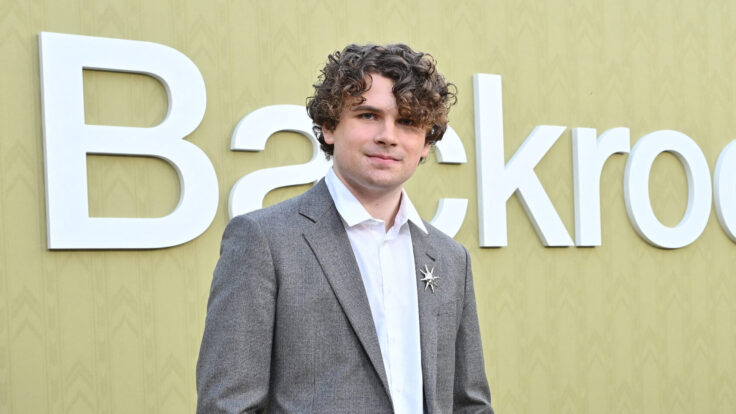
movie on more screens. In the end, he mobilized a fandom to actually show up on opening weekend. Kane Parsons wasn’t self-distributing Backrooms, but he and A24 nevertheless converted a dedicated online fandom into butts-in-seats ticket sales.
But for every Markiplier or Parsons, there are hundreds of creators with massive followings whose subscribers have demonstrated no particular inclination to leave the house. Chris Stuckmann boasts more than
2 million YouTube subscribers, but his Neon-distributed horror film, Shelby Oaks, earned just $8.1 million earlier this year. (Yes, that’s an objectively fine take considering the $1.5 million budget, but you get the point.) Kris Collins has more than 50 million TikTok followers, but her found-footage chiller, House of Eden, earned just $313,000 after debuting on
600 screens last August.
This shouldn’t be much of a surprise. Finding success on a new platform after achieving glory on another has been a long-standing, existential challenge for the entertainment industry. When it comes to TV stars blossoming into movie stars, sometimes you’re George Clooney and sometimes you’re David Caruso or Taylor Kitsch. Hollywood’s challenge isn’t finding YouTube talent—it’s
finding the exceedingly rare ones whose fans treat them like a rock band. |
Let’s Obsess on Obsession
|
Hollywood should be studying Obsession’s performance with equal attention. YouTube sketch comic
Curry Barker’s $750,000 film just crossed $110 million domestic, becoming the second-highest U.S. earner ever (sans inflation) to cost less than $1 million to produce. More remarkably, the Focus Features release became the first wide opener outside the Christmas corridor since E.T.: The Extra-Terrestrial to increase its grosses in both its second and third weekends. (The closest comparison is Terrifier 2, which did so on around 700 screens in the fall of
2022.) |
|
|
|
A MESSAGE FROM OUR SPONSOR |
Puck sponsors include the record-breaking Paramount+ Drama Series THE
MADISON From executive producer Taylor Sheridan. Michelle Pfeiffer shines in this epic drama about resilience, transformation and the family ties that bind. Variety proclaims, “Michelle Pfeiffer gives a powerhouse performance” in a show RogerEbert.com calls “rock-solid,
gripping television.” Emmy eligible in all categories including, Outstanding Drama Series, Outstanding Lead Actress Michelle Pfeiffer, Outstanding Supporting Actor Kurt Russell, Outstanding Guest Actor Will Arnett and Outstanding Director Christina Alexandra Voros Now Streaming on Paramount+ EXPLORE MORE |
|
|
|
None of that happens without a TIFF premiere, genuine critical buzz, and an acquisition by Focus. Barker
didn’t conquer Hollywood by circumvention; he moved through it. Audiences didn’t need to know his YouTube filmography to enjoy the film. Ditto A24’s success with its 2023 Sundance pickup Talk to Me, which worked for audiences who had absolutely no knowledge of Michael and Danny Philippou’s prior short films. In other words, there may be an emerging template of success coalescing around online origins, a proper industry pathway, collaboration with
existing production and distribution outlets like Blumhouse-Atomic Monster, and obviously a product that stands on its own. Indeed, this was also the case with Backrooms, which works as a Lynch-ian meditation on middle age and squandered potential amid economic insecurity, even for viewers who have no knowledge of the source material or the online mythology. |
The Horror Ecosystem Provided a Healthy
Assist
|
The rise of YouTube filmmakers within horror isn’t a revolution so much as the natural consequence of the
genre’s economics—and its unusually robust promotional opportunities. As you know, horror doesn’t require massive budgets, A-list stars, or preexisting franchises to generate returns, which makes it attractive to both first-time directors and risk-averse studios. It also benefits from a media ecosystem with no real equivalent in other genres. Outlets like Fangoria, Bloody Disgusting, and Dead Meat Presents perform a promotional function—building awareness, stoking
enthusiasm, creating event-movie energy—that simply doesn't exist for a romantic comedy or a drama.
Aggressive promotional efforts and shrewd marketing campaigns aside, that genre-specific ecosystem amplified Longlegs, Weapons, Smile, and Obsession in ways that a conventional P&A campaign couldn’t have manufactured on its own. But whether this emerging generation of creators can expand beyond horror remains genuinely unclear. However, there are worse
ways to spend money than throwing relatively responsible amounts of it at promising online comedy talent and letting them make actual comedies. |
The Kids Were Never the Problem
|
The weekend was also another robust rebuke to a decade of bad-faith rhetoric from Wall Street analysts and
Silicon Valley evangelists who insisted that theatrical exhibition was a relic of a bygone era and only they understood younger audiences. The generation supposedly too online for movie theaters, and too distracted for anything longer than a TikTok, has been showing up in force whenever Hollywood offers something it actually wants. That may not be a weekly routine, as it was for Boomers, but the channel hasn’t evaporated either.
What’s changed isn’t young people’s appetite for cinema.
It’s the social context around it. Many of the traditional third spaces—malls, bookstores, gaming centers—have contracted, closed or become overly regulated. Concurrently, younger audiences are less inclined, even when they’re old enough, to socialize around alcohol. For a generation shaped by pandemic isolation, a movie theater remains one of the few widely available venues for genuine shared experience. Yes, streaming ushered massive convenience into our lives, but the comparative paucity of
theatrical releases has let many to overstate the decline of the value of theaters for younger generations.
Backrooms, Obsession, and Iron Lung didn’t succeed by replacing or renouncing theatrical exhibition. Instead, their creators embraced it, and viewed the notion of one of their movies playing globally in multiplexes as a career affirmation. Moreover, Parsons, Barker, and Fischbach all demonstrated that a nationwide theatrical release remains perhaps the
most effective vehicle for galvanizing an online following for an aspiring monocultural event.
In a hopeful sign, a decade of consolidation, disruption discourse, and streaming-era triumphalism hasn’t changed what the phrase “now a major motion picture” still signals to the people who matter most—the audience. An aspiring content creator can build a following on YouTube. But it still means something to a younger generation when people are watching their stuff on a Friday night in the
dark, together. |
Thanks, Scott. I’ll see everyone tomorrow.
Matt |
|
|
|
Puck sports correspondent John Ourand and a rotating cast of industry insiders take you inside the executive suites and owners
boxes where the decisions that shape the entire sports business are made. You’ll hear interviews with players, network execs, and everyone in between. The Varsity is an extension of John’s private email for Puck by the same name. New episodes publish every Wednesday and Sunday. |
|
|
|
Ace media reporter Dylan Byers brings readers into the C-suite as he chronicles the biggest stories in the industry: the future
of cable news in the streaming era, the transformation of legacy publishers, the tech giants remaking the market, and all the egos involved. |
|
|
|
Need help? Review our
FAQ page or contact us for assistance. For brand partnerships, email ads@puck.news.
You received this email because you signed up to receive emails from Puck, or as part of your Puck account associated with {{customer.email}}. To stop receiving this newsletter and/or manage all your email preferences, click here. |
Puck is published by Heat Media LLC. 107 Greenwich St., New York, NY 10006 |
|
|
|
|