Welcome back to The Varsity, our thrice-weekly private email on the sports
business. I’m John Ourand, coming to you once again from D.C. on this, the last day of July.
🎧 Pod alert: Sally Jenkins, who’s on my very short list of the best sports columnists of the past quarter-century, joins The Varsity this weekend. We’ll discuss her surprising/adjacent move from The Washington Post to The Atlantic—everyone is fleeing Bezos’s playpen these days, alas—and
examine the changing underlying economics of tennis, golf, college sports, and more. Also, make sure you listen to my partner Marion Maneker’s appearance on the pod yesterday. He explained why the big auction houses are getting deeper into the sports collectibles market. You’ll learn a thing or two, you philistines! (Okay, maybe not
Marchand, but the rest of you might.) |
|
|
A MESSAGE FROM OUR SPONSOR |
Forever at the top of its game, the trailblazing BMW 7 Series. Engineered to win. Learn more at
BMWUSA.com |
|
|
Player
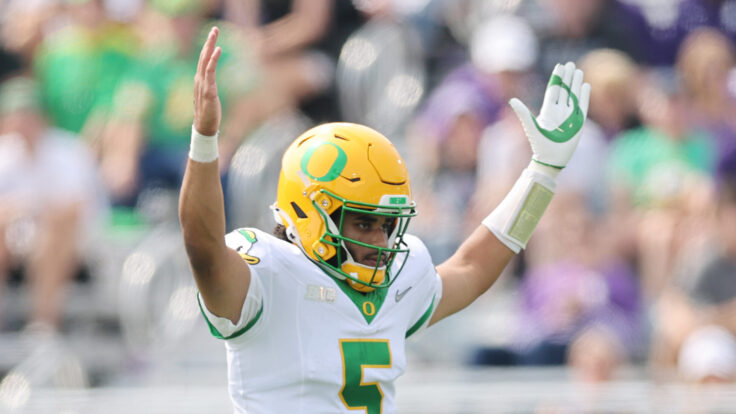
of the Week: Deion Sanders
|
We’re still four weeks away from college football’s Week 0—we need to retire
that awful moniker—and everyone’s already talking about Deion. This is a guy who beat bladder cancer, got back to work coaching a top 25 team, and signed an adult diaper sponsorship deal. You could make the case that he is the most recognizable person in college football not dating Jordon Hudson, and his team looks certain to play in the best national TV windows on Fox or ESPN. |
Down to the
J.V.: Will Lewis
|
As the Washington Post C.E.O. tries to remake the paper, a team of high-profile
reporters has taken a buyout and left—so many, in fact, that not even this Politico list is totally up to date. On the sports side, those defections include not only the estimable Jenkins, as I noted above, but also columnist and editor Dan Steinberg
and Commanders reporter Nicki Jhabvala (who wasn’t at the paper long enough to be offered the buyout but still left), both of whom decamped for The Athletic, as well as longtime soccer reporter Steven Goff, deputy sports reporter Cindy Boren, and reporter Matt Bonesteel. |
Dishonorable
Mention: Shannon Sharpe
|
Sharpe’s future in legacy media is in jeopardy; ESPN fired the former
Broncos and Ravens tight end a couple of weeks after he settled a lawsuit with an ex-girlfriend who had accused him of rape. ESPN took Sharpe off the air back in April, shortly after the woman filed the suit. |
- Fox takes a
bite out of Penske: The concept of media networks taking ownership positions in the leagues they broadcast is not novel. In the 1990s, ESPN launched and aired the X Games. Shortly thereafter, NBC took an ownership stake in the XFL. Last month, of course, ESPN took an interest in the Premier Lacrosse League. This morning, Fox Corp. announced it’s buying one-third of Penske Entertainment, the group that owns IndyCar and the Indianapolis Motor Speedway.
Sources have told me that Fox
paid around $125 million, which includes a rights extension. Fox was adding to its portfolio of significant stakes in the United Football League, the Big Ten Network, and postseason college basketball tournament The Crown. The network also owns a piece of Flutter/FanDuel and NYRA Bets. - Comcast’s $2.5 billion NBA bet: If you’re wondering why NBC paid $2.5 billion annually for NBA rights, Comcast C.F.O. Jason Armstrong offered a pretty
good explanation on this morning’s earnings call. Armstrong revealed that advertising revenue declined 7 percent in the second quarter, due partly to the paucity of sports content. “For us, the second quarter has historically lacked tentpole sports, so we’ve been more susceptible to fluctuations in general entertainment ratings. We look forward to that changing next year with the launch of the NBA,” he said, noting that the third quarter will face tough comps because of last year’s Paris
Olympics. “But [we] feel well positioned over the next year, given our strong lineup of content, including the NBA premiering in the fourth quarter and the Winter Olympics and Super Bowl in the first quarter of 2026.”
- MLB lockout optimism: Like just about everyone else who covers baseball, ESPN’s Buster Olney thinks that a lockout after next season is likely. But on yesterday’s Baseball Tonight podcast, he
outlined a scenario wherein the owners and players could reach an agreement without losing regular season games. Buster’s comments came during a discussion about the Rob Manfred–Bryce Harper fracas in the Phillies clubhouse last week: Harper, of course, cursed out the
commissioner over the mere idea of a salary cap. “I don’t know if Bryce Harper is speaking for the majority of the players,” Buster said. “This situation reminds me so much of the P.E.D. issues in the late ’90s.”
Back then, union leadership took the hard stance that players would never agree to be tested for performance-enhancing drugs. Eventually, rank-and-file players “bulldozed the leadership on that issue,” as Buster put it. More Buster: “I kind of wonder if the same dynamic may be in
play here with the salary cap. You have Scott Boras’s clients, in particular, like Bryce Harper, coming out and saying that they’ll never agree to a salary cap. … You talk to people privately, and you get, Hey, if it means more money for more players, we should explore that idea. I don’t think you’re going to have a lot of … rank-and-file players who are going to say, ‘Let’s win one for the Juan Soto.’ They’re wondering about the middle class.” - Sports memorabilia gets hammered: Recently, my partner Marion Maneker profiled auctioneer, memorabilia collector, and Netflix star Ken Goldin. Back in 2012, Goldin’s company was an $800,000 business; by 2019, that number was $28 million, and Covid provided a further boost. Last year, eBay acquired the company for
an undisclosed sum.
On yesterday’s Varsity podcast, Marion explained why auction houses are getting more involved in sports memorabilia, with some setting up their own sports departments. “One of the hidden stories of the art market,” Marion told me, “is that everyone’s distracted by the money, so they think that what’s important is the money. But
what they don’t understand is almost every art trade—and this extends to collectibles—is someone not caring about the money. They want to have it in their possession, and have the experience of seeing it on a regular basis, under their control. … The great collectors are people who want to be able to experience their art, and show it to other people, and explain to them why it’s important.” - The Paramount sale fine print: Lurking inside the F.C.C.’s
long-awaited approval of the $8 billion Skydance-Paramount deal is language that could change the economics of the streaming business in the U.S. I’ll let my partner Eriq Gardner explain: “In the details of the F.C.C.’s Skydance-Paramount
approval, there’s a noteworthy comment on ‘must-carry rules’—the requirement that cable TV systems carry local broadcast stations—and whether they should extend to streaming services offering linear channels. The idea came from Fuse TV, which warned that Paramount+ could favor its own content over independent programmers, and asked the F.C.C. to impose must-carry obligations as a condition for approval of the Skydance deal. Interestingly, the
F.C.C. didn’t reject the concept outright, noting that ‘such matters are best addressed through rulemaking proceedings than the transaction-review process.’ Translation: The F.C.C. may open a docket item soon, which could give Nexstar, Sinclair, and other local station owners a path to demand carriage on streaming platforms. Stay tuned.”
|
Now, on to the main event… |
|
|
Relative affordability—$400 million, anyone?—and some timely rule
changes have opened up the market for Mexican soccer clubs to U.S. investors. |
|
|
U.S. investors looking to own a soccer team are having a moment… in Mexico. A number
of groups are circling Mexican clubs like Atlas, the Liga MX team that Grupo Orlegi has put on the block with an initial asking price of $400 million. That followed the news that U.S. investment firm Innovatio Capital was leading a group to acquire a fútbol club called Querétaro for $120 million. Other Mexican league clubs are expected to hit the block this year.
The pitch is simple enough: The get-in price is relatively low, especially compared to U.S. teams, which are getting
too expensive for all but the most elite individual buyers. Mark Walter’s purchase of a majority stake of the Lakers in June, which valued the franchise at $10 billion, is proof enough. Likewise, the $6.05 billion that a group led by Josh Harris paid for the Commanders in 2023, and the Celtics sale this past March for $6.1 billion to a group led by Bill Chisholm. |
|
|
A MESSAGE FROM OUR SPONSOR |
Forever at the top of its game, the trailblazing BMW 7 Series. Engineered to win. Learn more at
BMWUSA.com |
|
|
Liga MX officials also point to several rule changes—such as a bylaw that now bans
companies from holding positions in multiple clubs—that they believe make their league even more attractive to investors. (That’s why Grupo Caliente, which also owns a club in Tijuana, had to let go of Querétaro, and why Orlegi, which also owns Santos Laguna, had to put Atlas up for sale.) The opportunities for prospective team owners to get involved will be ongoing—two other groups own more than one team: Grupo Pachuca has León and Pachuca, and Grupo Salinas’ TV Azteca has Mazatlán and
Puebla.
Since 2020, investment in Mexican soccer clubs has become safer, because Liga MX dropped (or paused, as they said at the time) a promotion-relegation system that sent the worst teams down to the first division, and promoted the first division’s best team to Liga MX. This stands in stark contrast to Europe, where leagues still have promotion and relegation, draining some of the glamor and allure for American investors. Relegation is great for fans and media companies, but
it only invites risk for investors given the potential revenue oscillation.
I recently spoke about all of this with Liga MX president Mikel Arriola. The excerpts from our conversation have been lightly edited for length and clarity. |
John Ourand: Why are investors
interested in buying Liga MX teams?
Mikel Arriola: We are the only net exporter of football in the world. You will never see this viewership and fan base from one country to the other. We have 60 million fans in the U.S. The trend in the U.S. is that consumption of live sports and soccer is now seeing double-digit growth. We are part of that.
When you go to market in MLS, teams are being bought at 10.5x
revenue. And in Mexico, the last operation that we had prior to Querétaro was 2x sales. The multiple for Querétaro was 5x sales. We are not at the same level of economics as the U.S., but we’re following this increase in value due to the fact that our teams are well-known in the U.S., and our product can be merchandised here.
Does Liga MX have rules about private equity taking ownership stakes in your teams?
We don’t have any
regulation regarding what kind of figure we would like to have as an owner. The board has to approve new ownership. What we see now is a new kind of buyer. We see interest from funds in buying teams in Mexico. Our historic model of ownership is not a fund-oriented league. But we are becoming a fund-oriented league with the new owners. I spoke with Marc Spiegel, the chairman of Innovatio Capital, who just bought into Querétaro, and his theory of investment is to sell more
tickets, increase the fan base with technology, and more digital content. It’s a new model of investment.
Where will new investors find growth?
One area of opportunity is in infrastructure. We play in municipal stadiums in some cases. Incentives to invest in such stadiums are low, because that’s not your property. With the case of Querétaro, one possible solution would be to build a new stadium that would develop new areas of a
city that is so important to our economy. If you change from having a free lease from the municipality to building a stadium with an MLS model, that would be something we would support. That’s why when the funds come to invest in Liga MX, they do it to increase the value of the team, and that helps the other teams.
What’s going on with media rights?
We are in the process of restructuring the league, and we see a huge opportunity,
for the first time in our history, to renegotiate our TV deals and centralize them. The owners of the TV rights now are the broadcasters, not the teams. So we should have them back and empower the league to negotiate. We need to do that in order to continue competing with the other leagues that have TV rights that are centralized.
We are modernizing the league. We are generating new properties with the U.S., like the Leagues Cup tournament with MLS. The most important market in terms of
value is the U.S. We have this unique opportunity, and are in the process of promoting new investment. |
On Dave Portnoy’s Fox deal: “The daily weekday ratings comparison between
McAfee and the Barstool show will be the most widely watched scoreboard in sports TV (at least for the first month or two). And if both have full editorial control over their shows, there is huge potential for direct (and very personal) sparring through their TV shows.” —A journalist
On a Cheap Seats note from a former ESPNer: “You can debate Dave Portnoy all day—but coming from an ESPN orbit, it rings hollow. ESPN has long
protected controversial personalities when it suited them, and only draws lines when the backlash gets too loud to ignore. Fox works with bold voices, and doesn’t flinch when others do. That doesn’t mean endorsing every opinion—it means respecting the audience enough to decide for themselves.” —A media executive
On Don Van Natta’s Varsity pod appearance:
“I understand and agree that Don Van Natta has done great reporting on this NFLPA story. But you couldn’t mention Pablo Torre or Mike Florio one time the entire show? Don and Kalyn Kahler wouldn’t have anything to expand on if Pablo didn’t
expose the buried report to begin with.” —A podcast listener via Bluesky
On Marion Maneker’s guest turn on The Varsity: “You can tell your Puck overlords that your collectibles pod made me want to check out Marion’s
other Puck content.” —A D.C. lawyer with impeccable taste |
|
|
Ace media reporter Dylan Byers brings readers into the C-suite as he chronicles the biggest stories in the
industry: the future of cable news in the streaming era, the transformation of legacy publishers, the tech giants remaking the market, and all the egos involved. |
|
|
Join Emmy Award-winning journalist Peter Hamby, along with the team of expert journalists at Puck, as they let you
in on the conversations insiders are having across the four corners of power in America: Wall Street, Washington, Silicon Valley, and Hollywood. Presented in partnership with Audacy, new episodes publish daily, Monday through Friday. |
|
|
Need help? Review our FAQ page or contact us for assistance. For brand partnerships, email ads@puck.news. You received this email because you signed up to receive emails from Puck, or as part of your Puck account associated with {{customer.email}}. To stop receiving this newsletter and/or manage all your email preferences, click here. |
Puck is published by Heat Media LLC. 107 Greenwich St, New York, NY 10006
|
|
|
|