Welcome back to The Varsity. I’m John Ourand, currently in D.C., where I’ve been
keeping a close eye on YouTube TV’s carriage negotiations. Univision networks and Monumental Sports Network have gone dark, but the distributor was able to work out a deal with NBC. More on that below.
🎟️ In the Arena: Adam Silver, Josh Harris, Gerry Cardinale, Michael Rubin, Eric Shanks, Jay Marine… We have an all-star lineup set for our inaugural sports media conference, In
the Arena, which we’re hosting on October 16 in New York with our pals at MoffettNathanson. Tickets are going fast and we only have a few left. Click here to get yours.
🎧 Pod
alert: The billionaire Texas Tech booster Cody Campbell has flooded the airwaves this fall with the message that he wants to save college sports, in part, by modernizing the Sports Broadcasting Act of 1961. Campbell will join the Varsity podcast this weekend to outline his plan and respond to the blowback he’s been receiving. And make sure to listen to yesterday’s conversation with Axios’s Sara Fischer: We broke down the latest on ESPN’s blockbuster deals with the NFL and MLB, and the possibility of an early NFL rights shake-up. Listen here and here. |
Player of the Week:
Napheesa Collier
|
The Minnesota Lynx forward’s four-minute takedown of WNBA management was so effective that Stephen A.
Smith called for Cathy Engelbert’s resignation, and Scott Van Pelt piled on. Collier has positioned herself as the most effective spokesperson for the players—someone well-qualified to lead them through these tumultuous
negotiations and unafraid to challenge the opposition. |
Down to the J.V.:
Derek Sprague
|
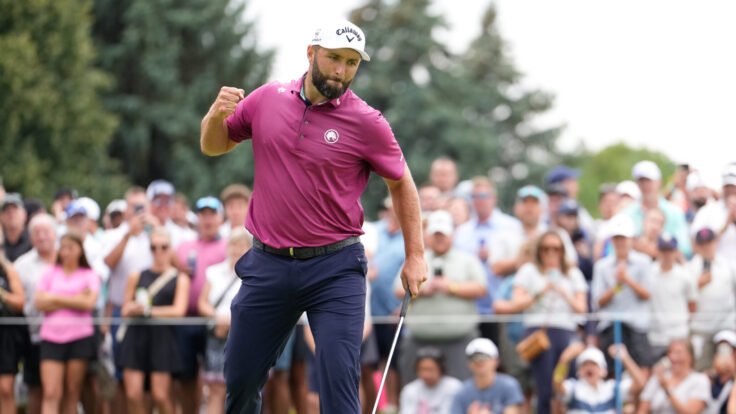
It was a disastrous week for the PGA of America and its C.E.O. It wasn’t just the U.S. Ryder Cup team’s
dreadful performance, or the loud minority of fans who behaved boorishly. The real problem is that sports fans in the U.S. simply didn’t care about the event—certainly not as much as they once did. While sports viewership has risen across the board, the event’s final-day TV ratings were lower than those of any Ryder Cup hosted by the U.S. this century. Sure, the match seemed lost before anyone teed off on Sunday, but it still marked the culmination of a week that the PGA would
like to forget. |
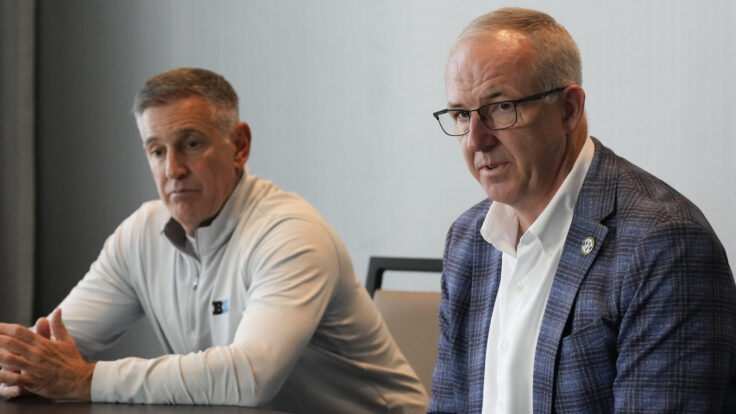
- Big Ten’s P.E. future: If the Big Ten moves forward with its plan to collect $2 billion in private equity—as ESPN’s Pete Thamel and Dan Wetzel reported yesterday—it probably won’t impact the mediacos that hold the conference’s media rights, at least not in the short term.
Fox, CBS, and NBC are locked into long-term deals with the conference. But this will also be the latest unprecedented event in what has been an extraordinary period of reinvention. And it’s impossible to truly fathom the outcome given that so much will come down to the specific terms of the deal and the nature of the investment, once closed. In fact, the ESPN story, itself, is sufficiently vague.
Indeed, all of the ostensible comps are imperfect or facile since what we’re really talking
about here is likely a credit or equity investment in a series of public institutions. And so while all the media partners are currently in safe harbor, I’m sure they’re all girding their loins for their next negotiation, when they’ll be trading deal terms with a professional grinfucker. Anyway, hold on to your hats—we’re not in the Horseshoe anymore. - Flag football: Roger Goodell has reiterated the NFL’s
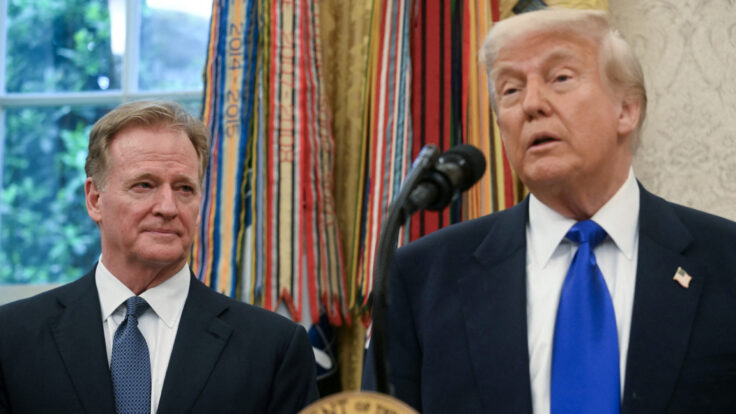
intention to launch a flag football league before the 2028 Olympics in Los Angeles, and today he spoke about rolling out both a men’s and a women’s organization. “We’re committed to creating a women’s professional league and a men’s professional flag league,” he said at the Leaders in Sport conference in London this morning. “We’ve had a great deal of interest in that, and I expect that we’ll be able to do that, launch that, in the next couple of years.”
Goodell made his comments
just a couple of days before the Vikings play the Browns at Tottenham Hotspur Stadium. The NFL, of course, pushed for the Olympics to include flag football in 2028, and Goodell talked about how the sport’s popularity among younger kids gives him confidence that these leagues will succeed. “If you set that structure up where there’s youth leagues, going into high school, into college, and then professional, you can develop a system of scale,” he said. “That’s an important infrastructure that we
need to create.” - Super Bowl halftime: So far, the NFL hasn’t commented on the meshuga, MAGA-aligned blowback over the selection of Bad Bunny as the Super Bowl halftime show headliner in February. On the Varsity podcast, Axios media reporter Sara Fischer pointed out that Bad Bunny was the
third-most-streamed artist globally on Spotify last year (he’s currently number two), and that his 2022 album, Un Verano Sin Ti, remains the platform’s most streamed album ever. The halftime performer has been chosen by Jay-Z and Roc Nation since 2020, but the NFL, obviously, can push back. “The reason he is so controversial is because he said earlier this year that he was not going to tour in the U.S. because of concerns around ICE raids,” Sara said of the Puerto
Rico–born megastar. “Bad Bunny has global appeal, which really matters to the NFL as it tries to expand into South American markets.”
- Jared’s new deal: In his excellent private email, In the Room, my partner Dylan Byers got under the hood of the $56 billion purchase of Electronic Arts ($36
billion for the company, another $20 billion in debt) by Silver Lake, the Saudi Public Investment Fund, and Jared Kushner’s Affinity Partners. Dylan knows a thing or two about this, having reported on Brian Roberts’s plan to merge EA with a spun-off NBCUniversal three years ago—a deal that fell apart over price and structure disagreements.
Anyway, here’s Dylan: “This deal has something for everyone: The Saudis get to turbocharge their investments in the
video game and e-sports sector, Silver Lake returns to form as a large-cap tech investor, and Kushner gets a seat at the table. … As for EA, this deal seems to carry a lot of upside: more capital to grow the business, and without the burden of public quarterly reports.” - Ryder Cup freeloaders: A rarely discussed benefit of forking over astronomical fees for sports rights deals is that mediacos leverage their events to entertain clients and partners. And
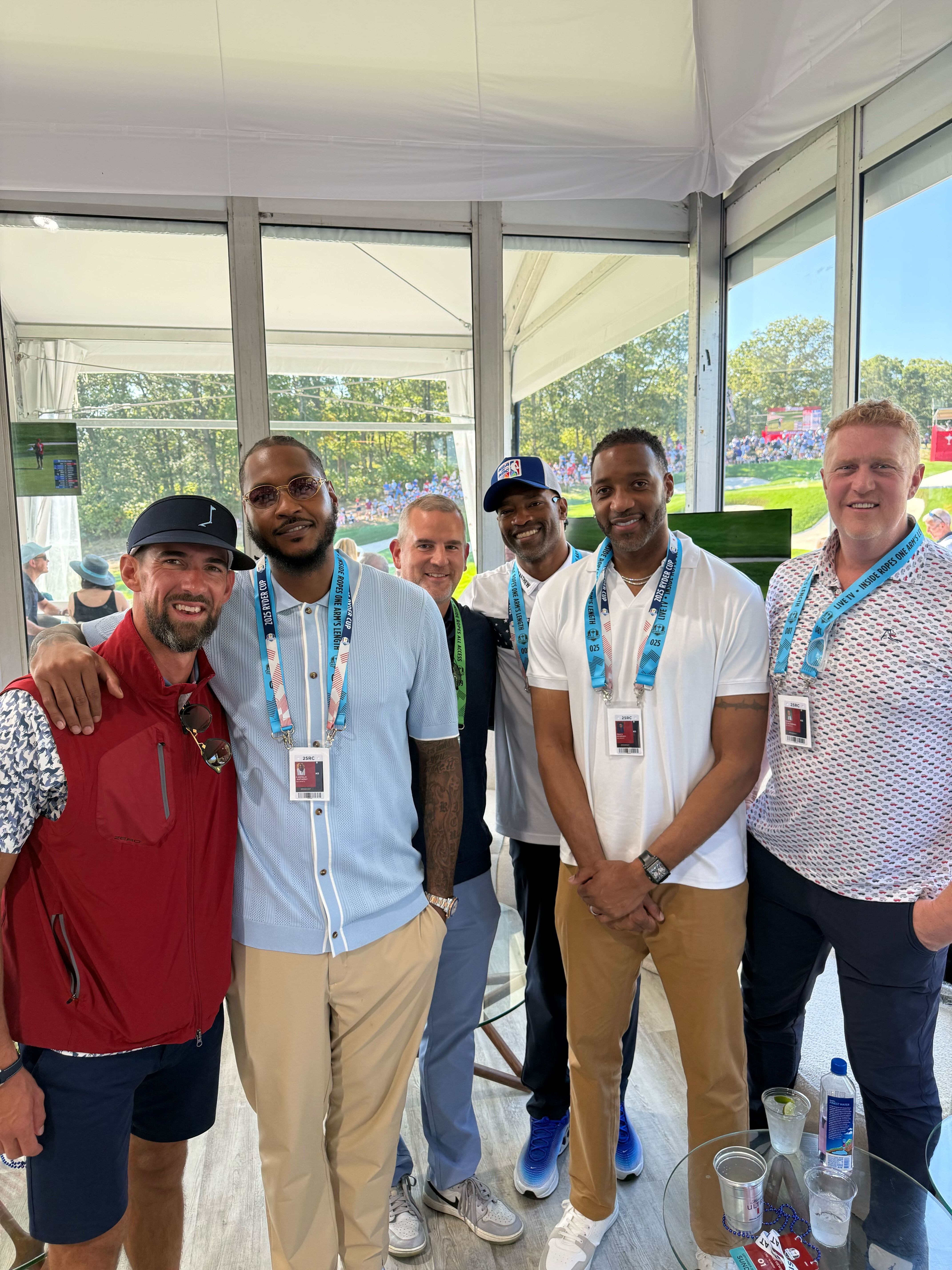
when an event is in a popular media town, like New York or L.A., the suites and hospitality tents can turn into sweet sixteens. At the Ryder Cup last weekend, a parade of bold-faced names threw back Aperol spritzes and wolfed down canapés at NBC’s double-decker hospitality suite beside Bethpage Black’s 15th hole. That included Comcast and NBC Sports execs like Brian Roberts, Mike Cavanagh, and Rick Cordella, of course, as well as top league
executives like MLB’s Rob Manfred, the NHL’s Gary Bettman, the Premier League’s Richard Masters, and the NFL’s Hans Schroeder and Mike North. Others huddled in the suite included some of the network’s NBA talent (Michael Jordan, Carmelo Anthony, Tracy McGrady, and Vince Carter), Jimmy
Fallon, Nate Bargatze, Michael Phelps, Peter King, Anthony Rizzo, Hannah Storm, and uber agent Sandy Montag, among many others.
|
|
|
News and notes on the platform’s recently announced temporary deal to semi-ingest NBCU.
|
|
|
The pay TV business has always favored the biggest distributors. Traditionally, the companies with the most
subscribers negotiate the best rates for channels, while smaller entities with less leverage are usually forced to pay top dollar for the right to carry a media company’s channels and content. Even Google, with its $3 trillion market cap, couldn’t change this ossified system. When the company launched YouTube TV in 2017, Google found itself at the bottom of the distribution barrel.
But as cord-cutters shed traditional distributors, YouTube TV slowly started gaining a significant
subscriber base, and the $2 billion a year it paid for NFL Sunday Ticket also proved worthwhile in this regard. YouTube TV now has around 10 million subscribers, making it the third-largest distributor in the land, and on pace to become the kahuna in short order. More recently, YouTube hired Justin Connolly away from Disney as its global head of sports and media—a jersey switch widely perceived to advantage the company in future negotiations with legacy mediacos, many of whom
are balancing the managed decline of their linear businesses while trying to grow their streamers. That’s a ton of leverage.
YouTube’s clout is currently on full view. In August, just as college football was starting, YouTube TV negotiated a new deal with Fox to avoid a blackout. YouTube paid more, of course. But Fox also gave in to some of the distributor’s streaming demands. And then there’s the concurrent negotiation with NBCUniversal, which resulted in a deal this afternoon,
following a short-term extension that was worked out earlier this week.
In many ways, the NBC deal looks like every other carriage deal that’s been made during the past several decades. YouTube TV will pay to carry all of NBCUniversal’s networks—from the broadcast network to Oxygen True Crime. But, of course, the whole fuss was about Peacock. This was an important aspect of the deal for NBC, as it was able to keep its bundle of linear channels intact, including the NBC Sports–branded
regional sports networks and the channels being spun off as part of Versant.
YouTube executives, with their newfound leverage, don’t want their customers to leave their platform to access a partner’s (often underpriced) streaming service. Naturally, they want to ingest the streaming product, thereby trading their scale and discoverability for some very valuable data. Obviously, these negotiations get sticky in the fall because, despite all its clout, YouTube TV doesn’t want to
lose what NBC brings to the table—the NFL, Big Ten, and Notre Dame football, among many other sports assets.
In the end, YouTube TV won a sort of Goldilocks deal. The business was able to convince NBC to allow it to ingest most of its sports programming—in a way. This fall, YouTube TV will launch NBC Sports Network, which will feature sports exclusive to Peacock. (There’s a carve-out for NFL games that remain exclusive to Peacock.) Sources did not divulge how much
YouTube TV is paying for NBC Sports Network, but NBC, obviously, was compensated well for it. Importantly, though, NBC will control all of Peacock’s streaming data—a point that mediacos have described as a third rail of negotiations. After all, the pay TV subscribers who would be watching NBC Sports Network skew older than streaming users. All other Peacock programming, including news and entertainment programming, will not be ingested into YouTube TV.
What did YouTube TV get out
of the deal? It now has access to Peacock sports programming within the YouTube TV environment, and its deals for NBC, Bravo, and Peacock have different lengths than its deals for the Versant channels and the R.S.N.s—which seemingly sets up another battle when those deals come due.
In the next couple of weeks, YouTube will be back at the table with Disney. The big question centers on whether ESPN will allow some of its direct-to-consumer sports programming to be ingested into
YouTube TV, too. Obviously Bob Iger and Jimmy Pitaro won’t prefer that option—they just launched a streaming service that they don’t want sports fans to ever leave. But it’s increasingly obvious that the monoculture that executives like Iger grew up in has been replaced by a far more balkanized reality—and YouTube and YouTube TV, alas, have positioned themselves as the platform most able to serve those consumption habits. Ingestion, in some form, is likely going
to be the way of the future. So much so that we ought to find a better term for it. |
On golf fans behaving badly: “I attended the Ryder Cup on Sunday with my young adult sons, and the
experience was not at all what transpired the day prior—99.9 percent of fans were cheering on the U.S. and exhorting them to victory. Any outlier ‘chirping’ was ignored, or greeted with eye rolls by other fans. Many of the Euro fans tried to egg on Americans, but very few took the bait. For me, it was a bucket-list event, and it did not disappoint.” —A former media executive and great dad
On F1 in the US: “You wrote that the Miami Grand Prix is ‘the most important F1
race in the U.S.’ Miami is a sexy and popular F1 stop, but Vegas is the most important. Exhibit 1: a paddock/tourist attraction that was built here for over $500 million.” —A multi-decade F1 fan (i.e., before it was fashionable) and Vegas resident
On watching TV sports: “You know how else ‘a sports fan could theoretically get significant sports coverage without ever signing up for a virtual cable package’? They could buy a digital antenna, and see all the broadcast
network sports for the onetime cost of like, $30. (No ESPN though).” —A Varsity subscriber who’s thinking outside the box
On Sunday Ticket numbers: “YouTube TV has between 2 and 5 million people getting Sunday Ticket? I’m really surprised at how wide a spread that is. My guess is that the package is likely still losing money, unless they truly are getting 5 million paid subs, which I would bet a ton of money they are not.” —A gambling man
On YouTube
TV and Hulu + Live TV dropping Monumental Sports Network: “Welp. You literally called this outcome three years ago—the minute Monumental bought the R.S.N. from Comcast.” —A journalist who has the receipts |
Have a great weekend. See you Monday.
John |
|
|
Finally, a media podcast about what’s actually happening in the media—not the oversanitized,
legal-and-standards-approved version you read online. Join Dylan Byers, Puck’s veteran media reporter, as he sits down with TV personalities, moguls, pundits, and industry executives for raw, honest, sometimes salacious conversations about the business of media and its biggest egos. New episodes publish every Tuesday and Friday. |
|
|
The industry’s go-to source for unflinching reporting on the trillion-dollar business of artificial intelligence - perhaps the
single most important technology of our time. Ian Krietzberg, the powerhouse journalist behind The Deep View, delivers twice-weekly insights into the latest dealmaking and breakthroughs in A.I., and how the intersecting worlds of finance, entertainment, media, and politics are being transformed in its wake. |
|
|
Need help? Review our FAQ page or contact us for assistance. For brand partnerships, email ads@puck.news. You received this email because you signed up to receive emails from Puck, or as part of your Puck account associated with {{customer.email}}. To stop receiving this newsletter and/or manage all your email preferences, click here. |
Puck is published by Heat Media LLC. 107 Greenwich St, New York, NY 10006 |
|
|
|