| On Tuesday afternoon, I was engaged in my usual weekly check-in with my partner Tara Palmeri to exchange ideas, dish a little bit, discuss new reporting in her notebook, and absorb the various exciting updates regarding her podcast, Somebody’s Gotta Win—a partnership with Bill Simmons’ The Ringer. In particular, we were chewing over some of the latest fodder from Mar-a-Lago as Trump’s tightly-knit new brain trust was vetting potential vice presidential contenders.
Tara noted that Doug Burgum had been ascending in this highly unscientific popularity contest. After all, he meets a number of Trump’s customary requirements: he’s rich; Melania likes him; he has a telegenic wife; and possesses a preternatural, almost Pence-ian talent to not upstage the boss. As ever, Trump has the political instincts of a television producer. And while Burgum wasn’t quite Cary Grant, the former president’s Platonic ideal for a running mate, Burgum at least seemed like the strong, silent type. Also, he hadn’t been around the scene long enough to get under anyone’s skin.
As we were chatting on the Zoom, my phone started to ring. I wasn’t surprised to see an incoming call from Bill Cohan, one of Puck’s founding partners and the greatest chronicler of Wall Street in our time. I’ve worked with Bill for years, and I could sense his urgency. That afternoon, the long-suffering Paramount Global deal had been set for a rubber stamp from Shari Redstone and the board’s special committee—a potential denouement to a heavily labored, highly publicized, and dysfunctional six-month public negotiation. Was there a last-minute wrinkle, I wondered?
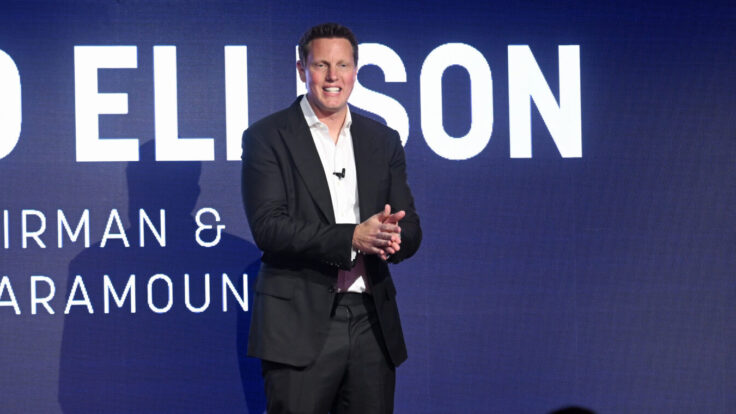
After my Zoom with Tara concluded, I rang Bill back and asked for the download. Yes, he said with certainty, a funny thing had happened on the way to the Forum. Bill had just been working the phones and learned that the complex transaction between Redstone’s National Amusements Inc. and the combined forces of David Ellison’s Skydance and Gerry Cardinale’s RedBird was collapsing on the one-inch line. And the reasons for the demise, Bill said, were utterly Shakespearean.
Some people around the deal believed that Charles Phillips, a former president of Oracle and current Paramount director, had given Shari cold feet. They wondered if Phillips was jonesing to take over Paramount, himself. (The company is currently run by an entirely untenable three-man interim “office of the C.E.O.” structure.) Others were curious if he was exacting retribution on the Ellison clan over his departure from Oracle years earlier. Either way, Bill reminded me, most deals die with age. And this latest twist was going to kill this thing off, once and for all. That afternoon, the Journal published a terse report acknowledging that Redstone was walking away from the deal for noneconomic reasons. (Our inimitable partner Matt Belloni broke the news of Phillips’s last-minute antagonism.)
Bill, who has been chronicling the Redstone family’s dysfunction for years, was actually putting the finishing touches on an excellent story about David Solomon’s turnaround at Goldman Sachs. But we eventually decided that that story would have to wait a couple days. (You’ll be able to read it in Dry Powder, Bill’s private email, tomorrow. Sign up here.) Instead, we reckoned that Bill should report out the devolution of the Paramount deal in all its gory particulars.
Shari-Kiri, the resulting story, is a masterpiece that details the economic challenges of the deal. Even with the $2.3 billion that Redstone would have received for NAI, Paramount’s parentco, she would still have to pay off around $200 million in bank debt, plus the $175 million in preferred stock she owes BDT & MSD Partners, her financial advisor on the sale. The remaining $1.9 billion would be divided between her and her late father Sumner Redstone’s five grandchildren, and subject to significant tax consequences. And then there would be a smorgasbord of shareholder lawsuits. “It was ugly,” one longtime family observer told Bill. “Like, scary ugly.”
Bill’s piece also captures the underappreciated psychological elements of the deal, like Redstone’s insecurity about her place in the mogul firmament, post-Paramount. Would she lose her booth at Dan Tana’s? Would she still be the belle of the ball at the Allen & Co media conference? Could she part with the heirloom that she had fought so hard to inherit?
Meanwhile, Matt was also cooking up a second epic Redstone dispatch. Shari Redstone Hasn’t Solved Her Biggest Problem: Shari Redstone is a remarkable, insiderly tour de force that conveys that damage she wrought on Paramount during this extended sales process. “It’s kinda amazing that the public market values Paramount—which includes the long-term NFL contract, all those movie and TV franchises, two growing streamers, and the still-big cable TV cash flow—at merely $7.2 billion, not including that debt,” Matt wrote. “Remember, Paramount turned down $3 billion for Showtime, a brand it instead chose to murder, execution style, by starving it of content and folding it into Paramount+. Now the whole company is worth just two Showtimes and change. Remarkable.”
If Puck’s industry-leading coverage of the Paramount debacle isn’t your thing, I’d turn your attention to Tara’s excellent story. After we hopped off the Zoom, she set down to write a characteristically cogent and witty piece, The Doug Bug, chronicling the new Burgum-Trump bromance. In and around Mar-a-Lago, sources told Tara, Burgum has become known as “Default Doug”—an apparent knock that actually counts as high praise in those quarters. “Doug Burgum does no harm. Trump needs someone who is sure-footed and would not contradict or upstage him, someone who understands he will not try to be the next future of the party,” a Trump advisor told Tara. “I think he may get it by default. Everyone else has a major flaw.”
These stories of our time remain as unpredictable as ever. All that’s certain is that you should expect to read about them in Puck.
Have a great weekend,
Jon |