Welcome back to a jam-packed What I’m Hearing that contains exactly zero Blake Lively or Justin Baldoni. Here in L.A., I think we’re all still pretty consumed by the fire aftermath. Even as winds die down and evacuation orders lift, air quality is still a preoccupation. (I’ve been using this site to monitor particulates.) Amid it all, Hollywood chugs along. To that end, Academy voters: Don’t forget to fill out your Oscar ballots by 5 p.m. tomorrow.
Reflecting this weird moment, tonight I’ve got some original reporting on Netflix’s big Greta Gerwig movie, Ben Stiller’s cost overruns on Severance, and what might end up being the movie flop of the year. Then I corral Puck political writers Peter Hamby, who you know if you are young and watch his popular Snapchat show Good Luck America, and John Heilemann, who you know if you are a little… less young and watched Showtime’s The Circus or MSNBC on any given day. The three of us have a frank debate about the fire fallout: personal, political, and for the business of L.A. and entertainment.
BTW, Peter and John write for Puck’s political newsletter, The Best & The Brightest, which you get for free as a WIH subscriber. Add it here. Got a news tip? Reply to this email or message me on Signal at 310-804-3198.
Let’s begin…
|
- Greta’s Netflix-Imax deal in detail: Remember today’s edition of What I’m Hearing—it’s when Netflix co-C.E.O. Ted Sarandos finally and officially agreed to an exclusive Imax run for Greta Gerwig’s big-budget Narnia movie, based on the Chronicles of Narnia books by C.S. Lewis. Netflix tells me the film will hit about 1,000 Imax screens worldwide on Thanksgiving Day 2026 and will not appear on Netflix until Christmas. That’s a four-week window of global exclusivity, though Imax has only guaranteed to play the film for two weeks. A third week could be added based on demand, and there’s a chance the movie could go to some non-Imax theaters before it drops on Netflix. Plus—and this was a key concession—Netflix has committed to market the Imax release like a typical theatrical tentpole movie and identify Narnia as a “Netflix/Imax” title from the outset. Gerwig will shoot the movie using both Imax and regular cameras for the dual release.
A big, precedent-setting deal months in the making, negotiated mostly between Netflix’s chief content officer Bela Bajaria, Imax C.E.O. Rich Gelfond, and Gerwig and her team at UTA and the Johnson Shapiro law firm. Multiple stakeholders weighed in, including theater owners, who initially weren’t thrilled at the prospect of an Imax theatrical exclusive but came around once they understood that the alternative was no theaters. But the big yes was from Sarandos, whose desire to placate a major filmmaker ultimately trumped his religious aversion to the multiplex (beyond the streamer’s token awards-qualifying and promo runs).
To me, this seems like a win-win; Ted can distinguish Narnia as merely an Imax aberration/stunt, in the process pleasing a red-hot director (and her producers: Amy Pascal, Mark Gordon, and Vincent Sieber) at a time when Netflix has lost a few big projects over the theaters issue, while “eventizing” a piece of I.P. that Netflix hopes will become a major franchise for the service. And Gerwig gets a guaranteed theatrical release in 90 countries for her Barbie follow-up (China censors must first clear the movie, and France has its own windowing rules), plus marketing muscle that Netflix films often go without, as well as the chance to create a cultural moment that extends beyond the walled garden of Netflix. Glass Onion: A Knives Out Mystery played in 700 theaters for five days over Thanksgiving 2022 before arriving on Netflix for Christmas. Gerwig did much better than that for her Narnia. The only question now is: Which other filmmakers will demand and receive the “Greta treatment”?
- There’s no business in monkey business: In less-positive news, I’m sorry to report that filmmaker Michael Gracey has violated a sacred tenet of Hollywood: He put his own money into Better Man, the disastrous Robbie Williams biopic starring a CGI chimpanzee that somehow cost $110 million to produce and opened to just $1 million domestic in 1,200 theaters. Gracey (The Greatest Showman) is one of six main investors cobbled together by producer Paul Currie, CAA Media Finance, and Australia’s Elevate Production Finance, including the Victorian government there. It’s unclear how much Gracey contributed to the R-rated anthropomorphic chimp pic (his rep declined to comment), but we know Paramount burnt $25 million on North American rights, in part because the studio is developing another, presumably more commercial movie with Gracey, Nevermoor. And Nigel Green’s Entertainment Film Distributors, which released the film in the U.K., where Williams is a major star, actually paid more for rights. Alas, Better Man has grossed only $6 million there, despite great reviews, becoming an early contender for flop of the year.
- ‘Severance’ studio stuck with Stiller’s bill: Pity Fifth Season, the independent studio formerly known as Endeavor Content, which saw most, if not all, of its profit from the about-to-debut second season of Severance wiped out by massive budget overruns. As I reported nearly two years ago, producer-director-bully-auteur Ben Stiller presided over an extraordinarily chaotic production, including scrapped storylines and sets; a marginalized producer; a hired-hand showrunner, Beau Willimon, who came in to help right the ship (and who quietly signed a first-look deal at Fifth Season); and Covid and strike shutdowns. All of which led to tens of millions of dollars in overages, about $20 million to $25 million of which Apple TV+ then passed on to Fifth Season, per multiple sources. Ouch. (Apple and Fifth Season declined to comment.)
Keep in mind that on a “cost-plus” show like Severance, a studio can typically hope to clear 2 million to 3 million bucks per episode. Do the math on the 10-episode season, and Fifth Season will be lucky to make much for its considerable trouble on Severance. Fortunately, the season turned out fine—it’s at a strong 83 on Metacritic—and if the audience and awards come back despite a nearly three-year hiatus, Apple will likely jump back into bed with Stiller and his weary studio partner.
- Box office over/under: Blumhouse’s stab at Universal’s Wolf Man property is tracking to about $20 million for the four-day weekend. That’s less than the $28 million for its similar Invisible Man over three days in pre-Covid 2020, so I’ll take the over. I’ll also take the over on $10 million for Sony’s Keke Palmer comedy One of Them Days, if only because SZA is in it.
|
|
Okay, now on to our chat about the fires and their aftermath…
|
|
|
|
An intimate conversation on the political, media, financial, and
Trumpian dimensions of the fire, and what it means for Hollywood, Bass, Newsom, Iger, and millions of Angelenos.
|
|
|
The aftermath of the devastating fire in Los Angeles has become a story defined by politics (local and national), the media, tech platforms, powerful moguls, and Hollywood itself, given the location and the number of entertainment people who have been impacted. On account of that unusually potent mix, and considering that Donald Trump’s second inauguration is taking place on Monday, I wrangled two of my Puck partners— Peter Hamby, who lives in Venice Beach and wrote about the local political situation on Monday, and John Heilemann, who grew up in L.A. and has covered national politics for decades—for a frank conversation about next steps. We discussed who in Hollywood might emerge as a leader in the recovery, and whether the new administration in Washington will help or hurt that effort, among other topics. Our edited conversation is below.
|
Matthew Belloni: First of all, can we all welcome Donald Trump’s newly appointed “special ambassadors” to Hollywood: Jon Voight, Sylvester Stallone, and Mel Gibson? Quite a trio. Maybe one of you can tell me what a “special ambassador” does?
John Heilemann: Given the composition of this troika, the only viable answer in the 10 years prior to November 5 would have been: Get canceled. But a new age is apparently dawning, Matt, and given what we’ve seen of it so far, I’d guess the answer now would be: Whatever Trump tells them to.
Peter Hamby: I figured R.F.K. Jr. would be his special ambassador—if not to all of Hollywood then at least to the testosterone replacement therapy scene at Gold’s Gym in Venice.
Matt: Okay then. Besides bashing Gavin Newsom and questioning the work of firefighters, Trump hasn’t engaged much on the L.A. fires. Newsom even baited Trump with an invite to tour the disaster areas, and he didn’t bite. But as of next week, the recovery of the country’s second-largest city will be the new president’s problem—if he chooses to try to solve it.
John: That’s a rather large besides, brother—and he’s also attacked Joe Biden, Karen Bass, and California’s environmental policies, along with spewing his usual stream of misinformation and general-purpose bullshit about everything from how faucets work to the source of rain (“from heaven,” our once-and-future president proclaimed the other day).
But your broader point is spot-on: From the moment Trump takes the oath of office at precisely noon eastern time on Monday, the fallout from the L.A. fires will be squarely on his plate. Whether his approach (and that of his G.O.P. allies in Congress) turns out to be constructive or destructive is the real question—but given the scope, scale, and cost of the recovery effort that’s going to be required, he (and they) won’t have any choice but to deal with it.
Peter: People are forgetting that Trump and Newsom jousted a lot back in Trump’s first term, when Newsom was also in his first term as governor. But they still found ways to work together when it came to federal aid and brass tacks. Remember, California had to deal with major fire disasters in 2018, 2019, and 2020—along with floods and, of course, the pandemic. I went back and looked up one meeting they had in Sacramento, in 2020, after another outbreak of wildfires. Trump told the cameras, “We’ve been working very well with Gavin. We’re obviously from different sides of the spectrum, but we have a very good relationship.” Newsom responded diplomatically and said, “I want to thank you and acknowledge the work that you’ve done to be immediate in terms of your response.”
Just last year, on the campaign trail, Newsom would lash Trump on certain political issues, but he also went out of his way to say that he approached Trump with “an open hand, not a closed fist” when he was president the first time. Anyway, I think these two both have to do the requisite political posturing to play to each of their base constituencies, but as John said, Trump knows he can’t just ignore the nation’s most populous state, and Newsom knows he has to work with the White House to keep the federal spigot on.
I also have a hunch that Trump kind of respects Newsom, even if he doesn’t like him. Newsom isn’t a pushover. He’s a showman in his own way—remember that Fox News debate with Ron DeSantis?—and he’s maybe the most famous Democrat in the country aside from Kamala Harris.
Matt: The right-wing media and Fox Newsers have been urging Trump to ignore the devastation or hold further aid hostage. Jesse Watters, for instance, said there have to be “strings attached” to relief funding: “Are we just going to keep destroying Western civilization and then paying to rebuild it over and over again?” Weird, I don’t remember Watters making similar comments after the recent hurricane disasters in North Carolina or Florida.
John: The idea of putting conditions on future aid out of D.C. is spreading like, ahem, wildfire among House Republicans—and not just whack-job MAGA backbenchers. Speaker Mike Johnson has repeatedly said that there should be strings attached to forthcoming federal dollars for L.A. recovery efforts, arguing that California “state and local leaders were derelict in their duty in many respects.” So now there’s talk about linking aid funding to everything from raising the debt ceiling to changes to California’s water policies, land management practices, and even its tax code.
This is sheer lunacy, of course. And, as you point out, Matt, hypocritical lunacy at that. But while I generally bow to no one in laying blame at the feet of Jesse Watters—who, in any just universe, would long ago have claimed the title Trump inaccurately bestowed on Don Lemon as the “dumbest man on television”—the source of the conditioning-aid concept isn’t Fox News. Nor is it the right-wing social media sphere, though Elon Musk has done his level best to popularize the malignant notion that D.E.I. (specifically, the L.A. Fire Department’s “racial equity action plan”) is to blame for the blazes in L.A.
No, the wellspring of the notion of using the pain and suffering of hundreds of thousands of innocent Angelenos as leverage to impose MAGA-friendly policy changes is Trump. As Newsom pointed out the other day on Pod Save America, 45/47 has a well-documented history of threatening to withhold disaster relief from states in need. And just this past fall, at a rally in Coachella, Trump laid out the approach he would take with Newsom going forward: “We’re going to take care of your water situation, and we’ll force it down his throat. And we’ll say: Gavin, if you don’t do it, we’re not giving you any of that fire money that we send you all the time.”
Peter: I wonder what Speaker Johnson would say if a hurricane had swamped Louisiana last year and President Biden or Nancy Pelosi said they shouldn’t get federal aid because of the state’s abortion ban? It’s honestly disgusting to politicize disaster relief. These are Americans of all races, incomes, and backgrounds.
But if Republicans want to make it political, I’ve got some inconvenient facts for them about California. As blue as it is out here, there are more Republicans in this state than any other. The state shifted three or four points in Trump’s direction last November compared to 2020. And the city of Los Angeles, itself, is even more Republican than it was four years ago. Trump made gains in L.A. County among Latinos, Persians, Jews, you name it. There are even some Republicans up there in Malibu and the Palisades who lost their homes—and there are definitely a bunch of Rick Caruso voters there who despise Bass and Newsom.
Another thought for Speaker Johnson: Many members of your barely there Republican majority come from California, including Ken Calvert in Riverside County, who was boosted to victory by that aforementioned Coachella visit. There was a fire that popped off in Riverside County just a few days ago! Thankfully, it was knocked down quickly. But there will be more—in Kern County, in Orange County, and other G.O.P. pockets of the state. Nature doesn’t care about your politics, and federal disaster aid shouldn’t either.
|
The Disinformation Jungle & The Bass Question
|
Matt: What, if anything, can be done about the widespread misinformation online that’s warped so many people’s perceptions of the fires and the response to them? John mentioned Elon and others blaming D.E.I. programs, and millions of people think it’s true. Or that illegal immigrants are to blame. Or the homeless. One big talking point has been that Democratic leaders let the Resnicks, the billionaire farming moguls, “hoard” water that should have gone to firefighting. That was debunked, and when Elon showed up to bait firefighters into saying there wasn’t enough water, the firefighters themselves said there was enough. The water pressure issue, the fire department budget, and the dry reservoir in the Palisades—all those questions are totally legitimate, but it’s shocking to me how fast the fires were politicized.
John: I’ll let Peter run with this one, since he’s way more online than I
am—and there’s at least a tiny chance he has something more hopeful to say about the future of social media than I do, now that X is the functional equivalent of a 19th century open sewer system, and the recent changes announced by Mark Zuckerberg seem destined to turn Facebook and Instagram into similarly toxic cesspools. But I will say this, Matt: The old William Goldman line about how nobody knows anything may still be true in Hollywood. But those of us who swim around in the political culture for a living do know one thing—or two things, actually: In America in 2025, anything and everything that can be politicized, will be politicized (almost instantly); and there’s really almost nothing that can’t be politicized, if you’re willing to make the effort.
Peter: I don’t have much optimism on the social media front, John! Zuckerberg’s pandering tells you all you need to know. As far as I can tell right now, Apple and Snapchat (where I work) are the only two Big Tech companies that still make an effort to curate a trusted information environment and put up certain guardrails around junk news and misinformation. On that note, I really get a kick out of young progressives, Squad members, and Democratic Senators like Ed Markey and Cory Booker making a brave final stand for TikTok, even though the app is polluted with fake-news garbage and conspiracy theories—including that debunked Resnick water conspiracy, which made it all the way to Emily Ratajkowski, who shared it on her TikTok account to 2.7 million followers.
Joe Biden warned about the dangers of fact-agnostic social media platforms and the erosion of our media universe in his farewell speech on Wednesday. People can roll their eyes at the old man, but he’s not wrong. I’m also told that in evening remarks to White House staffers after his address on Wednesday night, Biden said, “We have to be able to have a vehicle for people to get the truth.” I don’t know exactly what that means, and Biden could have been talking about what he perceives is unfair treatment by the Washington press corps. But moving forward, if there’s going to be any regulation of these big platforms, it’s going to come from Europe or Australia or wherever, because it’s definitely not coming from Trump or his sycophant tech execs who will be joining him on the inauguration dais come Monday.
Matt: Then there’s the Karen Bass question. A lot of Hollywood people reached out to me after reading Peter’s piece from Monday night to say they voted for Bass, but she should resign after failing to meet this moment. John, do you agree she’s cooked?
John: I don’t know if I’m ready to stick a fork in Mayor Bass quite yet. California recalls are incredibly easy to undertake, but historically they’ve failed more often than they succeeded. Why? Because recall elections are almost by definition situational, quirky, idiosyncratic, and often feature splintered oppositions and poorly organized, meagerly funded replacement candidates.
Matt: But Rick Caruso, Bass’s chief antagonist, is not exactly hurting for money.
John: True, but given the size and timeline of the recovery efforts that will consume L.A. for months to come, any Bass recall could take a while; more than long enough, that is, for the political winds to shift as dramatically as the Santa Anas. None of which is to say I think Karen is off the hook. Indeed, I’d bet every dollar in your pocket, Matt—and in Peter’s, too—that there will be a Bass recall election. But it’s too early to consign her to the departure lounge just yet.
Matt: Caruso is on Bill Maher’s show tomorrow. I imagine her and Newsom’s names might come up.
Peter: Bass is going to get absolutely annihilated on that show. Maher already previewed his Friday monologue to TMZ and said it’s going to be about Newsom and Bass. “We should demand better,” he told Harvey Levin. I’m sure Maher will give Caruso all the runway he wants to dump on the mayor.
On the recall front, the signature threshold in the city of Los Angeles is slightly higher than it is for a statewide recall. You need 15 percent of the city’s roughly 2 million eligible voters to put down verified signatures on a recall petition. You can do it in four months—the signature window—but it’s a tall order to ask for a recall when there’s already an election next year. I think Bass is all but certain to lose, and you can read all the reasons why in my piece from Monday. Julia Wick of the Los Angeles Times also scooped on Wednesday that there are photos of Bass gripping and grinning at a cocktail party in Ghana while the Palisades burned.
The question I have is: Does Bass even run again? She’s already declared for reelection, but the mayor is gonna get some polls back in a few weeks or months that will tell her all she needs to know. Another question: Does Caruso run for mayor or governor, because I know he’s been making calls about the latter option for a while now. If Caruso doesn’t run for mayor, I can see Traci Park, the centrist city councilwoman from the Westside, jumping in as the fund-the-firefighters and clean-up-L.A. candidate.
|
John: Matt, I can’t believe we’ve gotten this far without hearing from you on what Hollywood’s role will be in recovering from this nightmare.
Matt: Well, to start, nobody’s really working much. I mean, the west side of the big CAA “Death Star” building in Century City looked directly out at the Palisades fire last week. People in the evacuation zones or with the means went to Orange County, Palm Springs, Santa Barbara. Others just stayed home. Everyone’s trying to help where they can, whether it’s offering friends a place to stay or donating clothes or money or volunteering. The business has slowed. Meetings have been canceled, offices are half-empty. Very Covid-y.
John: I guess there are really two separate questions: What do the leaders of the entertainment industry think their role will be as we sit here today? And what do you think their actual role will be in the fullness of time—once the ongoing fire threats and immediate sense of horror has receded, and the DEFCON 1 urgency of the disaster fades a bit, and the long hard slog of recovery and rebuilding begins?
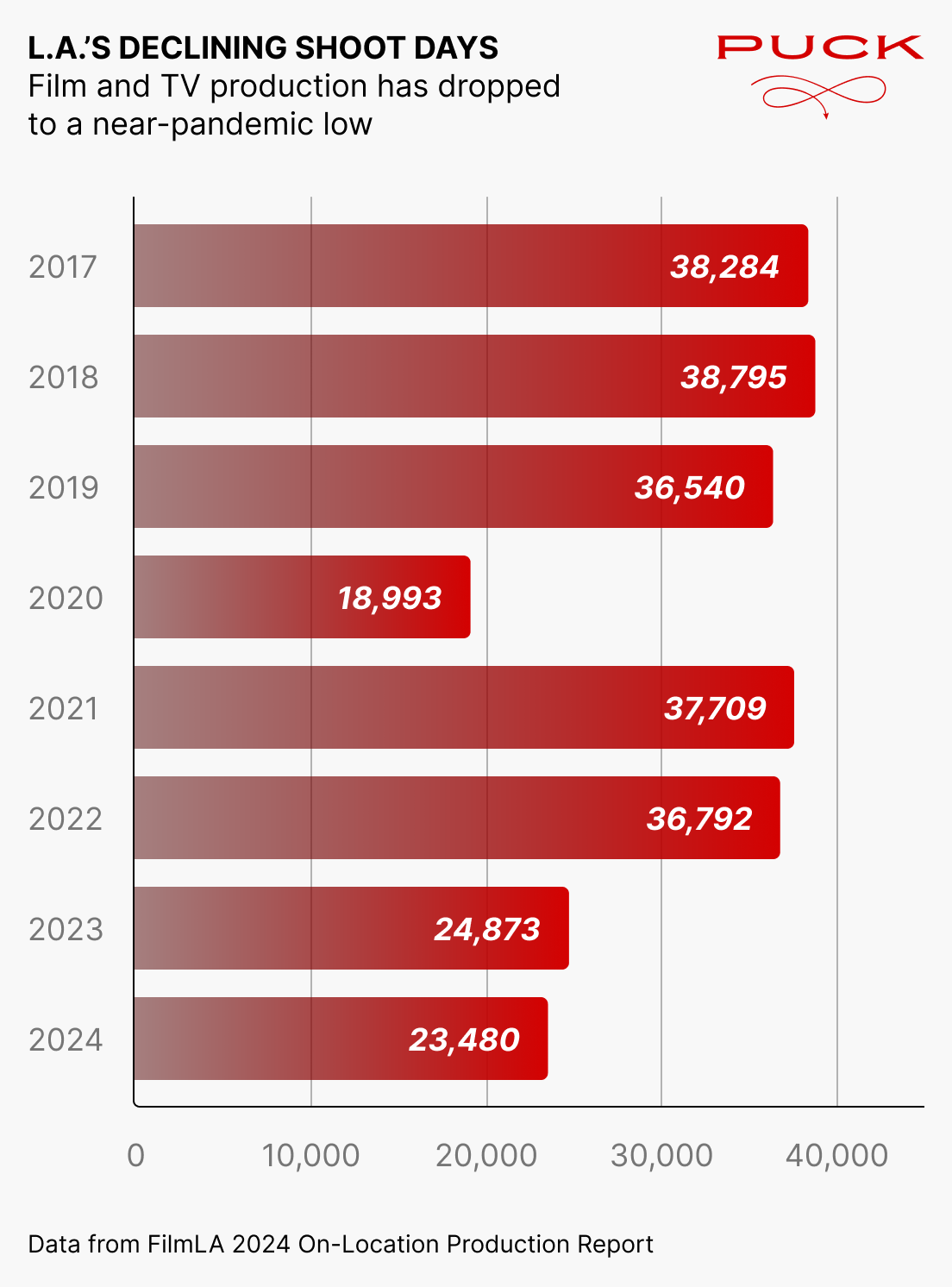
Matt: I think Hollywood will necessarily be a major catalyst of the recovery. Brooks Barnes made a good point in The New York Times: Neither the studio lots nor that many of their productions have been impacted—because nearly all Hollywood content is now produced elsewhere. Here’s the most relevant chart:
|
So the best way these entertainment business leaders can help L.A. recover is to help the industry recover in L.A. Both the Palisades and Altadena areas are big hubs for entertainment people, but will they stay? I’ve already heard the We’re outta here sentiment from one industry friend who lost everything. (For the record, I’ve heard the No way are we leaving sentiment a lot more.) Local jobs and opportunities are the best way to keep this industry from scattering, and that’s something the government can work with industry leaders on. But it takes money and initiative.
John: What do you think that kind of collaboration would look like? How would it work? On the Hollywood side, who might lead it? And are people already out there talking about this in practical, pragmatic, programmatic terms—or is it still too soon for that?
Matt: So far, only Bob Iger at Disney has publicly gone beyond the immediate disaster relief. “We want to help rebuild,” he told The New York Times. “Can we help in setting up temporary schools? Can our Imagineers help design new town centers? Rebuilding is not just about money. It’s about ingenuity and determination.” That sounds like Iger wants to be more involved—remember, he considered running for president at one point—though all the major studios, streamers, and tech companies have stepped up with varying donations to the recovery.
California may soon pass a tax credit package valued at $750 million, which would help a little in luring back productions. But practically speaking, it’s not nearly enough to compete with places like Georgia or the U.K. The benefit of one-party rule in California is that Newsom, Iger, and other leaders could do something, if they choose. A few months ago, a very smart executive sent me a good nine-point blueprint to help keep productions big and small in town. These suggestions are wonky but they feel a lot more urgent now, so I’ll include them:
|
- Get the base rebate rate for films under $25 million to at least 30 percent before uplifts.
- For films under $25 million, allow producers to elect to sell the credit to third parties or get a refund over three years, which will unlock the ability to finance the incentive in the commercial bank markets. Allow the sale to third parties to work like the Georgia system, where it can effectively be syndicated to many buyers.
- Qualify above-the-line spending (meaning fees for stars and filmmakers), including writing steps that were paid within some reasonable period prior to qualification, subject to some per-person and percentage-of-budget caps.
- Create uplifts for hitting diversity, apprenticeship, and jobs-ratio targets.
- Qualify contingent compensation like the U.K. scheme does, to incentivize more producers and platforms to give it.
- Figure out some way so that qualification can happen at any time during the year instead of in set windows.
- Apply the above to television projects with gross budgets under like $6 million or $7 million per episode.
- Create chained uplifts for sequels and subsequent seasons. That means for each initial film or TV series that qualifies for the credit, an extra 2.5 percent for each sequel or season that shoots in California, up to some cap. If you don’t qualify for the credit in any subsequent season, the uplift chain breaks. That incentivizes platforms to re-up California projects, and for producers to keep them here.
- Lastly, they should consider introducing a postproduction and visual effects credit for projects that spend at least 80 percent of the post and/or VFX spend here. That part of the pipeline is the next to leave, especially once it’s impacted by A.I. Incentivize innovation and companies to be here instead of offshore.
|
California has so far refused to compete, but if Newsom is serious about a Marshall Plan to rebuild L.A., aggressively courting back the industry that the city invented and dominated for decades would be a great start. Not a bad legacy for him or Karen Bass or Rick Caruso or any of these politicians who have been making speeches.
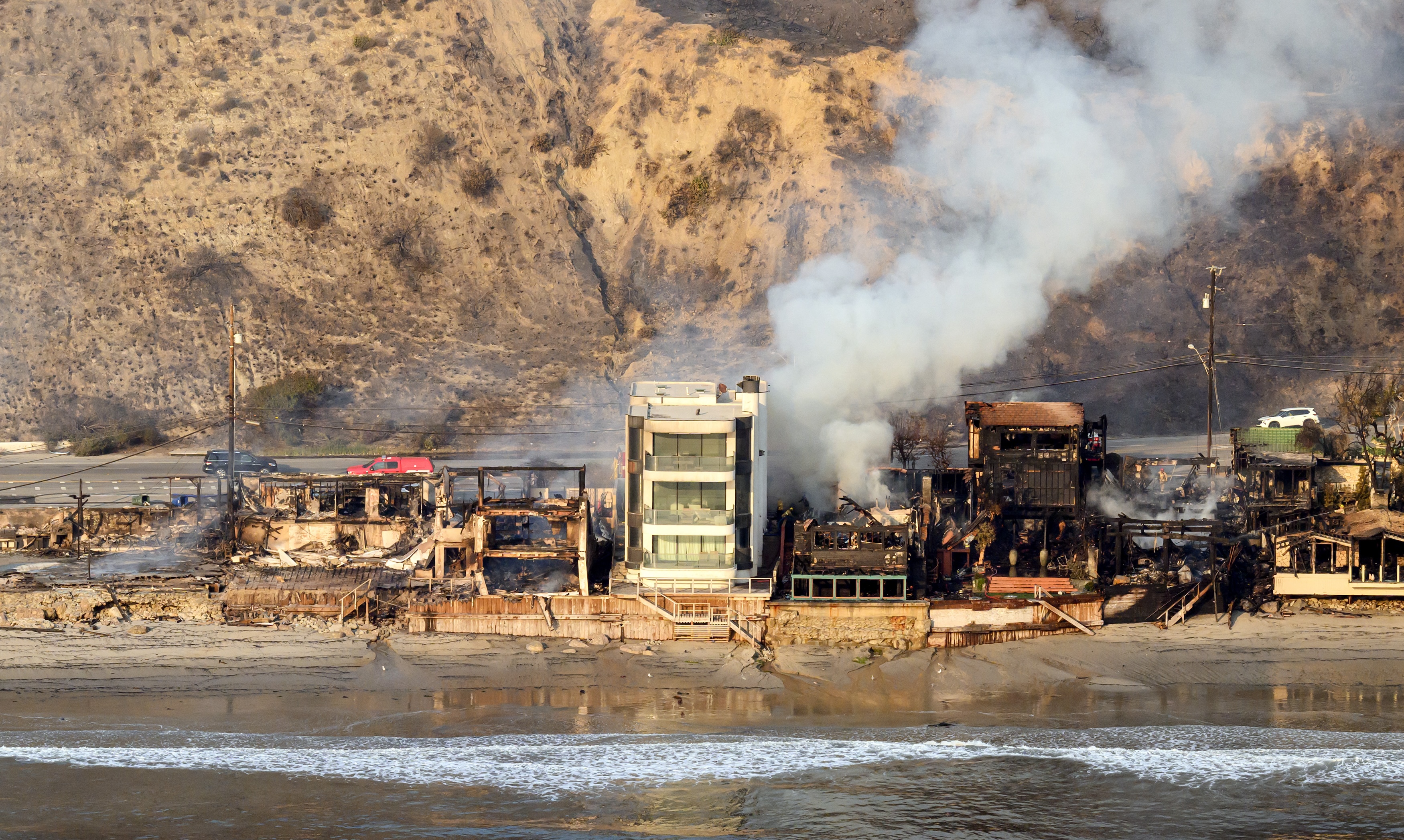
John: Wow, Matt, that’s quite an agenda—maybe Trump should fire those other three guys and name you as the special ambassador to Hollywood. Before we sign off, guys, as you both know, I grew up in the Valley and have a million friends in L.A.—and the experience of texting with them nonstop for the past week-plus while watching the apocalyptic footage play out on cable has been about as traumatizing as anything could be from 3,000 miles away. Also: just entirely surreal. The other day, the New York Post ran this picture of a house on P.C.H. in Malibu that the fires had somehow miraculously skipped over:
|
|
Photo: Josh Edelson/AFP/Getty Images
|
|
And I realized I’d actually lived in this place for several months back in 2011, when I was a house guest of the guy who owned it then, a close pal of mine from college!
I mention this because, amid all the tragedy of the past two weeks in the city the three of us love so much, there have also been the occasional flashes of hope, or courage, or blind shithouse luck—and reminders of the astonishing resilience in the face of natural calamities, from wildfires and earthquakes to coastal mudslides, that has marked L.A. from the jump. And I’m wondering if y’all could share some observations about what you’ve witnessed up close in the past fortnight that’s reinforced your sense of why, even now, you still wouldn’t live anywhere else?
Matt: The overwhelming amount of giving and charitable activity has been a really welcome surprise, especially given L.A.’s reputation for detached insouciance when it comes to local community issues. Some of the shelters and supply drop-off centers have been turning away donations because they are full.
Peter: Yeah, I’ve talked to a lot of L.A. pals who aren’t from here originally—people who are out there helping friends and strangers alike—who told me this is the first week they’ve actually felt like a real Angeleno. The unity across the city and county right now is heartwarming, even amid the sorrow. I hope it lasts, because we’ll be feeling the downstream effects of these fires for years to come.
|
See you Monday,
Matt
Got a question, comment, complaint, or want to donate to L.A. fire relief?
Go here or email me at Matt@puck.news or call/text me at 310-804-3198.
|
|
|
|
Puck founding partner Matt Belloni takes you inside the business of Hollywood, using exclusive reporting and insight to explain the backstories on everything from Marvel movies to the streaming wars.
|
|
|
|
Puck’s daily political newsletter from Washington—featuring Tara Palmeri, Julia Ioffe, Peter Hamby, Tina Nguyen, Abby Livingston, and chief political columnist John Heilemann—on what’s really happening in this town, from the White House to the Pentagon to Capitol Hill, K Street, and the campaign trail.
|
|
|
Need help? Review our FAQ page or contact us for assistance. For brand partnerships, email ads@puck.news.
You received this email because you signed up to receive emails from Puck, or as part of your Puck account associated with . To stop receiving this newsletter and/or manage all your email preferences, click here.
|
|
Puck is published by Heat Media LLC. 107 Greenwich St, New York, NY 10006
|
|
|
|