Welcome back to What I’m Hearing...
Hello again. A reminder that I love hearing from readers, and I always respect confidentiality. Just email me at matt@puck.news, DM me on Twitter at @MattBelloni, text me at 310-804-3198, or ask me for my Signal info.
Discussed in today’s email: Bob Bakish, Ava Duvernay, Jeff Zucker, Ben Silverman, Alan Ladd, Jr., Drake, John Malone, Dolly Parton, Reed Hastings, and Putin’s ‘girlfriend.’
Who Won the Week: Toby Emmerich and Walter Hamada
Yes, a Batman movie is pretty much a sure thing, but the leaders of Warner Bros.’ motion picture and DC units must love the timing of the $248.5 million global debut of The Batman–especially considering that incoming Warner Bros. Discovery C.E.O. David Zaslav is currently deciding their futures at the company.
Today’s announcement that Netflix is shutting off its service in Russia came as I was looking into the company’s deal with the country’s National Media Group…

Reed Hastings and Ted Sarandos’ deal with a Russian media partner tied to Vladimir Putin was already deeply controversial inside Netflix, even before Putin invaded Ukraine. Back in early 2020, Netflix was deciding whether to go all-in on Russia. At the time, the streamer offered only a very limited product in the territory. But a proposed deal with the country’s National Media Group, the Kremlin-friendly media association, would potentially supercharge its effort, allowing for popular regional shows, payment options in rubles, and Russian subtitles.
Given its goal of becoming a truly global service, the Russia push made strategic business sense, despite the radioactive politics associated with the move. But three Netflix sources tell me that the NMG aspect of the move was very controversial internally, and was hotly debated. Several top executives, including Cindy Holland, then the company’s V.P. of original content, sounded alarm bells in multiple meetings about NMG’s especially close ties to Vladimir Putin. The topic was discussed generally among executives, including at V.P. level get-togethers, which included co-C.E.O.s Reed Hastings and Ted Sarandos.
Ultimately, Hastings and Sarandos decided to do the deal anyway. It was announced in September 2020, and Netflix has since generated less than 1 million members in Russia. So today, when the company announced that “we have decided to suspend our service in Russia” due to Putin’s invasion of Ukraine–on the heels of refusing to comply with a local propaganda law and pausing Russia-based productions–there was a bit of a told-you-so feeling coursing through some people internally. (Netflix declined to comment beyond its statement, and Holland, who left the company in September 2020, didn’t respond to a request for comment.)
Most major companies do business in Russia, of course—or did, until this week, when, one by one, global brands like Apple, Boeing, Ford and all of the Hollywood studios pulled their products and canceled joint ventures. For some at Netflix, the retreat was a long time coming. Foreign media companies must partner with a local outlet to comply with Russian law, and it’s hard to operate in that country without enduring some connection to Putin. Other U.S. media outlets, including Discovery, have run channels with NMG, which operates tons of media assets in Russia.
But NMG isn’t just any Russian company. Its founder, the oligarch Yuri Kovalchuk, is particularly close to Putin, who has publicly called Kovalchuk a personal friend. He’s been described as “Putin’s banker,” “Putin’s pal,” and even the second most powerful man in Russia. "He has never held any government position, but he's obviously one of the most influential personalities in Russia and he is ideologically very close to Putin," the journalist Mikhail Zygar, who wrote All the Kremlin's Men, recently told Sky News.
Then there’s Alina Kabaeva, the former Olympic gymnast and “Russia’s most flexible woman,” who is said to be Putin’s longtime girlfriend. Kabaeva was appointed as chairman of NMG in 2014, and has been paid more than $10 million a year for her services, according to the Times of London. “Although Ms Kabaeva, who is often referred to as Russia’s ‘secret first lady,’ had previously hosted a television chat show entitled Steps to Success, she was not known to have had any experience in media management when she was appointed to the post,” the Times wrote in 2020. Just this weekend, Page Six reported that Kabaeva was living in Switzerland with four of Putin’s children.
The Putin links to NMG were all well known by Netflix executives, I’m told. But, hey, it’s Russia: the options are limited, and the deal is said to have been structured to avoid deep entanglements. Netflix provided the content and technology, but there was no local office or staff, and it wasn’t an official joint venture, whatever that means. The arrangement enabled Netflix to avoid some of the country’s censorship laws; content like the Oscar-nominated Ukrainian documentary Winter on Fire and LGBTQ-centric shows remained on the service there. It’s also how Netflix could avoid complying with a new regulation that required carriage of state-run broadcasters. But that’s all moot now, as Putin proved too hot for even Netflix to handle.
Quote of the Week
“Respectfully, and I had no part in the decision, but the word ‘excluded’ is a powerful one for many … I think it’s important to call things by their right name so as not to minimize the meaning of true exclusion in these spaces.”
–Ava Duvernay, the filmmaker and Academy governor, responding to the uproar over the pre-taping of eight Oscar categories, which prompted Mark Harris, the author and vocal Academy critic (and husband of West Side Story screenwriter Tony Kushner), to respond on Twitter: “Respectfully, seizing on the word ‘exclusion’ in order to change the subject does not speak to the substance of the complaint.”
The Inside Conversation: Shari’s Choice, Zaslav’s CNN, & Hollywood’s Russia Problem
It’s been a dramatic couple of weeks as the soon-to-be Warner Bros. Discovery grappled with an abrupt leadership change atop CNN, ViacomCBS rebranded as Paramount Global, and the Ukraine invasion rippled worldwide. So I went back and forth with my Puck partner William D. Cohan, who writes the Dry Powder private email, to debate what it all means for Hollywood and Wall Street…
Matt Belloni: Bill, you floated in a column that the recently exited CNN president Jeff Zucker might be a good fit to run Paramount Global (the former ViacomCBS). Not sure I agree with that. Zucker had some stumbles as C.E.O. of NBC Universal from 2007-2011. I remember when he put the erratic Ben Silverman in charge of NBC, which everyone knew would be a disaster. (It was.) And he engineered the botched Tonight Show transition from Leno to Conan and then back to Leno, and he wasn’t exactly loved by his bosses at the end. What makes you think Shari Redstone needs Zucker?
William D. Cohan: Well, Matt, Paramount needs to do something, anything to make it relevant to a potential acquirer. That’s got to be Shari’s main goal after years of financial engineering. She has to prove to her family that wresting the company away from her father Sumner and recombining CBS and Viacom—all pretty much against his previous wishes—was worth it. Her chosen leader, Bob Bakish, has done little, if anything, to improve the Paramount Global share price. Since he took over the combined company in December 2019, the stock is down nearly 14 percent (and that includes last week’s surprising 18 percent jump), at a time when the S&P 500 index increased 39 percent. Some say that Bakish deserves credit for merging these complex entities and refocusing on its streaming services, but these are simply the baseline requirements of the job. So Bakish is not exactly inspiring confidence.
Belloni: But that’s Bakish. What makes you think Zucker could be the solution?
Cohan: Zucker is exactly what Paramount needs: He’s an annoying micromanager who commands great loyalty and can run a news division (CBS News, check), a streaming business (Paramount +), TV channels (Showtime and CBS), and even a movie studio (Paramount proper). I’m not saying he’s Bob Iger, or even Steve Burke, and he has his flaws, but hiring Zucker would create huge buzz at Paramount—and some brief headline risk, too, but Redstone can easily deal with that. It would also generate momentum toward Shari’s goal: a sale, at a valuation well north of the $22 billion the company sits at now. By the way, Jeff Immelt, Zucker’s boss at G.E., loved him; it was his new masters at Comcast—and Burke in particular—that pulled the plug on Zucker’s reign at NBCU.
Belloni: So you’re convinced Shari is actively hunting for a sale. I agree, but some still think she hasn’t resigned herself to that fact yet. And to get the deal she wants, she’s going to need to improve the company’s financial performance, not just its streaming subs.
Cohan: All you have to do is look at what Zucker accomplished financially at CNN—growing operating income to $715 million in 2020, from $320 million when he took over in 2013. That’s pretty impressive, and my gut is that he could do something similar with the Paramount assets, and certainly more than Bakish has done. And you’d probably get Allison Gollust in the deal too.
Belloni: Well, those 2020 profits had a lot to do with Donald Trump and the election. CNN’s financials likely won’t be nearly that strong in 2022, and with those numbers came some long-term damage, thanks to the politicization of the CNN brand.
Cohan: But even pre-Trump, Zucker was going all in on certain topics—missing jet, anyone?—and sure, it became politicized, but our whole culture has become politicized. I can handle one lunatic Kennedy, but more than 80 million Americans still have not taken one dose of the Covid vaccine. Shari needs to do something to shake things up. You can’t fire the team, but you can swap out managers, especially when a successful leader is there waiting to be scooped up.
Belloni: Most think investor John Malone will influence Warner Bros. Discovery C.E.O. David Zaslav when it comes to CNN: moving it to the middle, politically, and away from the anti-Trump anchors. But replacing Zucker with Chris Licht, whose experience is at Colbert and Morning Joe, seems like the opposite. What’s your take on Malone’s influence on CNN and other aspects of WarnerMedia?
Cohan: Look, we both know Malone is a deity in cable television. He’s also been a longtime mentor to Zaslav. No question, he will have both access to, and influence on, Zaz. He’ll be a big shareholder in Warner Bros. Discovery with a board seat, and a big voice. But, as I’ve written, the real power at the merged company will be Steven Newhouse...
My Reading List
A Studio Boss Who (Gasp!) Gave Away His Bonus
Alan Ladd, Jr., the producer and studio executive who died this week at age 84, was one of my first clients as a young lawyer. There are a million famous stories about Laddie, who did everything from greenlighting Star Wars at Fox to winning an Oscar for Braveheart and producing the Police Academy movies. But his loyalty and generosity didn’t show up in the obituaries I read, so I asked his daughter, producer Kelliann Ladd, to recount the great anecdote about how he handled the studio’s Star Wars windfall back in 1977…
“Fox had suffered financially prior to Star Wars. So when it came to year-end bonuses, the studio chairman wanted to compensate the heads of all the divisions—even those who had nothing to do with Star Wars and had actually lost money. Those were not the people Laddie felt truly deserved to be rewarded for Star Wars, so he took his own bonus, which was large, and divided it among 14 people who he felt directly aided the Star Wars success. People heard that 14 employees received checks, but he never openly disclosed who they were. Fox’s publicity department even had T-shirts made saying, ‘I’m one of the Fox 14,’ but no one ever really knew. To this day, it’s anyone’s guess.”
The Feedback
My Thursday column on The Batman upcharge and the future of “variable pricing” in movies generated many interesting thoughts about theaters. Some examples:
“This is basic economics, dummy! Charge more when demand is high and less when it’s not. That applies to [individual] titles, and it should apply to seats in the theater too. In sold out shows, the front row should not cost the same as the center aisle.” –A film studio executive
“Variable pricing could be an independent distributor’s best friend if handled well.” –An indie film exec
“The main problem in the U.S. is twofold: too many screens and too few films. Consider, for example, that the U.S. market has one screen for every 7,500 Americans, vs. 1 per every 15,000 in the U.K. It’s no coincidence that the U.K. is a dramatically healthier market. (That’s also due to actual theatrical windows.) What needs to happen is we need to lose 30 percent of screens ASAP. –An analyst
“Maybe high-end dramas could have a chance again in theaters because they attract older, wealthier people [willing to pay more]. Maybe you can make movies that deeply attract a niche audience [willing to pay extra] instead of attracting a wider audience.” –A publicist
“How has this taken so long?! Hard to even say this is disruptive when it is such a basic concept. Reminds me of newspapers being slow to evolve after having the same local geographic monopolies in towns and being disrupted by the vast and endless distribution channels of the Internet. Evolve or be gone…” –A professor
Finally…
On this week’s film tracking chart, more evidence that Paramount’s The Lost City (March 25) will be a hit, and spikes in interest for some April movies… 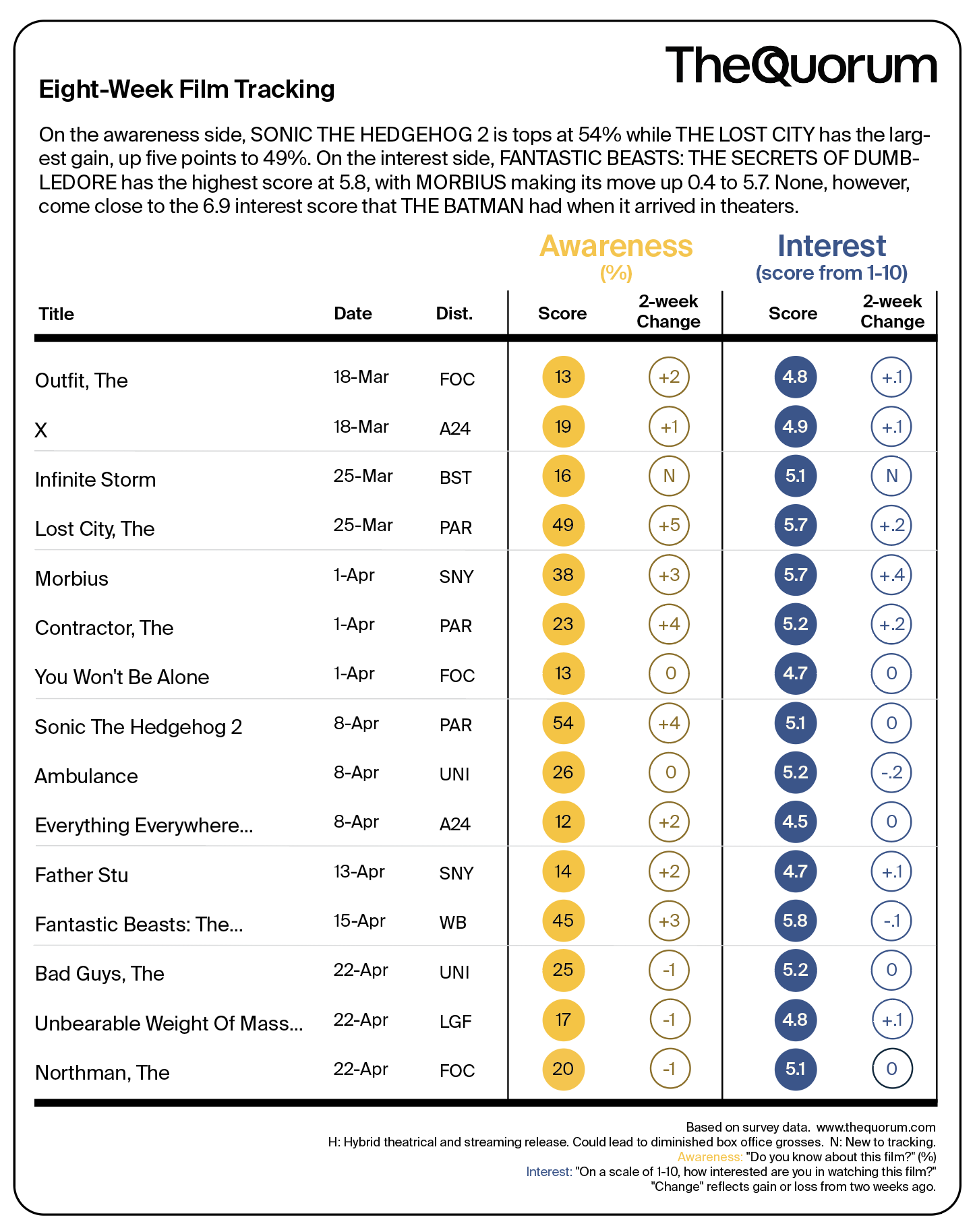
Have a great week, Matt
Got a question, comment, complaint, or want to out yourself as one of the Fox 14? Email me at Matt@puck.news or call/text me at 310-804-3198. 
You received this message because you signed up to receive emails from Puck.
Was this email forwarded to you?
Sent to {{customer.email}}
Interested in exploring our newsletter offerings?
Puck is published by Heat Media LLC.
For support, just reply to this e-mail. For brand partnerships, email ads@puck.news |


SHARE