 |
 |
|
Welcome back to What I’m Hearing+! I’ve finally returned to New York after having to cut my last trip short, but I’m excited to be in Brooklyn for the next 30 days at least—the longest I’ve been home in a while!
Tonight, I offer my initial thoughts on Netflix’s newly released trove of consumption data. I’ll offer a fuller dissertation next week, but my initial observations focus on the company’s strategy and evolution.
I also examine what Disney C.E.O. Bob Iger needs from Hulu to both complement Disney+ and paper over some of its material weaknesses. Throughout his career, Iger not only masterfully acquired companies but also beautifully integrated them. A successful tie-up here will mightily benefit Iger’s successor, once he gets around to picking one.
Let’s dive in…
|
 |
| Netflix’s Data Bomb & Iger’s Hulu Wish List |
| A talmudic reading of Netflix’s first-ever, hotly anticipated “What We’re Watching” report. Plus, an evaluation of what Disney+ needs from Hulu in their new streaming marriage. |
|
|
|
| Netflix just unveiled its first-ever “What We’re Watching” report, an extraordinarily detailed data dump that includes viewership figures for more than 18,000 titles between January and June of this year, accounting for about 99 percent of all viewing on the platform. To say it’s extensive is a profound understatement, and I’m still digging through all the crosstabs. (Unfortunately, the report doesn’t include the new “total completed views” metric that Netflix rolled out in June since, on an apples-to-apples basis, shows with more episodes and thus longer viewing times will naturally beat out those with equivalent engagement but shorter viewing times.)
Nevertheless, I wanted to share my initial thoughts on the data and what they suggest about audience behavior, the company and the industry. Herewith, the top five takeaways from the Top 100 titles (based on total hours viewed, as reported in this list) on Netflix… |
| I. Netflix Is the New CBS |
|
| For all the money that Netflix spends on content—about $17 billion this year and counting—viewership still tends to agglomerate around the broadest, most populist fare. That’s not surprising, of course, and it’s absolutely by design.
But for all the attention lavished on prestige features, like Roma or May/December or Maestro, the Top 100 titles list really shows what people love: oldies but goodies (Suits, Breaking Bad, The Blacklist); buzzy but bingeable series (Ginny & Georgia, Wednesday, You, Outer Banks); and family programming (Paw Patrol, Cocomelon, Minions: The Rise of Gru). I should note here that each season gets its own designated spot. So both seasons of Ginny & Georgia appear in the Top 10 of the new list. These latter titles also tend to skew pretty young, speaking to the core audience—young families and kids—that Netflix has courted over the years.
Notably missing from the Top 100 are more experimental programming options, like live events, and various genres, including horror, that have strong followings but appeal to smaller batches of viewers. That doesn’t mean they’re not working; there are more than 18,000 titles on this list. But when it comes to what subscribers are watching in hordes, it’s still procedurals, thrillers, comedies, and teen content—the stuff that broadcast television has been successfully selling to people for years. That’s not a knock on broadcast, either: CBS retained its position as the most watched U.S. network for its 15th year this past May. Not a bad position for Netflix to chase. |
|
A MESSAGE FROM OUR SPONSOR
|
 |
|
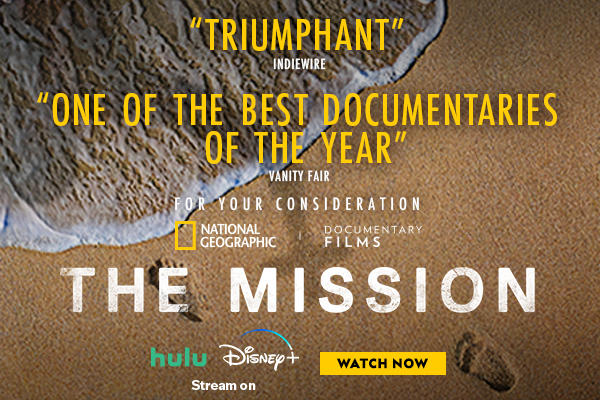
In 2018, a shocking event made headlines around the world: a young American missionary, John Chau, was killed by arrows while attempting to contact one of the world’s most isolated Indigenous peoples on remote North Sentinel Island. Through exclusive interviews and with unprecedented access to Chau’s secret plans, personal diaries, and video archives, THE MISSION examines the mythology of exploration that inspired him, the evangelical community that supported his quest, and reveals his own father’s heartbreak as Chau’s youthful thirst for adventure became a fatal obsession.
|
|
|
|
|
| There are 11 movies among the Top 100 most-streamed titles, and five are comedies. (Action and thriller titles accounted for another five, and one was a family film.) Interestingly, all but The Rise of Gru were original Netflix films, which is a real feather in the cap for chief content officer Bela Bajaria and film chief Scott Stuber.
But the list is weighted toward series, which are typically 6-10 hours per season, at least for U.S. shows. So it’s an impressive feat to see so many comedies, like Jonah Hill and Eddie Murphy’s You People, and the Reese Witherspoon rom-com Your Place or Mine, in the Top 100. You People saw the vast majority of its viewership (155 million hours) happen within its first four weeks, where it landed on Netflix’s Top 10 back in January and February. While this is similar to theatrical films that earn the vast majority of box office in the first 40-60 days, Netflix’s list gives us some insight into the potential long tail of these films. At 30 million more hours viewed post-landing on the Top 10 (or about 15 million household views), we now have an idea of what the decay rate looks like for a successful Netflix original film. Whether that decay rate is low or high will be revealed in future analysis. |
| III. Korean and Spanish Programming Dominates |
|
| Perhaps most interesting, at least to me: More than 30 of the Top 100 titles are Korean and Spanish fare. Now, to be clear, Spanish telenovelas and Korean series are naturally longer so that speaks to the level of consumption but not necessarily the popularity. That’s why there are only two Korean series on Netflix’s Top 10 all-time non-English speaking list versus The Glory, which is number three on this list, but didn’t break through the Top 10 (yet). This is what’s missing from the apples-to-apples comparisons found in the Top 10. For example, some titles, like Café con aroma de mujer, won’t be surprising to avid observers of Netflix’s weekly Top 10. (Café has appeared on the non-English-language titles list nearly 30 times—on par with Squid Game.) Others, however, may be surprising or entirely unfamiliar to U.S. audiences. Netflix, unlike its peers, is now truly a global content platform.
Still, the numbers are somewhat surprising given that the APAC and LATAM markets have seen fluctuating net subscriber growth between Q1 and Q3 this year. That raises a series of cascading, and deeply fascinating, questions. Among them: Are Netflix subscribers streaming these titles outside of those core regions? And are these titles attracting new customers in those regions? Or are they retaining older customers and creating habitual use?
Some of this programming isn’t making a huge splash in the U.S., but that’s okay. While Netflix would love to create a Squid Game every quarter, its true international content goal is less about producing global phenomena than establishing a dominant position in every market in which it operates. This breakdown gives us a little more insight into where those audiences may be coming from and what they are coming to watch. |
| IV. Original and Licensed Content Is Converging |
|
| Sixty-nine of the Top 100 titles are Netflix originals. These include multiple seasons of a show, including the first two seasons of Ginny & Georgia, which was released in January, as well as movies like The Mother and unscripted fare, such as the Korean game show Physical: 100. That’s not too surprising; the vast majority of Netflix originals are global, and therefore have the broadest reach. They’re also marketed much more heavily (just look at the immense advertising campaign behind Wednesday) and promoted more heavily on the Netflix homepage (The Night Agent).
Netflix’s licensed programming, which comprises the other 30 percent of the Top 100 list, truly complements the originals. Netflix has not yet been able to replicate successful broadcast procedurals like Suits, The Blacklist, and New Amsterdam, which is why it has licensed these shows to increase customer engagement in between drops of new originals. At the same time, Netflix is clearly trying to operate in the same space. To wit: It has elevated executives with strong broadcast and cable backgrounds, like Bajaria, and greenlighted broadcast-esque shows like The Night Agent.
The data presented in this giant dump are what Netflix’s teams examine on a daily basis… minus a few key elements like the cost of a program or revenue contributed by a title. Much about viewer behavior, however, can be gleaned. Licensed fare plays a big part—about 45 percent of all titles on the entire list— and while the data may not reveal the yellow brick road of Netflix’s content strategy decisions, it certainly illuminates areas of expansion and contraction. Paw Patrol and Cocomelon amass hundreds of millions of hours, which explains why Netflix has invested heavily in children’s programming. What remains to be seen, however, is whether Netflix should continue to produce even more of its own family animation, which can be costly, or continue licensing from others. Which brings us to our last point… |
|
|
| V. Rotating Libraries Spruces Up Old Favorites |
|
| Viewership patterns haven’t changed very much—original titles bring in big crowds, older titles lose some of their steam. Broadcast fixed this challenge through syndication, which breathed new life into older series on other networks. Netflix doesn’t syndicate (although this data makes a very strong argument for a Netflix FAST engine or some form of licensing play), but it can resurface once-buzzy content via its recommendation engine and/or prime placement on the platform’s front page. Suits was available for years on Prime Video and Peacock before making it to Netflix, where it found a massive audience; same with Manifest and Lucifer, which did lead to Netflix acquiring and producing additional seasons of those shows.
Netflix’s new dataset suggests that additional value could be unlocked from even older shows. Seasons of Orange Is the New Black and House of Cards, which both debuted in 2013, ranked in the top 1,000. Orange Is the New Black’s first season, for instance, amassed just under 50 million hours within the measurement period, coming in at a ranking of 314. So while these shows are still performing somewhat well for Netflix, and are through their amortization period, one has to wonder how these titles might perform on another platform.
In other words, what is the value of holding on to some of their most prominent original titles as engagement or retention fodder versus loaning them out to competitors for recurring revenue? Netflix has the advantage of scale and habitual audience right now, but licensing could generate a significant new revenue stream, too. And, of course, who actually owns the series (Orange Is the New Black is owned by Lionsgate, for example) may play a role in this conversation, as well. But let’s not make it too complicated. |
| And Now, Iger’s Hulu Wish List… |
|
| Bob Iger’s to-do list at Disney is both extensive and mildly harrowing: juice the stock price, fend off Nelson Peltz, revive his studio, figure out what to do with his linear TV assets, and solve the ESPN question. And that’s before he even considers the challenge of ensuring that Disney is synonymous with childrens’ entertainment at a time when 85 percent of kids under age 12 are seeking out YouTube before any other SVOD or VOD offering. Or figuring out how to keep his largest franchises, such as Marvel and Star Wars, continuously relevant without brand saturation or dilution.
And then there’s his acquisition of the remaining one-third of Hulu. After months of hype, Iger’s vision for an integrated Disney+ and Hulu has finally been revealed. The unified product, now available to subscribers, is still in beta mode, but it’s our first real look at what Iger intends to do with his ~$30 billion acquisition.
Let’s get the basics out of the way: The new integration is only available for Disney+ and Hulu subscribers within the streaming bundle. (Therefore, if you only have Disney+, you won’t see the Hulu tile. That will change once the full version rolls out next year.) Also, there aren’t any imminent changes to the current Disney Streaming Bundle pricing. If you do subscribe to the bundle, the integration will simply add a Hulu tile next to the Star Wars, Marvel, Pixar, and National Geographic tiles within the Disney+ app.
Below the surface, of course, Iger is hoping to eliminate three key pain points for subscribers, which I refer to as the three I’s: the inability to find what they’re looking for, irritation caused by poor user interfaces, and infuriation over rising prices. According to Statista surveys conducted earlier this year, 28 percent of global streaming customers recently canceled a service because they felt they had too many; 26 percent canceled because they weren’t using a platform enough; 25 percent canceled because a streamer was too expensive; and 23 percent canceled because there wasn’t enough new content. Combining the third- (Disney+) and sixth- (Hulu) largest services globally (by subscribers), with an improved interface and at a competitive price, ought to address those headaches.
Both Disney+ and Hulu are already in a relatively strong position compared to some peers. While D+ has maintained a respectable average of 2 percent of all U.S. viewing time, per Nielsen, Hulu has steadily increased to around 3.5 percent on average. By comparison, Netflix has hovered around 7.8 percent, Prime Video has steadily grown from 2.8 to 3.6 percent, and YouTube, the leading champ, has steadily grown from 7.2 percent to 9.1 percent. Notably, according to Parrot Analytics, where I work as director of strategy, Disney+ has seen its share of demand for originals shrink in recent quarters, as viewers have soured on the latest entries from Marvel and Star Wars. For its part, Hulu’s overall catalog has retained the largest demand share in the U.S.
Disney+ and Hulu are also both among the stickiest streaming products, with individual churn rates under 5 percent—bested in the single-platform category only by Netflix, the industry leader, at about 3.5 percent. Combined, Disney+ and Hulu (along with ESPN+) have an even lower churn rate: under 2 percent in 2022, according to Antenna. That’s a remarkable advantage over, say, Discovery+ (8.2 percent) and Paramount+ (just under 8 percent), reflecting the incredible loyalty for Disney’s unique brand and Hulu’s expansive catalog. Together, they give Iger more pricing power than his competitors. |
|
|
| Of course, Disney does have some glaring issues with its streaming business. It needs broader content to increase engagement without hurting the Disney brand; it needs the right type of content outside the core Disney franchises (next up: a new Percy Jackson series debuting this month); it needs the right licensing strategy to build stronger revenue without helping competitors too much; and it needs to reach a wider audience. The hope is that integrating Hulu will allow the Disney direct-to-consumer team to address these shortcomings by using Hulu’s more robust machine learning tools to better understand what different households want during their streaming time.
After all, Disney+ has limited audience learnings since it is much more niche. Hulu has strong machine learning algorithmic capabilities but doesn’t have the event-driven momentum of Disney+. Combining the event-driven capabilities of Disney+ with the broader offering of Hulu will not only help to create stronger and better recommendations, but also decrease churn and increase overall per-week sessions. The latter, of course, is very important to advertisers.
The north star for the Disney bundle—Disney+, ESPN+, and Hulu—isn’t to reduce churn, which is already low, but rather to create regularity. Among Disney’s three streaming platforms, only Hulu is a daily habit, thanks to its extensive library of network series (including newer shows like Abbott Elementary, but also comfort food like The O.C., Modern Family, Family Guy, How I Met Your Mother, etcetera). The ESPN+ audience is mostly driven by big live events, including UFC and Formula 1, while Disney+’s is largely dictated by event TV and Pay-One windows for Disney theatrical titles. While these types of events are critical for acquiring customers, they aren’t a “necessity” for the broader subscriber base, or for increasing day-to-day engagement, or extending session time in a way that’s valuable to advertisers. That’s why Iger needs customers to think of Disney+Hulu as a daily destination, rather than a weekly treat, particularly as the competition grows, and especially if he wants to raise prices. |
|
|
|
| FOUR STORIES WE’RE TALKING ABOUT |
 |
|
 |
| Cher’s Royalty War |
| Inside a legal battle over how rights are valued in Hollywood. |
| ERIQ GARDNER |
|
 |
|
 |
|
|
|
|
|
 |
|
|
|
Need help? Review our FAQs
page or contact
us for assistance. For brand partnerships, email ads@puck.news.
|
|
You received this email because you signed up to receive emails from Puck, or as part of your Puck account associated with . To stop receiving this newsletter and/or manage all your email preferences, click here.
|
|
Puck is published by Heat Media LLC. 227 W 17th St New York, NY 10011.
|
|
|
|