Puck’s second original research study reveals consumers are souring on their streaming services, from Apple’s ‘Ted Lasso’ familiarity deficit to the HBO Max/Discovery+ divide and more.
Apple TV+ continues to struggle in our survey, despite the perception around town that its content offering is improving, and the return of Jason Sudeikis and ‘Ted Lasso.‘
Photo courtesy of Apple
Remember the good old days, back in… January? A.I. was barely a twinkle in the Writers Guild’s eye. Avatar 2 hadn’t yet caused its financier to sue Disney for allegedly stealing profits. And this very publication debuted its first original research study: The Official Streaming Service Hierarchy. I had a humble goal: Beyond subscribers and churn rates and ARPU, I wanted to determine brand attachment—how people actually feel about each service.
That meant enlisting The Quorum and its pollsters to interview 2,500 streaming customers, and calculating each streamer’s Net Promoter Score—i.e., asking people to rank their impression of a brand from 1-10 to determine how likely people are to evangelize about it. We also determined scores on metrics, like “trust” and “quality,” for both subscribers and those who were merely familiar with the brands. (We excluded those who weren’t familiar.) You can click here and here to read the January results, but here’s a quick summary:
1. Netflix—No. 1 in every “attachment” metric, but the company’s N.P.S. score of 49 among subscribers (the highest in the study, but well below ballast-like brands such as Starbucks or Costco) was concerning.
2. Disney+—Familiarity was high, and “quality” and “trust” scores were near the top. Subscribers skewed younger and more male.
3. HBO Max—Scored very high in “quality,” “trust,” and “admiration” metrics, and it scored second in N.P.S., behind only Netflix. Interestingly, Discovery+ scored at or near the bottom in those metrics, setting up a potential clash when they were merged as Max in May.
4. Amazon Prime Video—A middle-of-the-road brand, per its N.P.S. score (33 among subscribers). Its viewership was relatively evenly distributed across demos and income levels.
5. Hulu—Despite a high score in “familiarity,” it scored in the middle of the pack for all the attachment metrics. This was a surprise for me, an avid Hulu viewer.
6. Peacock—It scored on the low end in everything, including N.P.S. But Peacock is strong with older women and lower-income subscribers.
7. Paramount+—It scored last in “admiration” among subscribers, and performed poorly in “trust.” But shows like 1923 had a high rate in the “recall” polling, meaning people knew they were on Par+. Audience skewed female.
8. Apple TV+—Lowest in “familiarity” and the attachment metrics, but it over-indexed among affluent people. Only 20 percent of its own subscribers knew Ted Lasso was on Apple TV+. Kinda amazing.
That was then… now, six months later, we sent Quorum researchers to do another survey of 2,000 people, evenly split between men and women over and under 35, and some interesting takeaways emerged:
Disappointment in the Category: All the streamers saw sizable decreases in Net Promoter Scores. That suggests a significant decline in goodwill towards streamers as a category.
The question is why? Recent price increases? Password-sharing crackdowns? Pulling shows without notice? Markedly worse content? Maybe all of the above. Most streamers saw a drop of more than ten points from January to July. Even Apple TV+ fell seven points despite the return of its biggest hit, Ted Lasso. Disney+ slipped five points despite the fact that the Disney brand is in the name. “This study shows that consumers are already feeling the effect of shrinking libraries,” lead researcher David Herrin told me today. “Among the 2,000 people surveyed, 45 percent have said they have noticed the removal of some programs and they don’t like it.”
At the same time, notably, the service that held best was Max, which was down only three points from the HBO Max number in January, and which has pulled several shows from its roster and licensed a few HBO series to Netflix. Here’s the full chart showing the drops:
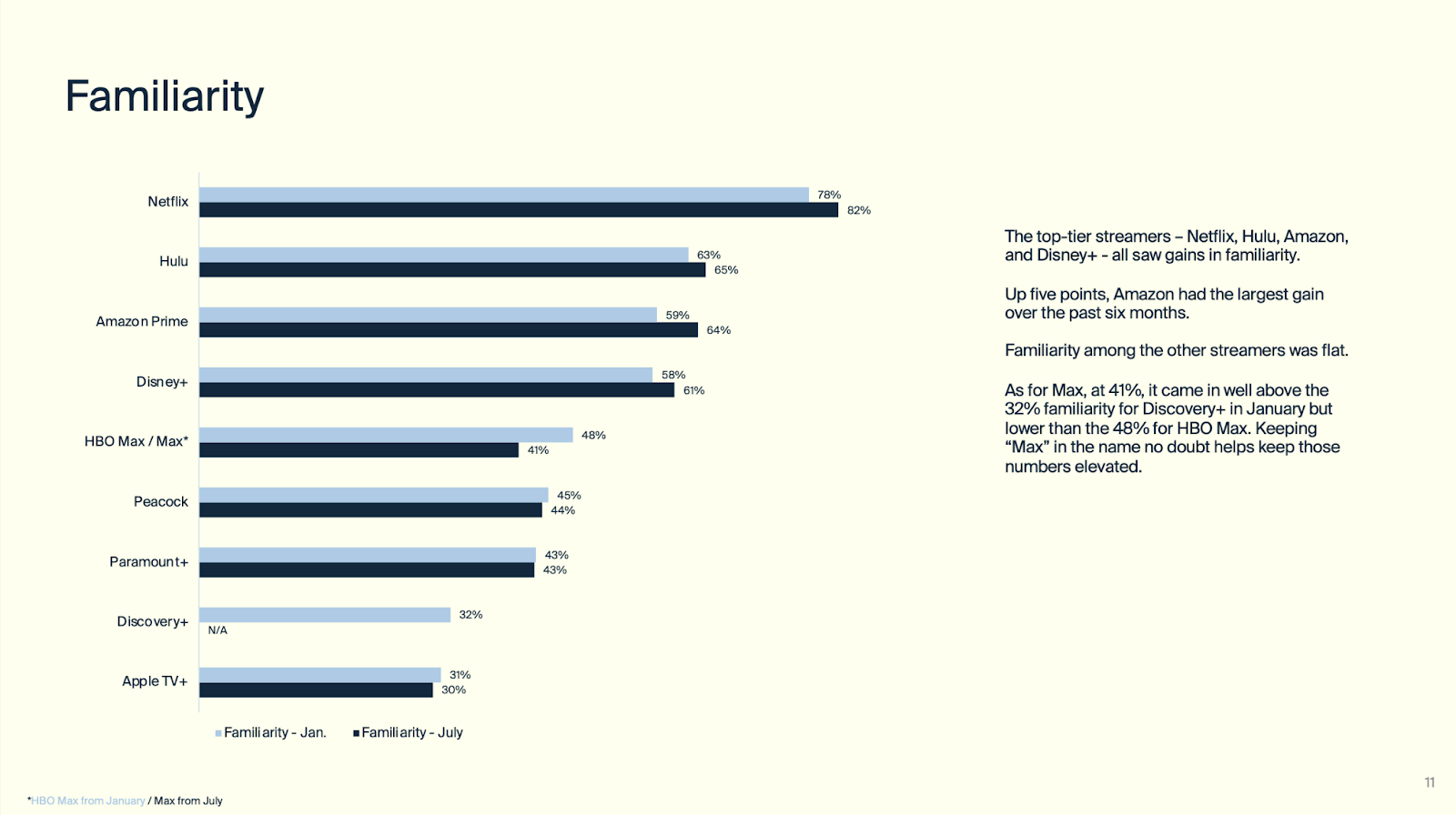
More Apple Challenges: Apple TV+ continues to struggle in our survey, despite the perception around town that its content offering is improving, and the return of Jason Sudeikis’s mustache. The number of subscribers who know that Ted Lasso is on Apple TV+ has risen to 33 percent; that’s better than 1 in 5, but still surprisingly low. “Bottom line,” Herrin told me, “it’s hard to build meaningful and lasting attachment when consumers can’t even recall a streamer’s programs.” The Apple platform saw its numbers decline in all brand equity metrics, including “familiarity,” where it ranks last:
Amazon Inertia: While Amazon Prime Video saw growth in “familiarity” and overall subscribers, it still ranks toward the middle of the pack in “quality” and “trust.” That’s despite its 45 Emmy nominations in July across Prime Video and Freevee.
The Max Riddle: Remember, in January, HBO Max ranked second in the “quality” and “trust” categories, and Discovery+ was near the bottom of the list. Having since been combined, Max seems to be benefiting most from its ties to HBO, as it ranks second in both those attachment metrics, behind only Netflix. We’ll have a deeper look at Max later this week.
The Coolness Factor: For the first time, respondents were asked which streamers they would describe as “cool.” Netflix was tops with 54 percent, but Max came in a close second at 52 percent. It’s interesting to see that Amazon was near the top in subscribers, but people don’t see it as a “cool” streamer. Clearly, they don’t watch Bosch.
I’ll get into the specific Max results in a forthcoming issue, but clearly the big takeaway is that consumers aren’t happy with their streaming services—or at least they’re significantly less happy today than they were back in the good old days of January. It’ll be interesting to see if this turn in sentiment begins to impact subscriber numbers.
Try Puck for free
Sign up today to join the inside conversation at the nexus of Wall Street, Washington, A.I., Hollywood, and more.
Didn't get an email? Check your spam folder and confirm the spelling of your email, and try again. If you continue to have trouble, reach out to fritz@puck.news.
Didn't get an email? Check your spam folder and confirm the spelling of your email, and try again. If you continue to have trouble, reach out to fritz@puck.news.
Member Exclusive
Get access to this story
Create a free account to preview Puck’s full offering, including exclusive articles, private emails from authors, and more.