 |
|
|
|
Forward this email to a friend!
|
|
For our second anniversary, subscribers can share the benefit of Puck with an exclusive code (INSIDEACCESS) that gets your network 30% off.
|
|
|
|
|
|
Happy Labor Day, I’m Eriq Gardner.
|
|
Welcome back to The Rainmaker, a private email about money, power, fame, and, most of all, the law. (If you’re not already subscribed, click here to receive this weekly.)
In today’s edition, a campaign of vengeance by a disgraced businessman, once one of the most connected figures in the world. Plus, on the lighter side, a trademark dispute breaks out over Deez Nuts.
But first…
|
|
|
- What’s fraud, anyway?: Everyone’s pushing back on federal fraud statutes these days, from the “Varsity Blues” parents who recently beat their convictions to Sam Bankman-Fried’s lawyers arguing that vague fraud statutes are too broadly applied. The latest to escape on a technicality is Hernan Lopez, a former Fox executive who was implicated in a scheme in South America aimed at bribing soccer officials to secure broadcast rights. (Lopez later founded Wondery, the podcast studio, which Amazon bought in a deal worth $300 million.)
Following a jury verdict in March, Lopez faced 40 years in prison. However, a recent Supreme Court decision prompted U.S. District Court Judge Pamela Chen on Friday to vacate his conviction. She concluded that honest services wire fraud doesn’t apply to foreign commercial bribery schemes due to ambiguity over who is actually owed some fiduciary duty of honesty. You can read the full opinion, which includes a noteworthy section explaining why just a few days earlier, Michael Avenatti wasn’t quite as lucky in his own attempt to overturn a fraud conviction tied to efforts to solicit a bribe from Nike.
- Scientology’s E-Meter mystery: After a decade, the “right to repair” movement, which champions a consumer’s entitlement to rip apart smartphones, tablets, and other digital devices, is gaining traction. The Federal Trade Commission has begun a review of the issue, while states are enacting their own “right to repair” laws. Even Apple, surprisingly, is now backing a bill in California, which has prompted “hell freezing over” headlines.
But Scientologists, who believe in an immortal spirit, don’t seem too thrilled. To wit: Every three years, the Librarian of Congress considers petitions to enable various hacks to copyrighted works. This year, Author Services Inc., an entity associated with L. Ron Hubbard’s literary estate, is opposing the ability to break into computer programs for the purpose of repairing a device. This is being interpreted as an effort to protect E-Meters—Scientology’s seemingly magical soul auditing tools.
Here’s the thing, though. This isn’t the first time that Author Services has opposed the hacking of software. Back in 2016, the entity told the Copyright Office that the then-pending federal bill, the You Own Your Devices Act, “would adversely affect our business model.” When given the opportunity to elaborate, they noted the potential disruption of sensitive negotiations related to the operation of its devices. In other words, not everyone should get to use E-Meters, and those that do should expect restrictions like not being allowed to take them apart to see how they work. With that noted, leading Scientologists can’t be happy about the “right to repair” momentum.
- Here comes Cuomo…: The Andrew Cuomo scandal may seem like old news, but it’s heating up again. According to new court papers, Cuomo has served nearly 50 subpoenas and conducted more than 20 depositions in recent months. Spending $6.6 million in legal bills, according to campaign finance disclosures, he’s vigorously investigating the accusations that led him to resign as New York governor. Attorneys representing a female trooper suing him for sexual harassment are complaining to a judge that Cuomo hasn’t sat yet for his own deposition.
And speaking of damaged men… |
 |
| A Legal Coda to the #MeToo Era |
| The bizarre story of a disgraced C.E.O. attempting to win back his reputation. It’s a plot that involves former lawyers for Harvey Weinstein and Gretchen Carlson, landmark legislation, Congress, and more. |
|
|
|
| Six years after the height of the #MeToo movement, some men accused of bad behavior are seeking restitution—and in some cases, revenge. Barstool founder Dave Portnoy and pitcher Trevor Bauer recently took news outlets to court after being accused of inappropriate behavior. Andrew Cuomo has served dozens of subpoenas in his quest to challenge the accusations that led him to resign as governor. Joshua Wright, a former top law professor, just sued the students who accused him of sexual misconduct, seeking $108 million in damages. Many could be hoping to emulate Johnny Depp, who won a defamation suit against Amber Heard in a high-profile trial last year.
Yet perhaps the most audacious example of a man attempting to fight back is Zia Chishti, the politically-connected former C.E.O. of Afiniti, an A.I. software company. A Pakistani-American inventor and entrepreneur, Chishti made a fortune as the founder of Align Technology, the pioneering orthodontics company making invisible braces. He later led a successful private equity firm, TRG, and even graced People’s list of 50 most eligible bachelors. He founded Afiniti in 2005. With a D.C. office overlooking the White House, Chishti had an enviable network of advisors, including former Bush treasury secretary John Snow, former House Majority Leader Dick Gephardt, former leaders of Britain, France, and Spain, as well as former chiefs of BP, Sony, and Verizon.
A few years ago, Chishti was accused of assault by a young woman named Tatiana Spottiswoode. According to Spottiswoode’s rendition of events, Chishti, a friend of her father, had pursued her when she was a 21-year-old college senior. Later, she became one of his young employees and they engaged in a sexual relationship, which she ended. But Chishti continued to pressure her, ultimately leading to a horrific sexual assault in 2019, she alleged, leaving her hospitalized with bruises around her neck and a concussion. Spottiswoode and Afiniti eventually settled in private arbitration.
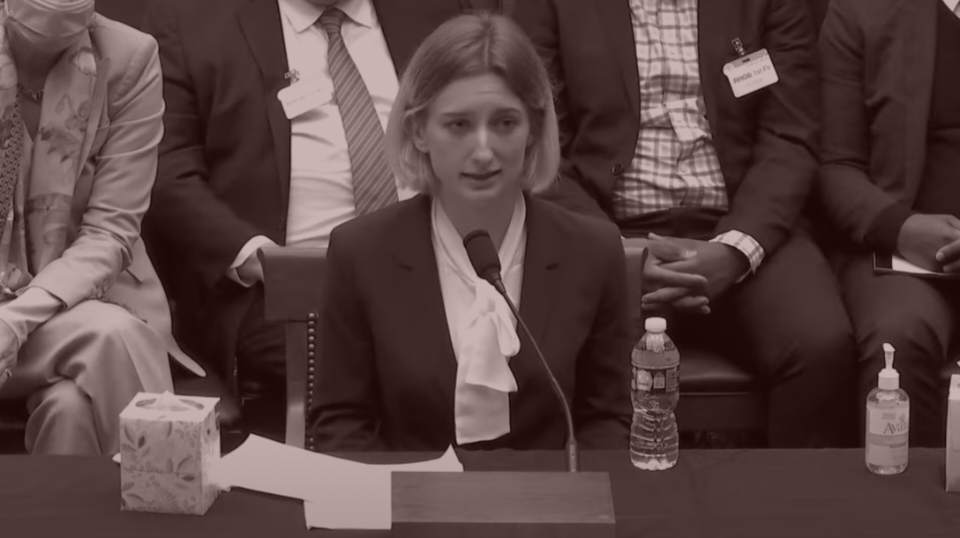
The alleged assault could have remained secret if Spottiswoode had not reached out to the House Judiciary Committee, which was examining the practice of companies forcing employees to take sexual misconduct complaints to private arbitration. In November 2021, Spottiswoode testified before the committee about Chishti pressuring her, allegedly subjecting her to humiliating situations at work and disturbing emails describing rape fantasies. Spottiswoode also revealed that she had then received a multi-million dollar award against Afiniti in arbitration, but faced aggressive challenges from Chishti’s legal team, which pushed her to withdraw her claims by targeting her father. She was also prevented from speaking out about the abuse, or the arbitration, due to a protective order.
The repercussions of Spottiswoode’s outspokenness were swift. Chishti exited the company that same month. Former U.K. prime minister David Cameron hastily severed his ties as chair of Afiniti’s advisory board. Shortly afterward, Congress passed a law abolishing mandatory arbitration for individuals claiming sexual assault and harassment—a remarkable legislative feat, undoubtedly furthered by Spottiswoode’s resolve to come forward.
But the saga didn’t end there. After testifying about the secrecy surrounding sexual abuse, Spottiswoode now finds herself embroiled in an ongoing legal battle, raising fundamental questions about the price of speaking out on the grandest stage—before lawmakers and the glare of cameras on Capitol Hill. The driving force behind this latest drama is, of course, Chishti, who is challenging Spottiswoode’s congressional immunity and seeking $500 million in damages, all in an attempt to salvage his reputation. If he wins, it could potentially disrupt the entire calculus surrounding congressional testimony, with far-reaching consequences. |
|
|
|
|
| After Spottiswoode’s public testimony, Chishti filed a 102-page complaint in D.C. federal court pro se, meaning he represented himself. This also meant there was no lawyer to talk him out of doing silly things like picturing in his court papers the Hermes riding crop that Spottiswoode supposedly “enjoyed being whipped with,” and the Hermes leather collar she “enjoyed being choked with.” The Judiciary committee, not amused by Chishti’s attack on their witness, responded by putting every harrowing detail of the arbitrator’s findings into the public record.
Chishti is now represented by Imran Ansari, perhaps most notable for once defending Harvey Weinstein. Chishti’s defamation and breach-of-contract lawsuit, filed in November 2022 against Spottiswoode and her attorneys, including Nancy Erika Smith—best known for representing Gretchen Carlson in her landmark sexual misconduct case against Roger Ailes—serves as a testament to the significance of the matter, as well as its oddness. Chishti is pinning his hopes on proving Spottiswoode had a predilection for sadomasochism.
Since joining the case, Ansari has made a concerted push to bury nearly everything pertaining to the dispute over Spottiswoode’s testimony. This extends to a separate court fight with The Telegraph regarding the U.K. publication’s coverage. When I reached out to Ansari about his strategy, he expressed concern that his opponents had slipped me secret materials and warned me against amplifying them. (I’ll just say this: Rather than worry about whether your adversaries are leaking to journalists, if you’re going to ask the court to seal documents, make sure the exhibits attached to your request are also sealed.)
The documents Ansari accidentally left unsealed suggest that Chishti intends to make a key argument in his case against Spottiswoode and her lawyers: That what she told Congress isn’t privileged. Theoretically, Spottiswoode’s testimony and surrounding statements should be protected because she was compelled by subpoena to testify as a witness in a legislative proceeding. Chishti is pushing back against this immunity claim. What’s more, because her statements align with the arbitrator’s findings, Spottiswoode contends her allegations are not libelous because they’re true statements. Ansari attacks that theory too.
Surprisingly, there doesn’t appear to be a substantial body of precedent for defamation battles arising from Congressional testimony. This could be attributed to a more severe potential consequence (criminal perjury) for spreading falsehoods in this context. Alas, maybe the scarcity of these kinds of fights are because few have dared to imagine the possibility of pursuing civil action, as Chishti has.
For what it’s worth, both Spottiswoode’s legal team and Ansari point to Webster v. Sun Co., a 1986 opinion which dealt with a company lobbyist who sent an allegedly defamatory memorandum to Congress. Spottiswoode’s attorneys emphasize the part where the U.S. Court of Appeals for the D.C. Circuit recognized an absolute privilege to publish defamatory statements as part of a legislative proceeding in which someone is testifying, as long as these statements are related to the proceeding. The purpose of the privilege, noted the circuit judge, is “promoting candid legislative input.”
But in court papers filed this past week, Ansari highlights how, in this same opinion, the appellate court emphasized the importance of preventing “overbroad applications of the privilege,” particularly with respect to unsolicited statements. In short, he argues that Spottiswoode isn’t immune from any defamation claims arising from her initial outreach to Congress to gauge their interest in her story. Nor is she shielded from what was in her written testimony after she was subpoenaed, which Congress didn’t ask for. Furthermore, he argues that she’s not sheltered by what she said during the hearing itself because, circumventing the secrecy dictated by the arbitration proceeding, “There is no other reasonable interpretation of the facts other than that Spottiswoode and Smith conspired to have a subpoena issued.”
If all that sounds like desperation (and frankly, it does to me), it pales in comparison to the oddball arguments that Chishti and Ansari are putting forward to convince a D.C. federal judge to disregard the arbitrator’s conclusions. They contend that an accusation of rape “could not possibly be the proper subject of a civil arbitration proceeding,” and regardless, the arbitration award doesn’t represent a final judgment on the merits because Chishti decided not to contest the arbitrator’s decision in open court. Instead, Spottiswoode was paid $6.9 million. Astonishingly, Ansari suggests that his client should be credited for being led to believe that the settlement would remain secret. As he puts it, “Had Chishti known that Spottiswoode was going to break her promises and destroy his life, he surely would have moved to vacate the award.” |
|
|
| Meanwhile, Chishti has other legal issues to manage. During the height of the pandemic, he relocated from Washington D.C. to the Bahamas. He subsequently got married and currently resides in Puerto Rico, where he’s the co-owner of an A.I. startup called Isbei Ltd., registered in Pakistan.
Interestingly, while Spottiswoode’s testimony may have led to Chishti’s departure from Afiniti, his former corporation is now suing him for essentially creating a copycat company specializing in artificial intelligence for call centers. According to a complaint filed earlier this year, Chishti and his new wife are alleged to have misappropriated Afiniti’s trade secrets (including computer code), recruited its employees, and solicited its customers.
Chishti’s legal team argues that he had legitimate access to the information in question due to his previous role as C.E.O., and they also contend that he’s not violating a non-compete by operating in a market, such as China, which had to be abandoned following his unceremonial departure. This corporate dispute is undeniably unusual, serving as a remarkable epilogue to one woman’s hard choice to speak up.
Finally, something fun… |
|
|
| You might recall a viral news story from a few weeks back about the uber-popular YouTuber Jimmy “MrBeast” Donaldson suing over his reputation being supposedly tarnished by an “inedible” and “revolting” hamburger bearing his name. Well, let me break news about an emerging separate lawsuit over nuts. Specifically, Deez Nuts.
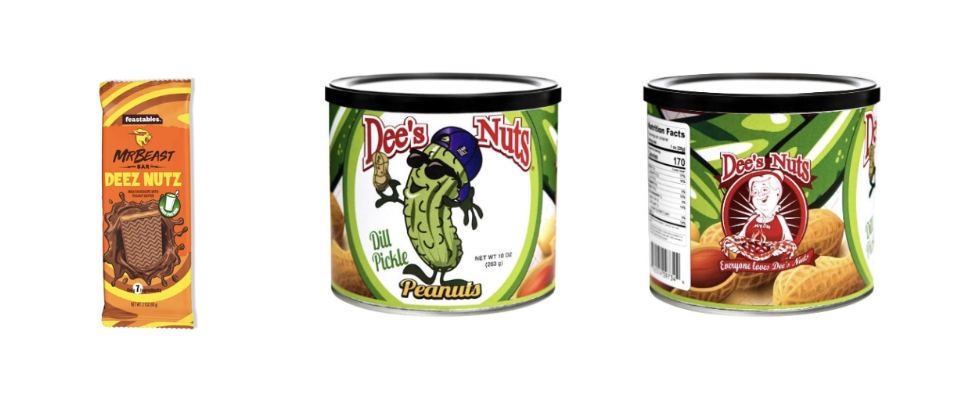
The suit was filed in Florida federal court on Aug. 25 by the producer of gourmet flavored peanuts featuring the Dee’s Nuts insignia. The entity is associated with Brian Ditore, who apparently wanted to pay homage to his grandmother who everyone knew as “Mrs. Dee.” Ditore holds a trademark registration, and when he noticed a MrBeast Deez Nuts chocolate bar also on the market, his attorney sent a rather menacing letter to MrBeast’s reps, demanding this competing snack food be crushed out of existence.
In response, there was a letter, not from MrBeast himself, but from Paul Havel, an attorney representing Feastables, the manufacturer of the chocolate bar in question. Havel pointed out several issues with his adversary’s arguments. For instance, Dee’s Nuts hadn’t opposed the encroaching trademark registration of M!lk These Nuts, and how could any consumer really be confused about the origins of these products based upon the packaging: |
 |
| The full letter (read here) delves into the history of the Deez Nuts joke, from its earliest known use on Dr. Dre’s seminal The Chronic album to its place in the Urban Dictionary. Havel instructs, “It is not a literal reference to testicles; rather it is used figuratively to disrupt and show disrespect to whatever discussion is currently occurring.”
It doesn’t appear Ditore was satisfied by the explanation as he now is in court over the phonetically equivalent competition. He is seeking an injunction, corrective advertising, and treble damages. But hey, Deez Nuts, right? |
|
|
| That’s it for now. Back again next week. |
|
|
|
| FOUR STORIES WE’RE TALKING ABOUT |
|
|
|
|
|
|
|
 |
|
|
|
Need help? Review our FAQs
page or contact
us for assistance. For brand partnerships, email ads@puck.news.
|
|
You received this email because you signed up to receive emails from Puck, or as part of your Puck account associated with . To stop receiving this newsletter and/or manage all your email preferences, click here.
|
|
Puck is published by Heat Media LLC. 227 W 17th St New York, NY 10011.
|
|
|
|