Welcome back to The Varsity. I’m John Ourand, back in
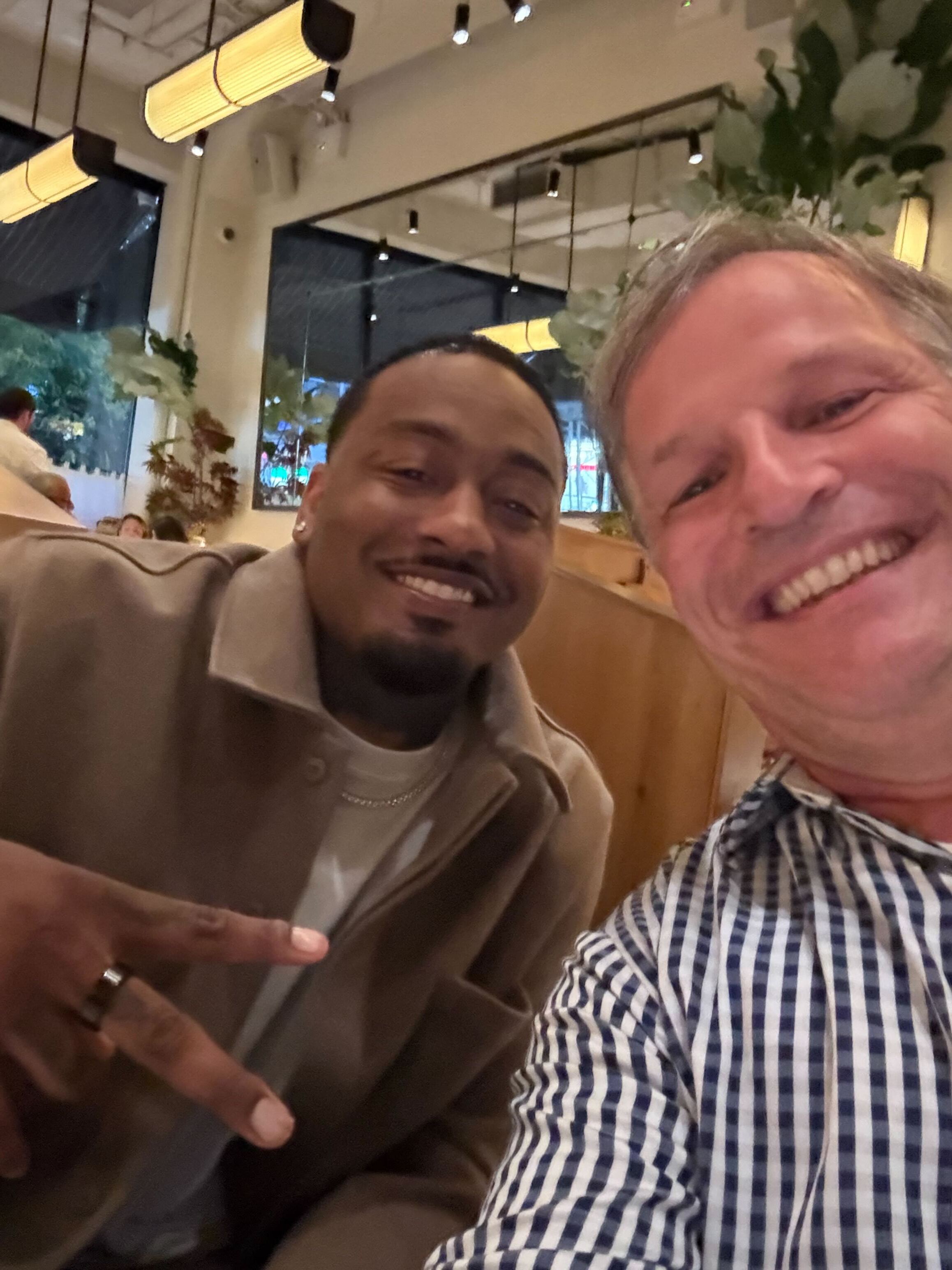
D.C. after a whirlwind trip to New York, where I dined with Amazon Prime’s NBA team of executives and broadcasters. Amazon’s Alana Russo was wise enough to have me sit next to John Wall, whom I proceeded to bore with hours of Washington Wizards talk. Yes, I took a selfie, which you can see at the bottom of this email.
🚨 Breaking: We’re one week away from our inaugural sports media conference,
In the Arena, and we are officially sold out. That means that all you procrastinators who waited to secure a seat are out of luck, and will instead need to scalp one off Marchand. (Sancerre time, Andrew! Not getting any younger here…)
Alas, fear not, stragglers. The Varsity will publish a bunch of news and analysis coming out of the event, which Puck is
producing with MoffettNathanson. Given the boffo lineup—Michael Rubin, Adam Silver, Josh Harris, Gerry Cardinale, etcetera, etcetera—there will be plenty to discuss.
🚨🚨 Pod alert: We’re about a week and a half away from the start of the NBA season, so I rang up Frank DiGraci and Noah Eagle to give us a preview of what lies ahead. DiGraci is NBC Sports’s coordinating producer for the NBA, and Eagle will
be one of the network’s top play-by-play voices. Meanwhile, ESPN’s Greg Wyshynski stopped by for an NHL season preview yesterday. Life is good on the ice right now. Listen here and
here.
The best thing I read this week: Before we start, I behoove you to read Eriq Gardner’s piece on the lawsuits that Disney and Warner Bros. Discovery filed
against Charlie Ergen and Dish Network over the Day Passes that it’s offering for $4.99. Eriq: “As plaintiffs, of course, Disney brings serious legal firepower—but [Judge Arun] Subramanian doesn’t seem the type to rubber-stamp an injunction.” The story is worth your time.
Okay, let’s get to it… |
Player of the Week: Jeff Price
|
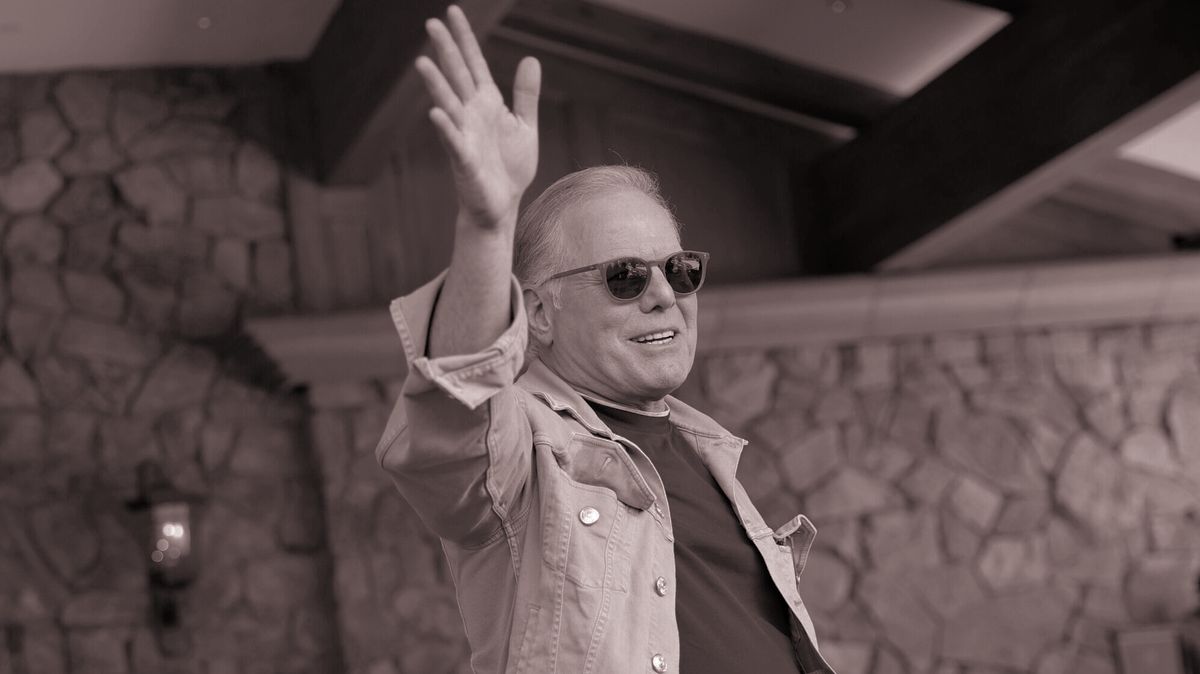
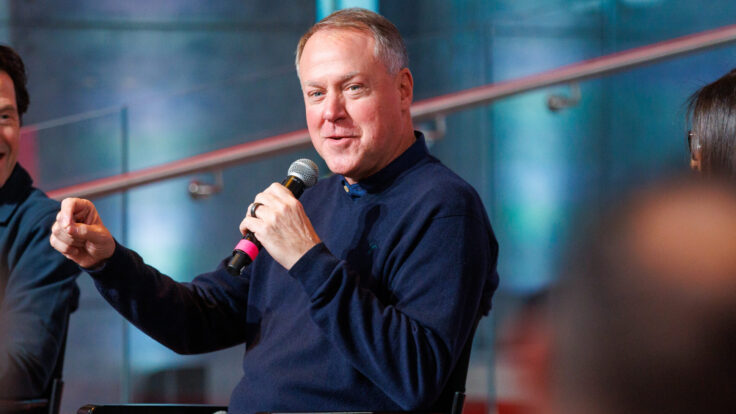
Is there a more underleveraged property in sports today than the Heisman Trophy, arguably the most
prestigious individual award in all of sports? Yesterday, the Heisman Trophy Trust hired sports business veteran Jeff Price as its first C.E.O. His number one job is to figure out how to make more money off of the award. Officially, the trust says it wants to bring in more revenue to fund philanthropic initiatives, so it’s not surprising that Disney recently announced that ABC would air the December ceremony, the first time the broadcast network has carried the event. |
Down to the J.V. (Reader’s Choice Edition):
Mark Sanchez
|
I was inundated with sacks of mail after opening up this week’s “Down to the J.V.” award
to a reader vote. Your choice was unanimous! We still don’t know the full story about what happened in Indianapolis last weekend, but the Fox Sports analyst and butt fumble pioneer was hospitalized and charged with a felony. Related: The truck driver with whom Sanchez allegedly fought is now suing the former QB and Fox. And we’d bet that Sanchez won’t be returning to the broadcast booth any time soon. |
- NBC’s MLB plan: I’m told that NBC and Peacock will open the baseball schedule with a stand-alone primetime game on Thursday, March 26, the second day of the season. Twenty-eight of the 30 MLB teams will play that afternoon, but only one will be scheduled for primetime and appear on NBC. Neither the league nor the network has decided which game will take the slot, but intriguing possibilities include Paul Skenes and the Pirates visiting the Mets, or the
Tigers visiting the Padres in a battle of two playoff teams. As Marchand previously reported, Netflix will carry an opening night Yankees-Giants game on March 25.
This scenario came about as a result of horse trading during rights negotiations. When MLB awarded the coveted wild card playoffs to NBC, Netflix went looking for other games it could eventize. MLB gave them the season opener, which had been in NBC’s package, and gave Brian Roberts the stand-alone
primetime contest for the season’s second day. MLB’s deals with NBC and Netflix should be announced officially in the next couple of weeks. - A non-update update on ESPN and YouTube: All is quiet on the video bundle front, as YouTube TV negotiates its fourth major distribution deal in three months. Just a week after it reached an agreement with NBCUniversal, YouTube TV is back at it—this time with ESPN, whose deal is up at the end of the month. Sources
tell me that the two sides aren’t close, but that’s to be expected three weeks before a deadline. Deadlines spur action, so don’t expect any real news until the last week of October.
The big issues are familiar: YouTube TV wants ESPN’s direct-to-consumer programming to be available inside the YouTube TV environment. While NBC solved that by putting Peacock exclusives on its NBC Sports Network channel, soon to be available to YouTube TV subscribers, ESPN doesn’t have a linear
channel devoted to carrying its direct-to-consumer sports.
Note that the negotiations are occurring in the middle of the NFL and college football seasons, which has historically given programming networks a ton of leverage. Distributors like YouTube TV are loath to allow football games to go dark on their systems. But coming on the heels of YouTube TV deals with Fox and NBC, there is optimism that both sides have a road map to a potential deal. - Netflix
and the NFL: The Wall Street cliché about Netflix has always been to watch what they do, not what they say. That was my first thought when I saw co-C.E.O. Greg Peters tell Lucas Shaw at the Bloomberg Screentime conference that the NFL “doesn’t really fit with our strategy” of going after big
events. Sports are big events, of course, especially NFL games that draw tens of millions of viewers. Peters also cited the high cost of NFL rights, adding that Netflix wants to make sure its investments are profitable. “Some of the big-league sports things—we don’t actually have a way to figure out that math.”
Okay, sure, but when the NFL rights come up, everybody expects Netflix to have a seat at the table. Specifically, the league is expected to try to entice Netflix—and the other
streamers—with a package of international games that they can carry globally. - The NHL’s hometown discount: I was surprised by the news that hockey superstar Connor McDavid signed a below-market extension—two years, $25 million—to stay with the Edmonton Oilers. I didn’t think hometown discounts existed anymore. On this week’s Varsity podcast, when I asked ESPN NHL analyst Greg Wyshynski if NHL stars cutting
team-friendly deals would become a trend, he said that the situation feels unique to McDavid.
“He wants to stay in Edmonton and win a Stanley Cup for that city,” Wyshynski told me. “He wants to give the team an ample chance to extend their contention window and build around him, so he’s giving away money he would otherwise earn to help facilitate that. That being said, he also looks at this team and the roster and the pipeline of prospects, and everything else, and says, You’re on the
clock. You got me for a couple of years. If it doesn’t work out, he put in his time, and will go off to make the richest free agent contract in hockey history.”
Wyshynski noted that other teams would no doubt try to cajole their star players into following McDavid’s lead, probably without much success. “What’s funny about all this is that, at the same time that McDavid takes this team-friendly deal, the NHL also saw the richest contract it has ever handed out,” he said.
“Kirill Kaprizov, a Russian winger for the Minnesota Wild, signed for eight years and $136 million—in total value, the richest contract we’ve ever seen, beating Alex Ovechkin’s record from around 2008.” - Sunday Ticket appeal update: My partner Eriq Gardner has an update on the Sunday Ticket case that should interest all Varsity readers: “The Ninth Circuit is working to schedule oral
arguments over whether to revive the $4.7 billion antitrust verdict against the NFL or accept the league’s argument that the class action, over the way that its 32 teams pool out-of-market broadcast rights into one pricey package, should have never been certified in the first place. On Friday, both sides—Paul Clement, the star appellate lawyer tapped by the NFL, and Marc Seltzer of Susman Godfrey, representing the class of Sunday Ticket subscribers—proposed
February 10 as a mutually available date for arguments in Pasadena. For those keeping score at home, that’s two days after the Super Bowl.”
|
For the main event, I’m handing the keys to my partner Bill Cohan, whose scholarship on Warner
Bros. Discovery has been second to none. Herewith, his analysis of why the company might be more valuable split in two—with plenty of shareholder value still to be unlocked from WBD’s diverse sports rights portfolio—rather than sold off to the Ellisons.
Take it away, Bill… |
|
|
To defend against a Paramount Skydance takeover, David Zaslav will need to prove
that splitting up Warner Bros. Discovery will be more valuable for shareholders than selling everything to the Ellisons. According to analysts, he’s got a good case. |
|
|
If David Zaslav has any hope of keeping Warner Bros. Discovery out of the maws of
David Ellison and Paramount Skydance, he’s going to have to make a cogent and effective argument that, in the long run, WBD shareholders will be better off with the breakup plan that he set in motion in June, and which is expected to become effective by next April. He’s no doubt got bankers at Goldman Sachs working overtime putting together the deck, along with backup Excel spreadsheets, to make that very point—if and when the Ellisons get around to coughing up a bid for all of
WBD. The New York Post is reporting that the Ellisons have asked “major private equity firms,” such as Apollo, to join their WBD bid, should there be one.
Meanwhile, the widely respected Bank of America research analyst Jessica Reif Ehrlich has just issued a research report articulating the Zaz case. According to Jessica’s analysis, a WBD split into Streaming and Studios, under Zaz, and Discovery Global, under Gunnar Wiedenfels, would create more
shareholder value than selling out to the Ellisons and PSKY for something like $22 to $24 a share, to take CNBC analyst David Faber’s predicted range.
I’ve known Ehrlich since we worked together at Merrill Lynch in the late ’90s, before BofA swallowed up the investment bank during the 2008 financial crisis. In her report, she predicted a split WBD could generate $30 a share for WBD shareholders, materially in excess of what the Ellisons are likely to bid. Furthermore, she
argued that the stand-alone, relatively debt-free Streaming and Studios business would generate “a bidding war amongst potential buyers” and fetch a price of some 20x EBITDA, or perhaps adjusted EBITDA (it’s not clear—she references only the business’s “assets”), justifying the $30-plus-per-share valuation for WBD if the Zaz Plan comes to fruition. After all, she continued, there should be “significant demand” for Zaz’s Streaming and Studios business once it is “unburdened by WBD’s linear assets
and significant debt load.”
Perhaps more provocatively, Ehrlich argued that Discovery Global, the parent company that would house all of WBD’s linear TV businesses, is also being underappreciated by the market. Indeed, she posited that Gunnar’s business could increase in value over time, as a roll-up vehicle for a bunch of European linear TV companies—especially now that Zaz has diversified WBD’s assets internationally (buying rights to the French Open, creating an alliance with
Globo in Brazil, etcetera).
To that end, Ehrlich suggested that any one of ITV, RTL Group, ProSieben, Télévision Française, or M6 Métropole Télévision could be good candidates for Gunnar. All have market caps of roughly $5 billion or less—several of them are sub-$2 billion—and therefore, she thought, could make fine acquisition targets for Discovery Global. “We believe the European linear market is better positioned than the U.S.,” she wrote. “Rampant cord-cutting has impaired the U.S.
linear TV ecosystem and will likely continue to do so.” |
I have to give Jessica kudos for this idea. So far, the conventional wisdom has been that Global
Networks will end up combining with Versant, rather than rolling up the European linear TV landscape. “Consolidating this market could be accretive to the overall growth rate of Discovery Global,” Ehrlich continued. “Additionally, there is a clear opportunity to recognize synergies on the cost side through consolidation of overhead, advertising sales forces, affiliate sales, real estate footprint, etcetera.” Jessica also floated the idea that Gunnar could sell some of Discovery Global’s assets,
such as CNN, or TVN in Poland.
Ehrlich certainly isn’t the first to suggest that Discovery Global could be run solely to generate free cashflow in order to pay down what will likely be a large portion of the $30 billion of WBD’s net debt that will stay with Discovery Global. After all, there would no longer be any need to funnel free cash to Studios and Streaming. More specifically, she proposed that Discovery Global’s 20 percent stake in Zaz’s business—that’s part of the split-up
plan—could subsequently be monetized for $6 billion in 2026, and used to pay down what she estimates is $13 billion of net debt left on the Discovery Global business. (I suspect that $13 billion is low, but we’ll see.)
In any event, Ehrlich figures Discovery Global will be 4x leveraged at the start—four times as much debt as adjusted EBITDA—which could be reduced to 2.1x leverage by the end of 2027. “Deleveraging can drive value for Discovery Global,” she wrote.
Ehrlich’s grab bag
of options also included the possibility of selling Discovery Global to a private equity firm, as many have suggested, in the way that TPG bought DirecTV from AT&T and made a fortune. She dismissed this as “unlikely,” however, since she figures Zaz & Co. have already run WBD for cash (which is true) in order to significantly reduce the initial $55 billion debt burden, so there may not be much low-hanging fruit left for private equity. There probably still is, to be honest, but Ehrlich is
directionally correct.
While she was up and rolling, Ehrlich even suggested that Gunnar buy a broadcast network, arguing that they are enjoying “a renaissance”—are they?—and that the lack of one at Discovery Global is “a glaring hole” in its asset portfolio. I’m not exactly sure which network might be available to Gunnar, but maybe Bob Iger would consider parting with ABC, as he once suggested during that infamous CNBC interview in Sun Valley. In any
case, Ehrlich wrote that “these networks can serve as anchors for the linear businesses to support affiliate rates and advertising as a mitigator against ongoing secular headwinds from cord-cutting.” |
Anyway, Ehrlich is not alone in thinking a split WBD could be a better deal for shareholders than
the potential PSKY offer. I recently had a lovely email exchange on the topic with Wells Fargo analyst Steven Cahall, who suggested that if an Apple or Netflix were seriously interested in Zaz’s Streaming and Studios business, they could make an offer now, presplit, and agree to take some of WBD’s debt—potentially leaving Gunnar with a bunch of cash to pay off the remaining WBD debt, thereby giving shareholders a premium to whatever the Ellisons are thinking of
offering.
For now, at least, WBD shareholders remain in a state of limbo. The good news for them, though, is that the Journal leak caused the WBD stock to run up some 60 percent in the days after. I think the delay works in their favor in another way, too, especially if Zaz and Gunnar want to remain independent: If Jessica is right that the WBD split-up plan will generate $30 per share in value, which is more than the $25 per share that Zaz is reportedly demanding for all of the
company from any suitor—that’s not confirmed by me, by the way—and more than the $22 to $24 per share that the Ellisons are supposedly contemplating, that’s the more lucrative way to go for WBD shareholders, assuming Zaz and Goldman can make that case to them and to the board of directors. In any case, the ongoing delay from the Ellisons makes it seem increasingly possible that Jessica is right—that “a split is still the most likely outcome.” |
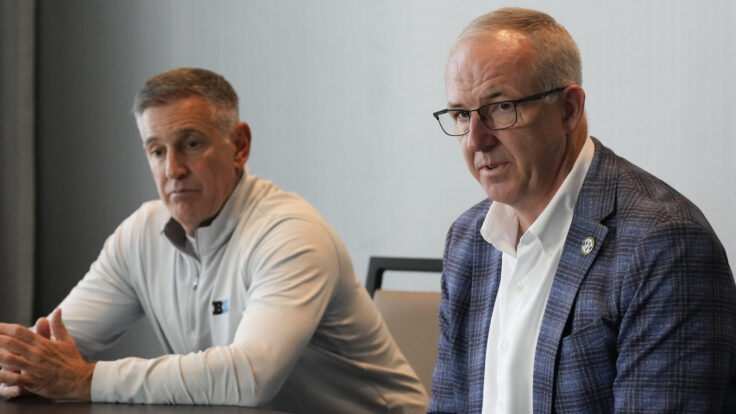
On Cody Campbell’s plan to save college sports: “It’s great that someone is
talking openly about an overdue reform of the S.B.A., but colleges are already free to pool their rights under any configuration they want. The very existence of conferences and conference realignment demonstrates it. There’s nothing stopping the Power Four from pooling their rights into one deal with equal revenue sharing. It would just be bad business for the bigger schools and a great deal for schools like… Texas Tech!” —A media executive
On Cathy Engelbert’s bad
month: “A year ago at this time, she wore a dress with the N.Y. skyline to the deciding game of that team’s championship. Now this month, she basically called one of the league’s best and most popular players a liar. At this point, next year’s October surprise for WNBA commish Cathy Engelbert would be if she were somehow still in the job.” —A media executive
On the NFL’s international push: “It’s insane how much the NFL takes over London
when it has games over here. Seeing Cleveland Browns fans at 9 a.m. on Sunday morning was not something I was expecting!” —A British Varsity subscriber |
Have a great weekend,
John
P.S.: Here’s my selfie with John Wall… |
|
|
Ace media reporter Dylan Byers brings readers into the C-suite as he chronicles the biggest stories in the industry:
the future of cable news in the streaming era, the transformation of legacy publishers, the tech giants remaking the market, and all the egos involved. |
|
|
Puck fashion correspondent Lauren Sherman and a rotating cast of industry insiders take you deep behind the scenes of
this multitrillion-dollar biz, from creative director switcheroos to M&A drama, D.T.C. downfalls, and magazine mishaps. Fashion People is an extension of Line Sheet, Lauren’s private email for Puck, where she tracks what’s happening beyond the press releases in fashion, beauty, and media. New episodes publish every Tuesday and Friday. |
|
|
Need help? Review our FAQ page or contact us for assistance. For brand partnerships, email ads@puck.news. You received this email because you signed up to receive emails from Puck, or as part of your Puck account associated with {{customer.email}}. To stop receiving this newsletter and/or manage all your email preferences, click here. |
Puck is published by Heat Media LLC. 107 Greenwich St, New York, NY 10006 |
|
|
|