Welcome back to The Varsity, our thrice-weekly private email on the money, power, influence, and egos that make up the sports business.
I’m in New York City today interviewing for the Knicks head coaching job after a great couple of days in Montauk for BofA’s media conference. Last night, an army of highfalutin types descended on the swanky, comme il faut Flyfish Club for a screening of Rabil’s Places, which debuted on ESPN. Lacrosse hero Paul Rabil was there, of course, as was ESPN content honcho Burke Magnus, Words + Pictures’ Connor Schell, Omaha’s Jamie Horowitz, and Mike “Vino” Levine, the co-head of CAA Sports.
Others spotted at the bar: CAA’s Matt Kramer and David Koonin, ESPN’s Brian Lockhart, Omaha’s Kevin Clark and Kelly Rafferty, ESPN’s Peter Schrager, and Roc Nation’s Lori York. In other words, it was the type of early summer get-together that sports media types do so well. (Was that Marchand holding a Ziploc by the arancini station?)
Also, in case you missed it, some exciting news: Puck has hired A.I. wunderkind Ian Krietzberg to expand our coverage of artificial intelligence. (Yes, the nerds are coming for the sports media industry, too…) Sign up here to receive The Hidden Layer in your inbox twice a week starting next month. This will be a must-read for anyone interested in this trillion-dollar business.
A ratings prophecy: Don’t believe the predictions that this year’s small-market NBA Finals will be a Chernobyl-style viewership event. Earlier this year, of course, Nielsen expanded its out-of-home viewership tracking to cover the entire country, to the benefit of the networks, generally adding about 5 percent to sports viewership figures. Plus, NBA playoff ratings have already been up slightly this year, which matters in a season when New York was the only large-market team in the conference finals and the Lakers lost in the first round. Yes, the Knicks’ loss will hurt, but I still expect the Finals will average more than 10 million viewers per game. (Last year’s Celtics-Mavs series averaged 11.3 million.) The drop-off will be bigger if it’s a four-game sweep.
Email me your best guesses. The closest will get a coveted Varsity shoutout.
Okay, let’s get going…
|
Player of the Week: Craig Barry
|
|
Roland-Garros has to be thrilled with TNT Sports’ coverage of the French Open, with its 300-plus hours of live coverage and four on-site sets. It’s largely the work of Turner Sports chief content officer Craig Barry, who has helped elevate viewership to a modest but respectable 292,000 viewers over the tournament’s first eight days, while truly sweating the value of the asset—a thesis of the Zaz playbook.
Anecdotally, several of my tennis-loving friends have reached out to praise TNT’s expansive coverage, which included a whiparound show on truTV during the first week. As TNT Sports boss Luis Silberwasser attempts to persuade sports properties to move over to his network, he can use the French Open as a great example of how the network eventizes second- or third-tier packages.
|
Down to the J.V.: Jay Monahan
|
|
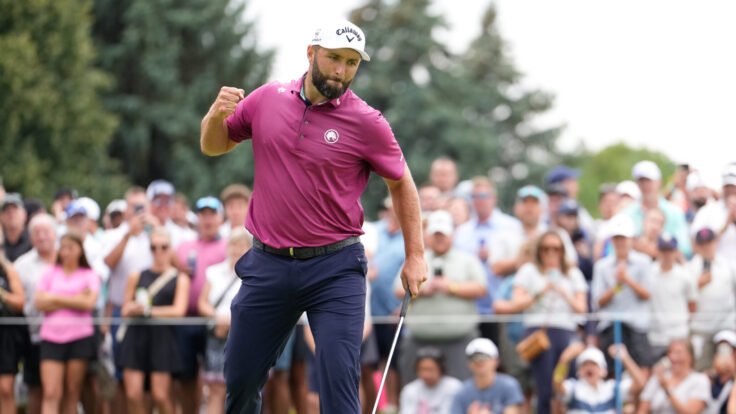
Not only are some of the PGA Tour’s biggest stars making a habit of skipping press availability, but many of those stars (Rory McIlroy, Collin Morikawa, etcetera) couldn’t care less. After all, the tour doesn’t mandate the gaggles and so most players view it as unnecessary. Rory recently defended his decision to skip a media gaggle at the PGA Championship, and implied that he would’ve met with the media only if it were required. Alas, players don’t seem to comprehend that engagement with the golf press corps leads directly to endorsement money. But PGA Tour commissioner Jay Monahan needs to get a handle on this before it becomes a full-fledged trend—and morphs into his latest headache.
|
|
|
|
A MESSAGE FROM OUR SPONSOR
|
Forever at the top of its game, the trailblazing BMW 7 Series. Engineered to win. Learn more at
BMWUSA.com
|
|
|
- MLB’s ESPN package: During his appearance at Wednesday’s annual owners meeting, it became clear that MLB commissioner Rob Manfred hopes to have agreements in place for ESPN’s vacated rights package by next month’s All-Star Game. At his press conference, Manfred said the league was in talks with three companies. “Two have been out there, and the third I’m not going to get into,” he said.As regular readers of The Varsity know, NBC and Apple are the two companies that are out there. NBC is interested in the Sunday night games, and Apple has shown a willingness to expand its current Friday night baseball schedule. As far as the third one, Fox has expressed interest in pairing the Home Run Derby with the All-Star Game, but it could also be a mystery bidder. Nevertheless, many still suspect that Manfred will reengage with ESPN at some point this season. The network had previously offered around $200 million per year for the package that includes Sunday Night Baseball, the Home Run Derby, and wildcard playoff games—an untenable drop-off from its previous rate of $550 million per year. If ESPN wants to bridge the delta, the window is closing fast.
- Manfred’s blunt talk: Manfred plans to give up the commissioner job when his contract ends in 2029, which means his legacy will be cemented over the next three and a half years—a period that will be largely defined by his management of the changing media landscape and the sport’s labor challenges. In particular, he has to solve an incredibly thorny labor problem by the start of the 2027 season to avoid a strike, and then negotiate a whole new set of media deals the following year.On this week’s The Varsity podcast, ESPN’s Don Van Natta offered a prediction for Manfred’s legacy. “He does love the game, and he wants what’s best for the game,” he told me. “But like any commissioner, he also wants what’s best for his bosses and the owners. We’re going to see that play out both with the media deals and the collective bargaining agreement.”
He continued: “Rob can be blunt to a fault at times—we saw that with the ESPN opt-out of their $550 million-a-year deal, when Rob was very blunt in that letter to owners, and said ESPN was a shrinking platform. That’s how Rob is, at times, publicly. It is certainly how he is behind a closed door.… He’s very plain-spoken, sometimes to a fault. And that doesn’t always work.”
- More on the Disney-YouTube skirmish: Late yesterday, an L.A. County Superior Court denied Disney’s call for a temporary restraining order preventing Justin Connolly, its former president of platform distribution, from taking his talents to YouTube. In his ruling, Judge James Chalfant seemed to suggest that Disney would have a tough time prevailing in court to keep the well-liked and highly respected Connolly from exiting his contract to take the gig. The key sentence in the judge’s decision was that Disney “has not demonstrated a probability of success on the merits.” The legal jousting will continue, but Connolly has emerged as the early frontrunner.
- A new hire at the NBPA: Jacinda Ortiz is leaving the NBA after seven years of slinging P.R. to become the vice president of communications for the National Basketball Players Association next month. It’s a good hire for the NBPA: Jacinda called a lot of shots in the NBA. I talked to her almost every day for months leading up to the NBA’s media deals with ESPN, NBC, and Amazon. It’s also a good move for Jacinda, who will lead her own department at the NBPA.
- A Darren Rovell sighting: Unlike you philistines, I devour my Puck partner Marion Maneker’s excellent private email, Wall Power, for observations on the Basquiat market and the latest hammer ratios on lots at Sotheby's. I always read it before my buying expeditions in Europe, especially when I send Marchand ahead to haggle. But it’s not every day that I recognize a name from the Varsity cinematic universe in its digital pages.In last night’s edition, however, our colleague Julie Davich referenced the recent exploits of former ESPN reporter Darren Rovell. Here’s Julie: “Film sleuths have pegged June 5, 1985, as the day Ferris, Cameron, and Sloane ditched school in the movie and became film icons in the process. To celebrate the 40th anniversary of Ferris Bueller’s Day Off, Sotheby’s is offering Ferris’ sweater vest worn by the titular character played by Matthew Broderick, in a dedicated online sale, going live tomorrow through June 24.”
Here’s the rub: Bueller’s vest, estimated at $300,000, is being consigned by Rovell, who bought it at Heritage Auctions in 2022 for $143,750 against an estimate of $60,000. Rovell buys and sells memorabilia, and recently launched a media company for the collectibles market. He also advises teams, brands, and leagues about how to create limited-edition collectibles around milestone events.
|
|
And now, on to the main event…
|
|
|
|
The full impact of a post-monoculture world, where sports are viewed on multiple platforms, is beginning to emerge. To no one’s surprise, the streamers, who are younger and new to the ad game, are already starting to dominate.
|
|
|
|
Over the past half-decade, as our media transformation has played out in Hemingway-esque terms—gradually and then very rapidly—a couple of truths have become self-evident. First, as we all know, live sports have become the coin of the realm. These days, middle schoolers can practically recite the rights fee that Netflix paid for its Christmas Day football doubleheader, or what Amazon forked over for its Black Friday contest.
Secondly, and downstream from the prior point, the leagues are distributing their games more widely than ever before. For years, the NFL pursued a broadcast-centric strategy. Now, it’s in business with Amazon, Netflix, and YouTube, in addition to old standbys NBC, CBS, Fox, and ABC (ESPN). The NBA’s hallmark $76 billion deal expanded from two to three partners, including a streamer. Major League Baseball’s multidecade relationship with ESPN imploded, in part, due to an opportunistic (and short-sighted) deal with Roku—which followed a similarly adventurous arrangement with Apple TV+. NASCAR used to split its rights between NBC and Fox. Now, its races are also on The CW, TNT, and Amazon Prime.
Anyway, dear reader, you know all this. But the ripple effects are now beginning to emerge in ways unforeseen, and yet entirely plausible in hindsight. The beauty of the media monoculture of yore was its simplicity: In a world neatly divided between broadcast networks and cable channels, advertisers could easily target their spends. C.P.G. companies that wanted to align with the NBA could either spend their marketing dollars with TNT or Disney. Automobile companies interested in the MLB could approach Fox, TBS, or ESPN. Yes, I’m being slightly facile here, but you get the gist.
|
|
|
|
A MESSAGE FROM OUR SPONSOR
|
Forever at the top of its game, the trailblazing BMW 7 Series. Engineered to win. Learn more at
BMWUSA.com
|
|
|
|
Now we live in a brave new world. Not only are consumers forced to utilize more services to watch their favorite sports, but the streamers themselves have refocused from subscription-first models to more blended ones. As my partner Julia Alexander noted the other day, Amazon Prime secured more than $2 billion in upfront advertising commitments last year, mainly due to Thursday Night Football, among other live events. Netflix is targeting $3 billion in advertising revenue this year—still a far cry from what the TV networks rake in, but they’re just getting started in this business.
As the monoculture continues to splinter, marketers must make increasingly labored decisions about where to spend their cash—and, not surprisingly, more and more of it is going to streamers. Not only are the streamers spending more on sports rights, but their audiences are simply more valuable—younger, more high-intent, and engaged. Meanwhile, MoffettNathanson recently released a new report reaffirming, as you might have expected, that the shift toward advertising revenue will benefit the streamers in the end.
“Sports has long been the final stronghold for [cable] networks, but even that is increasingly under threat, as platforms like Netflix, Amazon, and now YouTube make deeper pushes into live sports,” MoffettNathanson’s Robert Fishman wrote. “Ad-tier engagement and monetization will be key drivers of future streaming revenue growth, as the battle for ad dollars continues to shift from linear TV to streaming.” Fishman predicted that Netflix’s ad tier will generate $18 in revenue per user per month by 2027, up from $13.50 in 2024. “Notably, we expect the majority of this growth to come from advertising—not subscriptions,” Fishman said.
This is the latest sign of a virtuous cycle for the streamer and a vicious cycle for its cable and linear competitors. To continue its ad tier growth, Netflix needs to double down on sports rights. Of course, it has deals with the NFL and WWE, and it surprised the business when it picked up rights to the Women’s World Cup. But as its plans become clearer, so will its appetite.
|
|
On WBD layoffs: “WBD let go of a lot of really good people this week—the biggest bloodletting in a long time. Meanwhile, D.Z. demands his $50 million-plus salary despite shareholder concerns.” —A former Discovery executive
On TNT Sports’ coverage of the French Open: “I find TNT’s tennis coverage to be much better than ESPN’s. TNT seems to always be showing tennis, and staying away from fluff like ESPN’s focus on narratives and American players. One negative with TNT is that it didn’t show the Nadal retirement ceremony live last Sunday. It was on tape delay, and tennis fans were going ballistic thinking we wouldn’t see it at all. ” —A Varsity subscriber
On Matt Belloni’s acting chops: “The Puck x Belloni x The Studio collab is amazing. Does this mean I should expect to see your cameo on the new Apple show Stick?” —A D.C. lawyer
[Ed. note: Marchand, get Ari on the phone stat!]
|
|
Have a great weekend,
John
|
|
|
|
Puck sports correspondent John Ourand and a rotating cast of industry insiders take you inside the executive suites and owners boxes where the decisions that shape the entire sports business are made. You’ll hear interviews with players, network execs, and everyone in between. The Varsity is an extension of John’s private email for Puck by the same name. New episodes publish every Wednesday and Sunday.
|
|
|
|
Ace media reporter Dylan Byers brings readers into the C-suite as he chronicles the biggest stories in the industry: the future of cable news in the streaming era, the transformation of legacy publishers, the tech giants remaking the market, and all the egos involved.
|
|
|
Need help? Review our FAQ page or contact us for assistance. For brand partnerships, email ads@puck.news.
You received this email because you signed up to receive emails from Puck, or as part of your Puck account associated with . To stop receiving this newsletter and/or manage all your email preferences, click here.
|
|
Puck is published by Heat Media LLC. 107 Greenwich St, New York, NY 10006
|
|
|
|