Hello, I'm Matt Belloni.
Welcome to the REAL Sunday edition of What I’m Hearing... Apologies, but due to a mistake, last Thursday’s edition was sent out again this afternoon to some of you. Oops! Start-ups, man.
Reminder: My emails are for members of Puck, the new media company focused on the power centers of Hollywood, Silicon Valley, Washington, and Wall Street. If this email has been forwarded to you, you can sign up for a membership here. (Yes, we have group subscriptions, just email fritz@puck.news for details.)
But first, before we begin...
Five Quick Thoughts on Bond Box Office
After all the hopes and dreams, No Time to Die opened to just $56 million in the U.S., a solid pandemic showing but nowhere near last weekend’s Venom: Let There Be Carnage ($90 million) or even 2015’s Spectre ($70.4 million), let alone the hyperbolic $100 million floated by some.
Sponsored by Amazon Prime Video 

The initiative rankles some members, who see it as an intrusion into the artistic process. But after undertaking a years-long effort to diversify its membership, it’s clear the Academy wants to do more to bring about change. Here it is, the document that members of the Motion Picture Academy have been waiting to see, the long-in-development, highly debated, bound-to-be-controversial “Academy Inclusion Standards” form. It hasn’t been disseminated to the membership yet, but someone slipped it to me, and I know a lot of Academy members read What I’m Hearing…, so I’m passing along a couple screenshots.
For those not up to speed, the Academy decreed last year that to be eligible for the best picture Oscar, films must soon meet two of four “inclusion standards” aimed at increasing depictions and employment of women, racial and ethnic minorities, LGBTQ+ people, and those with disabilities. Films that don’t meet the threshold will be disqualified starting with the 2024 Oscars, but producers must begin submitting the confidential form this year to be considered for the top prize. It quietly went live on the Academy member portal about two weeks ago. 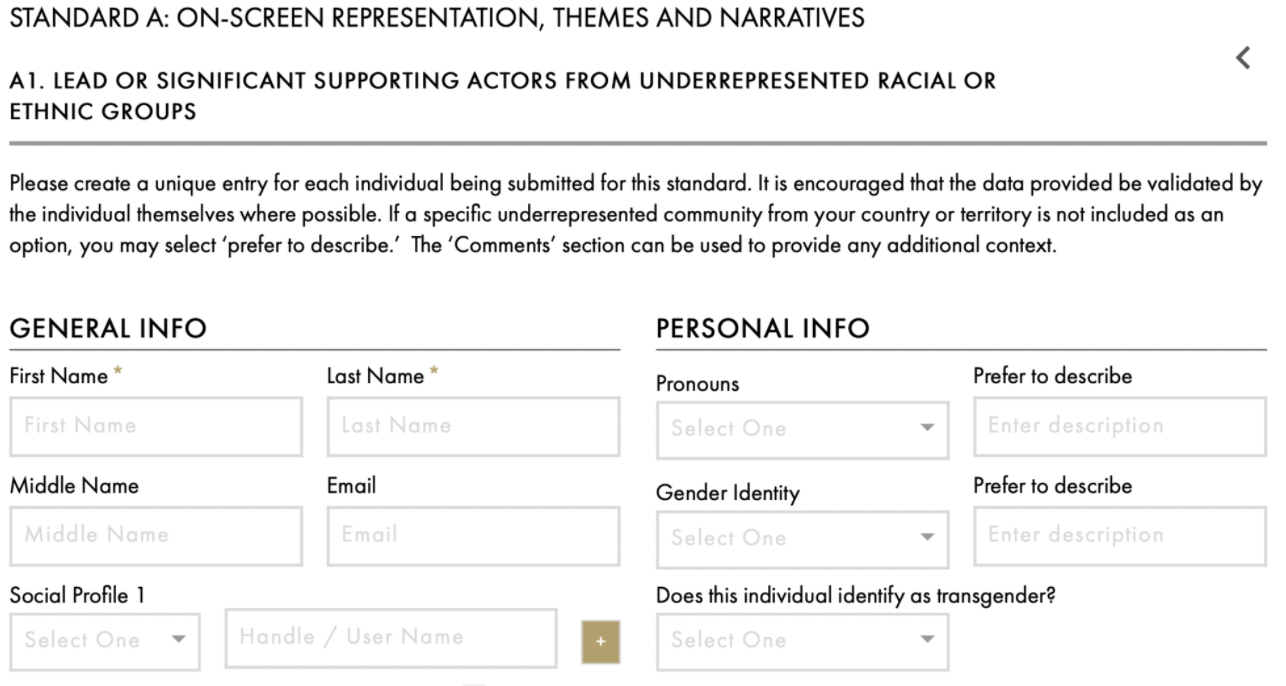
I know this initiative rankles some members, who see it as an intrusion into the artistic process by an organization whose sole function should be to honor and advocate for that art, not police how it’s made or by whom. And I’ll admit, it’s jarring to see a checklist asking a studio to determine whether a supporting actor is “gay” or “queer” (or both?). Some of the questions and drop-down menus also seem susceptible to a legal challenge, though Crash producer Bob Yari sued more than 15 years ago over the criteria for winning best picture, and a court basically ruled that the Academy can set its own rules. Still, the whole process is pretty onerous, with productions asked to “create a unique entry for each individual being submitted for this standard.” You know how many people work on movies?
But after undertaking an aggressive, years-long effort to diversify its membership, the Academy’s goals at this point are pretty clear: It wants to actively bring about change, rather than simply reflecting—in its membership and its awards—an industry that has largely been unwilling to alter its makeup to better serve its customers. That’s a tough task, and with those goals in mind, something like this Inclusion Standards form makes sense. 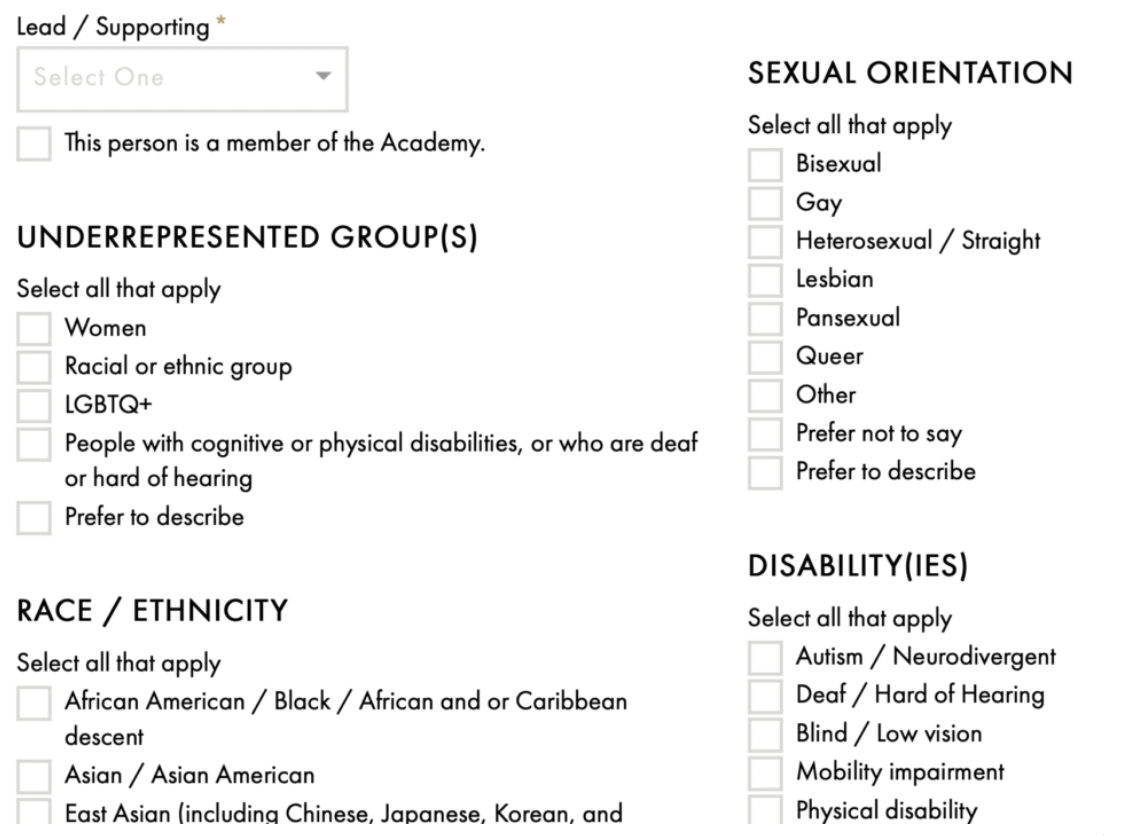
Also, at least for now, all the information is being provided voluntarily, and producers are encouraged to validate the stats with each individual themselves. Most awards operations at studios and streamers now employ dozens of people, and the task of filling out the forms will likely fall to lower-level staffers, using information from the productions themselves. (The heavier burden will likely fall on smaller distributors, which don’t carry that awards apparatus.)
ADVERTISEMENT
Amazon Studios presents VAL. For over 40 years, Val Kilmer documented his own life and craft through thousands of hours of footage, from 16mm home movies to time spent in iconic roles for blockbuster movies. This documentary reveals a personal and sometimes-hilarious look at what it means to be an artist and a complex man. The Wall Street Journal calls Val a "a one-of-a-kind portrait of a one-of-a-kind artist who has remained devoted to his art." 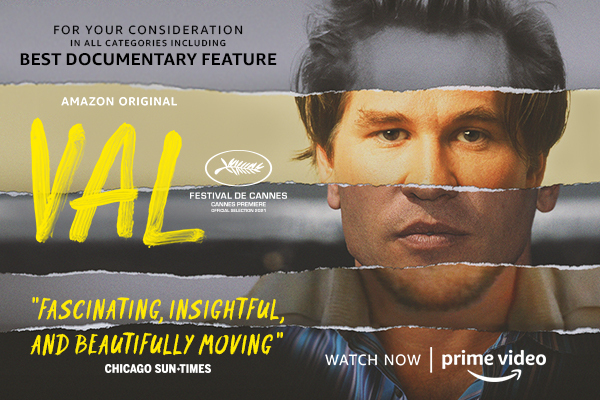
VAL is streaming now on Amazon Prime Video.
Quote of the Week
“He’s very different from me. That doesn’t mean he can’t do the job well. Give him time. It’s the only fair thing to do.”
–Bob Iger, the former Disney C.E.O., responding in The Hollywood Reporter to criticism of the current C.E.O., Bob Chapek, with a comment that some (including me) interpreted as a subtle dig on Chapek’s lack of experience in dealing with creative people.
Golden Globes Will Be Awarded After All
If an awards show happens, but there’s no one there to see it, does it make a sound?
We’re about to find out. The Golden Globes have been kicked off NBC for 2022, but the H.F.P.A. is officially planning to nominate and award winners this year, regardless of whether anyone accepts the trophies. In a Friday letter from H.F.P.A. president Helen Hoehn and interim C.E.O. Todd Boehly to studios and the group of publicists waging war against the organization, the leaders said for the first time that “we remain committed to awarding the 2022 Golden Globe winners.” They then proceeded to outline the revised rules for submitting films and shows for consideration.
Why?, you might ask. Don’t the Globes exist primarily to convince celebrities to gather in nice outfits and be shown on TV? Yes and no. The awards themselves do matter, as I’ve chronicled in this space, especially for the marketing of films throughout awards season. Plus, the H.F.P.A never said it wouldn’t give awards, and I understand the desire to keep the tradition alive, even amid the ongoing inclusion and governance scandal. It sends a message that the group isn’t just about a party and will continue its mission to celebrate and promote worthy projects, regardless of who shows up to kiss their rings. It’s the right move, both optically and practically.
Unless, of course, this year’s nominations are embarrassing, or stars use the nom news to crap on the H.F.P.A. anew, or even to renounce their honors. (Luckily for the H.F.P.A., Tom Cruise and Scarlett Johansson, the two highest-profile stars to “give back” their awards when the scandal broke, aren’t really in contention this year, unless the H.F.P.A. wants to honor Black Widow or give Johansson an honorary award for best performance by a lead actress in a short-lived lawsuit against Disney.)
An H.F.P.A. representative says they haven’t figured out how the nominations and awards will be announced. But remember, back in 2008, there was a Golden Globes press conference, rather than a usual show, thanks to the Writers Guild strike. It was awkward but got the job done. I’ve heard the H.F.P.A. will try something similar, maybe on the same night as the Critics Choice Awards (which used to be Globes Sunday), and invite news media to cover it. That’s not quite an NBC primetime extravaganza, but it’s better than nothing.
And at this point, it doesn’t look like the publicist-led boycott of the Globes will be ending anytime soon. Boehly, Hoehn, and other H.F.P.A. members, fresh off the announcement of diverse new additions and governance reforms, met with a few groups of talent flacks this week, including a Thursday Zoom with the gatekeeper faction led by Kelly Bush, Cindi Berger, and Marcel Pariseau. Depending on who you talk to, either small progress was made, or the publicists moved the goal posts again. H.F.P.A. press conferences continue to be a sticking point, with the P.R. pros wanting to end them entirely and the H.F.P.A. insisting that concerns about member behavior can be addressed without killing the access to talent that is the organization’s entire reason for existing in the first place.
One participant in the Thursday call passed along an amusing tidbit. Publicist Amanda Lundberg, in defending her role in this crusade, “said she doesn’t care what Matt Belloni writes about her, she’s not a gatekeeper, she’s an advocate,” this participant told me. Two things. First, when someone says she doesn’t care what a journalist writes about her, that person definitely cares what the journalist writes about her. And second, trust me, it was never my intention to become a chronicler of the Golden Globes, of all things. But this saga hits all the touchpoints of modern Hollywood: Power, leverage, race, identity, accountability, performative politics, conflicting agendas, hypocrisy, and, of course, money.
ADVERTISEMENT 
My Reading List (Part 1) …
This Trade Will Give You Great Coverage for Just $150,000 a Year
It’s open season for open secrets in the media industry. The New York Times’ Ben Smith took down Carlos Watson’s Ozy Media by simply illuminating (albeit in jaw-dropping fashion, complete with its C.F.O. allegedly impersonating a YouTube executive) the sham puffery of a media outlet without an actual audience—a fact that most people in the media already assumed about Ozy. Then on Friday, The Daily Beast revealed The Wrap boss Sharon Waxman to be an insane bully, who presides over a toxic sweatshop that “degrades” employees. Again, something most of us in Hollywood media knew years ago.
It got me thinking about other open secrets in media. Are you familiar with Hits magazine? It’s a well-read music trade publication, probably third behind Billboard and Pollstar. They cover deals, hirings-and-firings, charts and “innuendo” (their word) with a print magazine and web arm called Hits Daily Double. It’s also pretty well-known in the music business that Hits is pay-for-play, meaning it extracts financial deals with companies to guarantee certain coverage in exchange for money.
Listen, I’m no Pollyanna when it comes to the trade press. Having worked at a trade for more than a decade, I know better than most how it works when the subjects of the articles are also the advertisers/subscribers. Back-scratching and sponsored content are common. Music is particularly incestuous, with a history of payola going back decades.
But I’ve never seen anything as explicitly quid pro quo as this proposed contract that was sent by a Hits “research editor” in August to a major talent agency. (The agency says it refused to sign it; it then got passed around as a laughingstock and eventually leaked to me.) For the low-low-low price of $150,000 a year (“billed monthly,” according to the contract), the agency would get:
It goes on and on, an amusing 10-point plan of cash for coverage. And I’m told these kinds of deals are pretty common at Hits, with major agencies and labels routinely signing them. Indeed, in an email from the Hits editor to this agency, Hits boasted that competitors had signed such a deal (and the magazine helpfully pointed out that it had just killed a couple negative headlines based on the hope of making a deal). When I asked another agency if it signed a similar contract, it wouldn’t deny doing so. After all, Hits also has a gossip column, Rumor Mill, which sometimes goes after particular people. If I was a music executive or agent, I certainly wouldn’t want them going after me.
I called up Dennis Lavinthal, Hits’ co-founder and publisher, who launched the magazine in the ‘80s after a career in promotion, and asked how long he’s been doing these kinds of deals. In the old, pre-internet days, trades were cozier with their subjects, and scrutiny was light. But social media has made everything more transparent, and media outlets are now held much more accountable for their practices, as Ozy and The Wrap recently found out. Lavinthal politely told me to email him my questions, then he didn’t respond. I guess that’s a no-comment.
My Reading List (Part 2) …
The Feedback
I got some lively responses to my item on Thursday about the defection of Hulu’s president, and the backlash to the “leveling” at Disney. A few examples:
“You only scratched the surface on Hulu. It’s a shell of its former self, a ‘label’ rather than a company, with all its actual functions absorbed into the Disney machine. No wonder everyone is leaving.”–a lawyer
“Hulu never turned a profit until Disney took over. Why wouldn’t they streamline its digital operation, cut costs, and ‘level’ Hulu into the rest of the company? These whiners objecting to the new direction have obviously never been involved in a media acquisition.”–a banker
“It's unfortunate how Hulu just never hit its true potential because of the ownership structure. This is another chapter in a story that has been playing out for the last ten years.” –an executive
And Finally …
Do You Know the Anonymous Rich Guy Who Just Shut Down a Studio?
I’m certainly not one to tell the superrich what to do with their money. But the news this week that Solstice Studios, Mark Gill’s indie film outfit, lost its funding and will wind down after finishing Ben Affleck’s currently-shooting Hypnotic got me wondering: Who did this?
After all, Solstice launched back in 2018 with what was called a $400 million war chest, plans for 65 employees, and a strategy to make and distribute up to 3-5 films a year. Indie veterans know that’s not actually a guaranteed $400 million, and press releases often don’t turn out to be, you know, true. But sources at Solstice told me the backer actually did commit to $200 million if different thresholds were met. He just didn’t want to reveal himself publicly.
Then the pandemic hit, Solstice’s first movie (Russell Crowe’s Unhinged) was released amid closed theaters (though it did really well on VOD), and all of a sudden, the backer wanted out. I’m told Gill spent the summer scouring to replace the funds, and he was close with a couple potential saviors, but nothing panned out, and this week, the plug was essentially pulled. A mid-budget theatrical movie distributor isn’t the easiest sell to investors these days.
That’s life in the indie business, which has always been a playground for impulsive rich guys and shady money. But investors usually reveal themselves—after all, they need to get themselves into those premieres and parties—and if they don’t, they at least engage a front person as the face of the money. Solstice employees never saw that face, and the backer never revealed himself to all but a tiny few. A couple employees I reached didn’t know who he was, Gill wouldn’t talk to me, and the mystery backer’s lawyer, Lindsay Conner, wouldn’t comment. All I found out was that it’s a man, he’s American, and he’s not one of the usual suspects in film finance.
Do you know the guy who killed Solstice Studios? If so, there may be some status-defining Puck merchandise in your future.
Have a great week, Matt
Got a question, comment, complaint, or drinks invite? Email me at Matt@puck.news or call/text me at 310-804-3198.
FOUR STORIES WE'RE TALKING ABOUT 
I’ve never seen a quid pro quo as explicit as this proposed contract sent to a major talent agency. MATTHEW BELLONI 
For some, the 2016 election was the wake up call. For others it was the Jan. 6 attack on the U.S. Capitol. For most, it still hasn’t come. BARATUNDE THURSTON 
Despite coverage suggesting the contrary, Facebook is not facing an existential crisis, and Frances Haugen is far from Facebook's worst nightmare. DYLAN BYERS 
The import of Tesla moving its headquarters to Austin is certainly overblown. But there is no question that the pandemic has upset the traditional work-life balance. WILLIAM D. COHAN 
You received this message because you signed up to receive emails from Puck.
Was this email forwarded to you?
Sent to {{customer.email}}
Puck is published by Heat Media LLC.
For support, just reply to this e-mail. For brand partnerships, email ads@puck.news |


SHARE