 |
 |
|
Welcome back to What I’m Hearing, after a big weekend in Hollywood’s labor wars.
Programming notes: This week on The Town, Lucas Shaw and I asked why Disney went so big at Cannes, and producer (and former network/studio chief) Gail Berman explained why the studios won’t just pay the writers. Subscribe here and here.
Discussed in this issue: David Zaslav, Jon Avnet, Amy Pascal, Jeff Zucker, Rich Gelfond, Tom Cruise, Kathy Kennedy, Casey Wasserman, Sherry Lansing, Stacey Snider, Chris Nolan, Chris Licht, Ken Lerer… and the Con Queen of Hollywood.
But first…
|
| Who Won the Week: Phil Lord and Chris Miller |
|
| Easy one. The Spider-Man: Across the Spider-Verse writer-producers worked with many collaborators, but after being fired by Disney off Solo and seeing their The Mitchells vs. the Machines lose the animated feature Oscar to Encanto, they’re likely enjoying this $121 million domestic opening a bit more—especially considering Disney’s troubles in animation lately.
Bad timing: Last week’s 75 layoffs at Pixar—including two responsible for Lightyear—make news just as Sony joins Universal in kicking Disney’s animation ass this year. |
| Face to Face with the Con Queen of Hollywood |
|
| One of the weirder stories we published when I ran Hollywood Reporter was Scott Johnson’s 2018 investigation of a scammer we dubbed “The Con Queen of Hollywood.” Prominent industry women—Amy Pascal, Kathleen Kennedy, Donna Langley, Stacey Snider, among them—were being impersonated by someone who convinced creatives to spend thousands of dollars traveling to Indonesia in pursuit of movie projects that weren’t real.
It was a bizarre story that was soon followed by several media outlets and podcasts. But now, five years later, Scott is finally publishing his definitive account of the saga, The Con Queen of Hollywood: The Hunt for an Evil Genius (Harper). It’s out on Tuesday (pre-order here), and I tore through it this weekend. It’s great.
Scott actually tracked down the Con Queen in the U.K., confronted him on the street (yeah, it’s an Indonesian guy named Hargobind Punjabi Tahilramani, a.k.a. Harvey), and sparked a relationship of sorts over many phone calls. He chronicles Harvey’s journey from Jakarta to West Hollywood to Manchester, even through what Harvey claimed was an internship at the Weinstein Co., where Harvey—the convicted rapist Harvey—allegedly told Con Queen Harvey that he was his “favorite” and had a “future in this business.” Indeed.
Anyway, one thing I’ve always wondered about the Con Queen is why he impersonated these particular female executives. Johnson answers that question:
“Ever since he was a boy he had loved Amy Pascal. She was a ‘hoot.’ She was ‘dynamic.’ While it was unusual for a child to be drawn to the producer of a movie rather than its stars, Pascal’s history of generating hit after hit impressed him. He wanted to work for her. Some of these women, like Pascal and Kathleen Kennedy, were to be revered; he said he regretted what he had done to them. Sherry Lansing, with the black hair—he swooped his hand along the side of his head—was the classiest woman in this business. But there were others, like Stacey Snider and Deborah Snyder, both of whom he had impersonated, who ‘deserved’ what had happened to them—what he had done to them. In the course of normal business, all of these women might be at each other’s throats, as the Sony hack and the subsequent email dump had amply demonstrated. They were all wealthy and powerful, corporate warriors and captains of industry, responsible for shaping the cultural appetites of millions of people around the world. Feted, envied, and reviled in equal measure, they enjoyed a status somewhat akin to royalty in the insular world of Hollywood. Harvey had united them in ignominy.”
Dark stuff. So why, ultimately, did he do it? “Because when he spoke to people as himself, as poor Harvey, he was nothing more than a freak, a terrorist,” Scott writes. “But the voices of other people, powerful people, powerful women, were contained vessels, and once he inhabited them, he was liberated.” |
| Quote of the Week (Ari edition)… |
|
| “I would pay the salaries of Bryan Lourd, Kevin Huvane to stay in the job. I would pay their salaries. It’s the greatest competition of all time.” –Ari Emanuel, the Endeavor C.E.O., ripping his CAA rivals in a wild appearance on the Freakonomics podcast.
Runner up: “Mike Ovitz gave them everything. They had, for lack of a better metaphor, Tiffany. And you know what they did with it? And I think Walmart’s a great company. But let’s just say they made it Walmart.” –Ari, still ripping the CAA guys.
Second runner up: “If you're going to bet on somebody, I would bet on that man. On anything he does.” –Still Ari (!), explaining why Endeavor invested in Elon Musk’s Twitter.
More representation news: Casey Wasserman’s rumored acquisition of management firm Brillstein Entertainment Partners looks like it’s happening. Still some open items, including price and payouts, but both sides are optimistic the deal will close this summer. (No comment from Wasserman.)
Now to the big news of the weekend… |
|
|
| Last night, the Directors Guild and the studios reached a tentative deal, as we first reported. But is the pact as “truly historic” as DGA negotiations committee chair Jon Avnet claims? And how will the new agreement affect the ongoing Writers Guild strike, now in its second month, and the SAG-AFTRA negotiations, set to begin Wednesday?
What we know of the key DGA deal points: First, basic wages will increase by 5 percent in the initial year of the three-year contract, followed by 4 percent and 3.5 percent increases. The guild calls those bumps “groundbreaking,” but—unlike past increases—these don’t make up for hefty inflation in the past two years (7 percent and 6.5 percent) and don’t exceed current inflation, which is running at 5 percent per year. Past increases, typically 2.5 percent or 3 percent, exceeded inflation by about 1.5 percent. These don’t. |
|
A MESSAGE FROM OUR SPONSOR
|
 |
|
|
|
| So why the compromise? The reality is that most powerful DGA members don’t work at scale, so this issue affects mostly fledgling TV directors and below-the-line members such as assistant directors. That modest increase might satisfy the WGA too, as its most recent ask was just a percentage point higher than what the DGA got, but SAG-AFTRA is another story: Many members work at scale, and I’m hearing the actors’ union is likely to press for significantly higher wage increases.
Also hovering over the SAG-AFTRA negotiations: This is an election year for the union. That disincentivizes compromise with the studios, since the dominant Unite for Strength faction will not want to be vulnerable to attacks from the opposition Membership First group. Indeed, this year, both factions have been talking strike, especially recently. In a message to members this afternoon, SAG-AFTRA national executive director Duncan Crabtree-Ireland congratulated the DGA but cautioned, “Our bargaining strategy has never relied upon nor been dependent on the outcome or status of any other union’s negotiations, nor do we subscribe to the philosophy that the terms of deals made with other unions bind us.” For its part, the WGA also congratulated the directors but told its members, “Our own bargaining positions remain the same as they were on May 1, 2023.”
If the devil is in the details, it looks like the DGA’s focus was on a second issue, enhancing the residuals formula for foreign streaming, a key growth area for platforms such as Netflix. There, the directors gained a key victory, an apparently significant increase in the foreign residual. Details of that enhancement haven’t been released, and won’t be until the guild’s national board votes Tuesday on approving the new agreement.
But notably, the DGA does not appear to have achieved an increase in the domestic streaming residual (other than, presumably, the same percentage increases as with basic wages). Nor, crucially, did the DGA achieve a success-based enhancement to the streaming residuals formula, a demand that the guild abandoned early on, as I previously reported. The guild says it did achieve “increased studio transparency in residuals reporting,” but no word yet on the specifics of that.
A third key issue is artificial intelligence. The DGA says it obtained an acknowledgement that “A.I. is not a person” and that “generative A.I. cannot replace the duties performed by members.” Will this satisfy the other two guilds? The WGA already has contract language that says that a “writer” does not include “any corporate or impersonal purveyor of literary material,” but that doesn’t fully address the issues facing writers. And SAG-AFTRA is on heightened alert over A.I., given that VFX technology already enables deepfakes and other threats to actors’ personas. Here again, the details matter, and we don’t yet know what specific language the directors achieved.
Other DGA gains include improvements in comedy-variety programs (such as late night shows), high budget ad-supported video on demand (AVOD), D.E.I., safety, and economic and creative rights for feature and episodic directors and directorial crew. Some of those enhancements may set a pattern for the other two guilds, and the sheer volume of deal points is impressive.
All in all, a solid deal, but “truly historic” seems a stretch, in light of the compromises on wage increases and streaming residuals. And although the pact appears to meet the DGA’s needs, the writers and actors have concerns that remain unaddressed. That means that the writers will likely remain on the picket lines for the foreseeable future, unlike in 2008, when a DGA deal helped end the hundred-day writers strike. And if the actors and studios can’t come to terms by June 30, we’ll likely be looking at a second walkout.
Two concurrent strikes brought historic gains in 1960—residuals for major studios’ movies rerun on television, plus establishment of pension and health plans—and that year, rather than 2008, may be the model for the current labor turmoil. We’re hearing that the studios are concerned about the fall television season, and rightly so. That anxiety just might facilitate an actors’ deal and could bring the writers and studios back to the table in early July, but the window for saving the fall season will be short. That’s three contingencies that would have to fall into place for this all to end soon. Keep your fingers crossed. |
|
|
|
|
| Lost in the Spider-Verse cheerleading: Little Mermaid will barely limp past $500 million worldwide, a disastrous result for a $250 million+ franchise film. And Fast X has grossed in three weeks of domestic play only slightly more than Spider-Verse did in three days. [IndieWire]
A sign Disney vastly overestimated Mermaid: This pre-booked profile of production chief Sean Bailey, which turned from victory lap to exploration of political polarization. [NY Times]
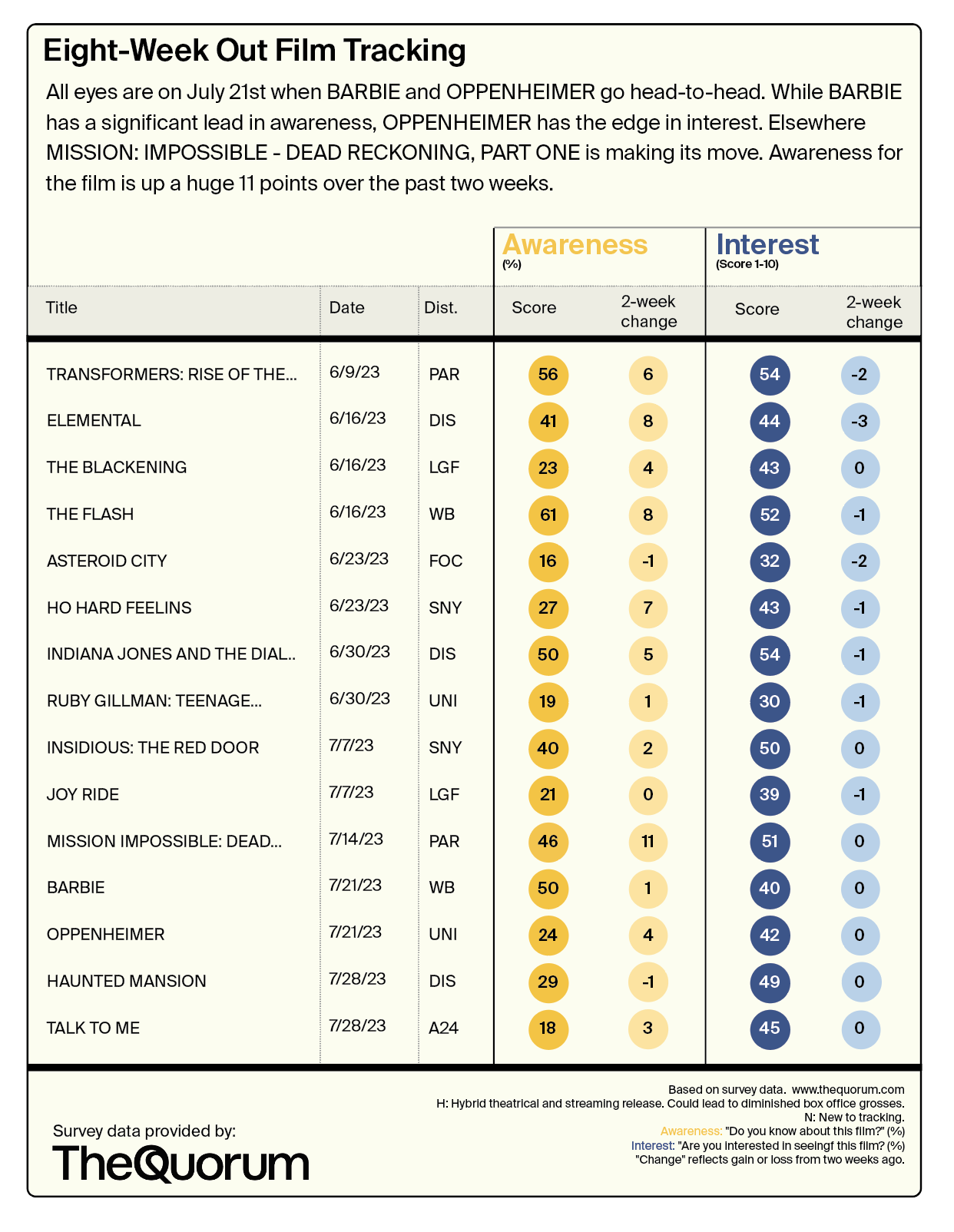
More nail-biting: Six weeks until the Barbie vs. Oppenheimer showdown, and both are tracking like one-quadrant films. Barbie, in particular, ranks 32nd in interest among young men and 46th—dead last—among older men.” [Quorum]
Key line from Tim Alberta’s already-legendary profile of CNN’s Chris Licht: “Everyone at CNN had long ago come to realize that Licht was playing for an audience of one. It didn’t matter what they thought, or what other journalists thought, or even what viewers thought. What mattered was what David Zaslav thought.” [The Atlantic]
More: My Puck colleague (and Licht-ologist) Dylan Byers follows up: “It has become clear, based on conversations with well-placed sources, that Zaslav’s once steadfast support has wavered considerably.” Ceding business operations to Zaz henchman David Leavy is either a last-ditch course correction or the beginning of the end for Licht, depending on who you believe.
New tonight from Brian Stelter: Can Chris Licht survive? [NY Mag]
One thought: When I’m old, semi-retired and teaching Media Relations 101 at a community college in Boca Raton, I’ll assign the Licht piece as the best example of how NOT to handle a major profile. Full access? For nearly a year? To a writer whose last profile, of Nikki Haley, almost derailed her presidential campaign? And for an untested executive taking on one of the most difficult and scrutinized jobs in media? Sometimes P.R. people need to step in to protect executives from themselves; not doing so here was a Hall of Fame mistake.
Ken Lerer’s advice for Jeff Zucker, who can’t seem to stop trash-talking CNN: “This is all very sad for Jeff. He should move on with his life. It’s disheartening to see.” Seriously. [NY Times]
Retiring theater lobbyist John Fithian joyfully rips Netflix’s Ted Sarandos for testing box office in other countries and keeping the (presumably positive) results secret. [The Business]
Expect Lucasfilm’s Kathy Kennedy to find herself under the media microscope in articles like this one if Indiana Jones doesn’t perform. [Fortune]
The San Diego Padres are becoming the test case for the implosion of the RSN model as bankrupt Diamond Sports skips a $13 million rights payment and MLB puts the games on a streamer and local TV carriers. Who’s next? [WSJ] |
|
|
| Tom Cruise, ladies and gentlemen. His aggressive efforts to secure premium screens for Mission: Impossible amid tough competition (and Oppenheimer’s three-week IMAX exclusive) drew some thoughtful responses. A few examples:
“This is why Tom Cruise is a movie star and why so many actors of my millennial generation are not. Cruise deploys his gravitational leverage and force of will to bend the Hollywood landscape around him for the best possible positioning. That also very often makes him come across as a self-centered, ego-driven jerk. Given the social media environment of today, celebs are (understandably) more image conscious than ever. I have spoken with more than a few who want XYZ done on their behalf but don't necessarily have the stomach for how they might be perceived as a result. It pays to be an asshole sometimes.” –An analyst
“What is Paramount doing here? There’s a great way to avoid Nolan’s IMAX blockade: Release Mission a week earlier!” –A producer
“Good for Rich [Gelfond, IMAX C.E.O.] for honoring the Oppenheimer deal when he knows he could make more money with Mission.” –Another producer
“That’s either a Paramount or Skydance exec dropping the ball, or Cruise himself. He was effusive in praising Tenet 3 years ago, right? He knows Nolan loves IMAX and shoots on it. It’s ironic that two of the guys most associated with promoting the theatrical experience over the last 5-10 years are in this situation, though it’s Cruise’s issue and not Nolan’s. They should be teaming up for the cause.” –An executive
“I’m so glad you wrote about the supply crunch. Certainly 2021 (and to an extent 2022) box office was depressed by the number of releases. However, the business has been way (way) oversupplied with movies for three decades. The industry would be insane to return to anywhere near pre-Covid volume. Exhibitors may complain/say they need all of those movies, but that’s because: 1) they have too many screens relative to audience demand, and 2) a number of those exhibitors are run by buffoons. Moviegoing has actually been insanely durable, Hollywood just made too many movies and spent too much on them.” –Another executive |
|
|
| Awareness for Cruise’s Mission: Impossible — Dead Reckoning Part One on The Quorum chart spiked in the past two weeks, hopefully not because of the Danny Masterson verdict… |
|
|
Have a great week,
Matt
Got a question, comment, complaint, or embarrassingly effusive praise? Email me at Matt@puck.news or call/text me at 310-804-3198. |
|
|
|
| FOUR STORIES WE’RE TALKING ABOUT |
|
|
|
|
|
 |
|
|
|
Need help? Review our FAQs
page or contact
us for assistance. For brand partnerships, email ads@puck.news.
|
|
|
|
Puck is published by Heat Media LLC. 227 W 17th St New York, NY 10011.
|
|
|
|