 |
 |
|
Hello and welcome back to What I’m Hearing.
|
|
As a reminder, I’m on vacation this week but you remain in the loving care of Puck’s streaming industry analyst, Julia Alexander, and Hollywood legal expert Eriq Gardner. Julia’s previewing the August streaming showdown between House of the Dragon (HBO) and The Rings of Power (Amazon), and Eriq’s got an update on CBS’s Les Moonves litigation and Paramount’s $100 million insurance dispute over Mission Impossible 7.
By the way, I’ll be interviewing some folks from Hulu’s The Dropout in New York City on August 10. Doors open at 6 p.m., followed by a panel and a reception with yours truly. Yes, there will be free food. It’s only for subscribers like yourself; RSVP here.
But first…
|
|
|
- The NFL Enters the Streaming Wars: The National Football League is launching a streaming service—kind of. The new NFL+ (what else would they call it?), which debuted on Monday, will offer out-of-market pre-season games and in-season local games, plus assorted bonus content, on mobile devices for $4.99 a month or $7.99 for its premium edition. It’s not quite a shot across the bow of ESPN and the broadcast networks—most of that content was previously available for free on the NFL app, and you’ll still need cable plus Sunday Ticket to watch everything else—but it does represent the league’s first true experimentation with the direct-to-consumer market. Will all NFL games eventually stream exclusively on NFL+? Not for the foreseeable future, given its extraordinary leverage over its broadcast partners and affinity for the advertising business, in general. But does the league want to have a closer connection (i.e. direct data) from its audience as it grows its events, merchandising, and rights licensing businesses? Yes, yes, yes.
- App Store Mind Games: Netflix is taking advantage of new rules stipulating that Apple has to let developers link out to external pages, rather than going through the App Store, for customers who want to sign up for a product. In theory this means Netflix can collect 100 percent of a customer’s subscription and avoid paying Apple’s 30 percent toll. But Apple isn’t making it easy to opt out; the company is displaying a spammy warning before customers leave the App Store to go to an external sign-up page. What’s worse, losing 30 percent of a subscription sign up fee or allowing customers to wonder if they’re getting phished when trying to watch The Gray Man?
- Netflix’s Franchise Fever: And Speaking of The Gray Man… Netflix is apparently happy with its most expensive movie to date (at $200 million) because film chief Scott Stuber and his team have already announced a sequel and a spinoff. That’s… ambitious. It’s also in line with Netflix’s new-ish franchise strategy. Red Notice, Army of the Dead, Bright… the list goes on. It starts with a movie, immediately followed by a sequel or prequel, delves into a spinoff film or series and, well, this is as far as we’ve currently gotten in the development cycle. Can The Gray Man be the big franchise blockbuster that Netflix so clearly craves? It debuted with 88.55 million hours viewed, which is about 60.15 million fewer hours than Red Notice. So… jury’s out.
- Paramount Gets Downgraded: Boutique research firm MoffettNathanson downgraded Paramount Global ahead of the company’s earnings on concerns that the company will face headwinds as the advertising industry starts to feel the pressures of the current economic climate. (Just look at Snap’s recent earnings…) The downgrade has nothing to do with Paramount+’s performance—MoffettNathanson actually notes the solid pacing that the streaming service has achieved. But when it comes to advertising dollar pullbacks, the firm doesn’t see Paramount as well placed as some of the digital giants.
And speaking of Paramount, Eriq Gardner reports… |
| CBS Has a New Moonves Problem |
|
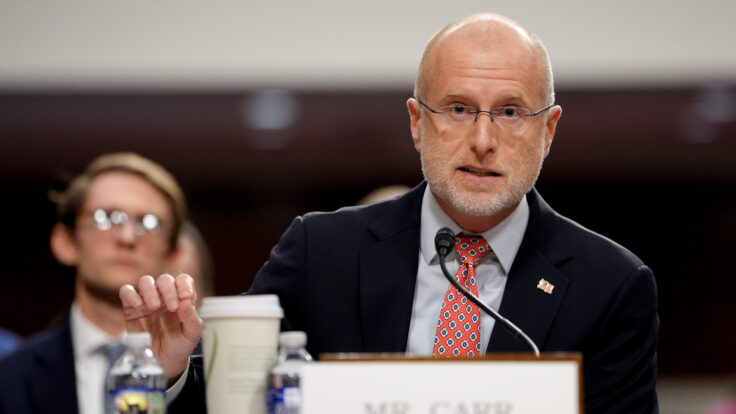
| Could New York Attorney General Letitia James be preparing to hit Paramount Global with a securities fraud case? Shareholders sued CBS back in 2018, contending that the company had misled investors by failing to disclose the extent of the #MeToo scandal surrounding Les Moonves, the former CBS chairman and chief executive who stepped down amid allegations that he made unwanted advances toward women. Earlier this year, as first reported by Puck, CBS settled the shareholder litigation.
But the $14.75 million deal still needs to be approved by a New York judge, and this week, James’ office surprised Paramount by submitting a statement of interest regarding the proposed settlement. According to a filing in New York federal court, the attorney general stated that during a securities investigation into CBS, it had issued subpoenas, obtained sworn testimony, conducted interviews, and received voluminous documents and communications. What’s more, James expressed concern that the settlement might interfere with her office’s own recovery efforts. Paramount obviously has known about this investigation—it’s been going on since April 2019—but it’s been several months since James was given a draft of the settlement. Now, suddenly, New York’s top law enforcement official is making an objection and hinting at something else that’s coming.
All’s not unwell at Paramount, though. The company’s film division is putting the final touches on settling a huge insurance dispute over delays for Mission Impossible 7, which was forced to shut down production in 2020 following at least one positive Covid test. (It’s reported that Tom Cruise himself was the individual who got sick.) Paramount believed this triggered its hefty $100 million policy that ensured the availability of top cast, but Federal Insurance Company (a unit of Chubb) insisted that only $5 million was available under a policy that kicked in when authorities in Italy—where M:I 7 was being filmed—issued quarantine orders that interfered with production. On Wednesday, a California judge was informed that the parties have a settlement. |
 |
| The Summer Box Office Wars Come to Streaming |
| At last, the streaming industry has matured to the state where it has multiple viable contenders, the best content on the market, and intense summer season face-offs can make-or-break a parentco’s quarter. |
|
|
|
| The summer blockbuster showdown used to happen in IMAX theaters across the globe. And by used to, I mean all of three years ago. Yes, there was once a time when the competition between franchises, helmed by the biggest studios in Hollywood, was measured in actual ticket sales and culminated weekly in an obsessively-scrutinized Sunday box office report.
That’s not true this summer. There’s only one blockbuster-style film, Brad Pitt’s Bullet Train, in theaters this August. The real showdown that has industry watchers salivating is happening on streaming platforms, and that’s something truly spectacular considering that Netflix used to be the only major player in the space. Again, by used to I mean three years ago. This summer, five shows will test a number of streaming strategies and theories, delivering key insights not only for their platforms but also for the industry at large: House of the Dragon (HBO), The Lord of the Rings: The Rings of Power (Amazon), She-Hulk and Andor (Disney+), and The Sandman (Netflix). |
| ADVERTISEMENT |
 |
|
|
| One of those prevailing theories has been that customers in developed markets will pay for 3-5 streaming services per household. Now, with the possibility of a looming recession and continued slowdown for Netflix in the United States, the new hypothesis is that maybe audiences will just toggle back and forth between streaming platforms, flipping their subscriptions on and off based on their monthly interest and what content is on tap.
Now that Disney+ and HBO Max have about 45 million subscribers (give or take) in the United States, Netflix has 75 million, and other streaming services like Paramount+ are catching up, we can test those theories. If content is truly king, the month of August will act as the king’s court, as competitors arrive to prove they can hold their own. Maybe everyone signs up for Netflix, Disney+, HBO Max, Prime Video, Paramount+, and all the rest. Or, just maybe, we see some intentional activity around signups and cancellations as subscribers discover the right service for them instead of just relying on whatever’s available. |
|
|
| So which titles are gearing up to go head-to-head for eyeballs and credit card numbers? Here are the five shows that industry insiders will be watching most carefully for early insights into which streaming services are winning, or defending, new market share.
House of the Dragon
- Cost: “Less than $20 million an episode,” according to Variety.
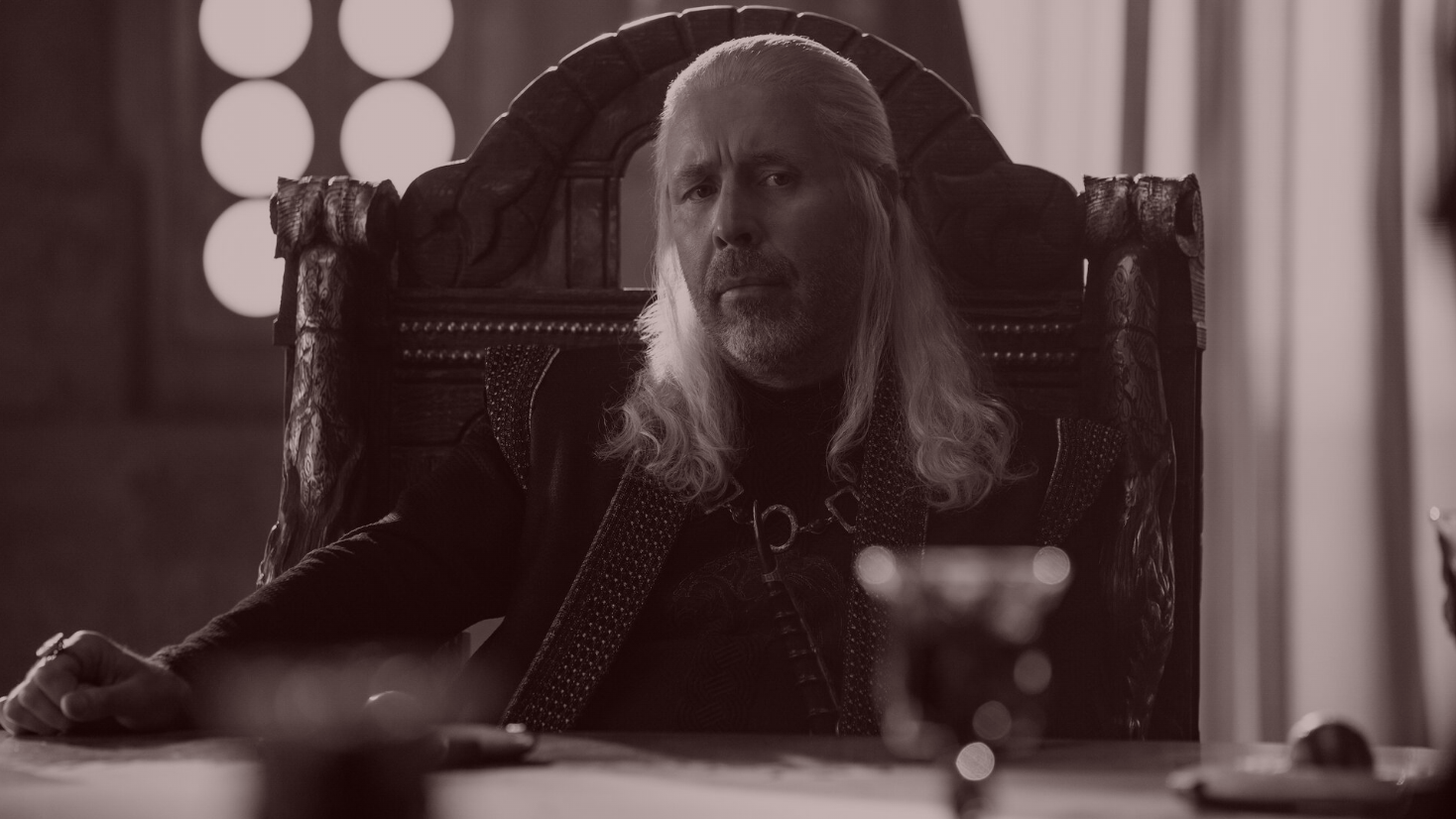
- Stakes: Pretty high. This is the first Game of Thrones installment since the original series ended in 2019, and a big bet that audiences will return for HBO’s first true franchise. The last Game of Thrones season didn’t generate much fan love, but the series was one of HBO’s most successful of all time. In a world of heavy reliance on I.P., and one where action fantasy series drive demand for subscriber growth, House of the Dragon needs to reinvigorate that love with old fans and newcomers alike.
- Goals: In the pre-HBO Max era, we had the “Game of Thrones Effect,” which referred to the exponential growth in HBO Now subscribers when a new season premiered, followed by an exponential churn cycle after that season of Game of Thrones ended. The value proposition of HBO alone wasn’t enough for Game of Thrones fans to stick around. Now, of course, HBO’s content library is much broader. We already know that Game of Thrones should bring in new subscribers; the question is whether the show’s referral value—i.e., how many of those subscribers then watch something else on HBO Max—can sustain those new audiences.
- Hype Level: Five fire-breathing dragons out of five.
The Lord of the Rings: The Rings of Power
- Stakes: There’s a lot riding on The Rings of Power. It’s gotta set up Amazon as a true franchise powerhouse. It’s gotta dominate weekly conversation and generate significant buzz—especially if it’s going to compete with established franchises like Game of Thrones and Star Wars. It’s gotta reinforce that Amazon can do high-quality fantasy storytelling. And, perhaps most importantly, it’s gotta set up Amazon Prime Video as a true entertainment player in the space and not just an add-on to the conglomerate’s retail service. What is Amazon Prime Video’s identity? The Rings of Power can help further establish that, too, since it has long moved away from quirky fare (The Marvelous Mrs. Maisel, Transparent, I Love Dick) toward broad based higher-TAM content.
- Goals: At $465 million, The Rings of Power has to bring in Prime Video subscribers in territories with low household penetration rates and where e-commerce isn’t as much of a cultural staple. India, for example. Look, Amazon just raised the price of Prime Video in Europe by 20 percent, so the team has to feel pretty good about The Rings of Power. Prime Video succeeds due to subscriptions (perceived value) and engagement, which leads to stronger advertising and cross-site usage (watch a show, buy some dog food). The Rings of Power has to help with all that, with a bet of nearly $500 million on one season.
- Hype level: Four Ringwraiths out of five.
She-Hulk and Andor
- Cost: We don’t have figures, but Marvel shows have run up to $25 million an episode while The Mandalorian was $15 million an episode. These two likely run on the cheaper side.
- Stakes: At this point in Marvel and Star Wars’ Disney+ expansion, a new title isn’t going to generate huge subscriber gains. Customers who signed up for Disney+ to watch Star Wars and Marvel are unlikely to cancel. What’s at stake, however, is addressing concerns about quality on both sides. Boba Fett and Obi-Wan debuted to less than stellar reception, while Marvel Studios is going through its own awkward teenage phase on the film and TV side. Questions about oversaturation hurting Disney’s biggest tent poles are surfacing more and more (just look at Lightyear). Customers are still watching—just like they’ll watch She Hulk and Andor—so there’s less concern on strict consumption, but thinking longer term, both Marvel and Lucasfilm need to inject some genuine excitement back into the fanbase.
- Goals: Broaden the base. Each new installment in the Marvel and Star Wars Disney+ universe at this point should exist to accomplish two goals: move the universe forward to support and expand upon the main films, and broaden the total audience base. Ms. Marvel was one of the first Marvel entries that specifically tried to appeal to young girls. She-Hulk is a series trying to find a more female-focused audience. Andor will try to appeal to non-Star Wars audiences who like a good science-fiction story. Carrying a franchise into a new generation only works if the audience base grows and new stories resonate.
- Hype: Three Hulk smashes out of five.
The Sandman
- Cost: Reportedly $15 million an episode.
- Stakes: Netflix has consistently tried to prove that it can do strong adaptations of beloved comic books and anime series. It didn’t succeed with Jupiter’s Legacy, which turned into a $200 million failure. It didn’t work with Death Note, a feature film that drew groans from fans of the original manga. Its adaptation of Bone was canceled before development began. The Umbrella Academy, however, is one of Netflix’s few successful comic book adaptations, and the company is hoping that The Sandman can follow suit. If it works, Netflix has a potential franchise builder on its hands—and reiterates to audiences that its creative teams can deliver.
- Goals: A show as expensive and prolific as The Sandman is designed to bring in new audiences globally. That’s always Netflix’s goal—new show, more subscribers. Similar to Disney’s issue with Star Wars and Marvel, though, there’s also a need to prove quality control still exists at Netflix on its sci-fi and fantasy side. The Sandman is a cerebral story, and one of Neil Gaiman’s most beloved projects. This is the exact type of product Netflix needs to nail.
- Hype: Three Dream appearances out of five.
|
| ADVERTISEMENT |
 |
|
|
|
|
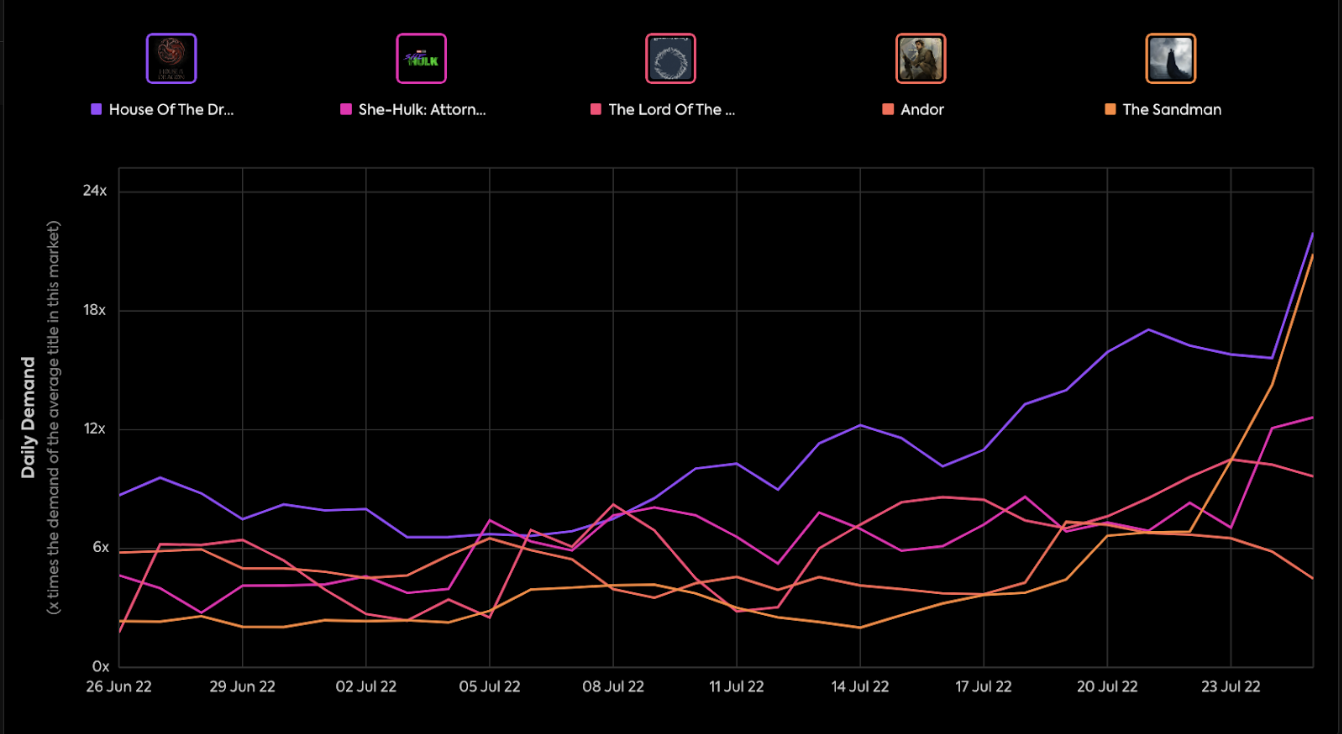
| Of all these new projects, House of the Dragon has the highest and most consistent level of pre-demand data, according to Parrot Analytics, where I work. Pre-release demand data is often used to demonstrate intent to watch a series. There are pre-release demand peaks, which often accompany a new trailer, but it’s the consistency in demand that can often reveal where audience anticipation truly lies. |
|
|
| The Sandman and She-Hulk both saw demand spikes following new footage out of San Diego Comic-Con that increased their visibility to audiences who may not have even known these shows were coming out. The Rings of Power has seen relatively consistent demand, albeit a little lower than House of the Dragon.
Here’s the thing though: none of this means it’s time to crown anyone a winner. What executives, producers, and showrunners really want from these shows is to have a Stranger Things 4 moment. Stranger Things likely helped Netflix stave off losing a million extra subscribers. (Good for the executives!) It became the most watched show on Netflix, and the most in-demand streaming original that Parrot has ever measured. (Good for the producers!) And it helped land the Duffer Brothers an overall deal with Netflix that included a Stranger Things stage play. (Good for the bros!) Stranger Things also dominated attention, on and off Netflix, and created its own ongoing cultural zeitgeist in and of itself that is still barreling along.
Winning in 2022 goes beyond box office receipts and opening weekend stream numbers—it’s a game of who holds the most attention. TikTok edits and viral sounds were just as crucial to Stranger Things’ success as the initial wave of consumption. And all of these shows—House of the Dragon, Lord of the Rings, Andor, etc.—belong to larger franchise-building initiatives. Those only work if there’s consistent levels of adoration and interaction beyond the first binge. Stranger Things, after all, is an obvious success from a viewership perspective, but it’s only a meaningful success because we’re still talking about it a month later. What title leads to longer engagement on a streaming platform, TikTok edits, gaming adaptations, and further investment down the line? For these types of titles, that’s the success the industry is looking for. That’s the big win.
More than anything, of course, this August’s streamer blockbuster season underlines one self-evident point: We’ve never seen anything like this before in the streaming space. The competition is exciting and it’ll produce meaningful data that we can then extrapolate to learn more about consumer behavior. If you’re into these things—and I imagine many people reading this are—August is kind of the month.
This is just the beginning, though. Competition is only going to increase. The move to streaming, while not as quick or profitable as some on Wall Street would have liked, is irreversible. Cord-cutting is increasing, alongside global broadband adoption rates. A hit show can help bring in new subscribers, but the bigger question is whether these shows help introduce new subscribers to the rest of the platform in order to keep retention rates high and revenue stable.
Remember, Game of Thrones helped to bring in a ton of new HBO Now subscribers with each passing season. Now, HBO Max needs to prove that House of the Dragon can do the same thing, and keep them from leaving once the credits on the final episode roll. |
|
|
|
| FOUR STORIES WE'RE TALKING ABOUT |
 |
| Ménage à FINRA |
| Revisiting an endless scorched-earth FINRA saga. |
| WILLIAM D. COHAN |
|
 |
| Cuomo’s Revenge |
| Chris's CNN media afterlife. Plus, Conde's financials. |
| DYLAN BYERS |
|
 |
| Hollywood's Secret Keeper |
| The notorious former “private investigator to the stars” has quietly returned to Hollywood. |
| ERIQ GARDNER |
|
 |
| Oz’s Great Escape |
| G.O.P. insiders are secretly frusted with the doctor's laissez-faire attitude. |
| TARA PALMERI |
|
|
|

|
|
|
| You received this message because you signed up to receive emails from Puck
Was this email forwarded to you?
Sign up for Puck here
Sent to
Unsubscribe
Interested in exploring our newsletter offerings?
Manage your preferences
Puck is published by Heat Media LLC
227 W 17th St
New York, NY 10011
For support, just reply to this e-mail
For brand partnerships, email ads@puck.news |
|
|