Welcome back to What I’m Hearing...
Happy Sunday, a little later thanks to Daylight Saving time. If you missed the news, my new podcast, The Town, launches tomorrow. It’s a collaboration between Puck and The Ringer, the Spotify studio founded by Bill Simmons. If you haven’t subscribed, you can do so here (for Spotify) or here (for Apple) or wherever you get podcasts… And I went on Bill’s show here to offer a preview.
Discussed in today’s email: Barry Diller, Spencer Neumann, Jane Campion, Geoff Morrell, Jay Penske, Kelly Campbell, Amy Schumer, Ron DeSantis, and Scientology’s $300 million donor…
SPONSORED BY 
Who Won the Week: Bob Iger
How great does the former Disney C.E.O. look for slamming the Florida “Don’t Say Gay” legislation weeks before Disney’s current leader Bob Chapek caused a firestorm by refusing to do so, before subsequently backtracking with a forced apology?
More on this topic below… but first, a few little news and notes items…

Disney’s new C.E.O. badly miscalculated in his attempt to pivot the company from left to center, compounding one of Disney’s worst internal crises in years. Will the public relations train wreck derail Chapek, too? I was having dinner last Friday in Brentwood with Geoff Morrell, the Walt Disney Co.’s new senior executive V.P. and corporate affairs officer, when he spotted a familiar face a few tables away. It was Bob Iger, the former Disney C.E.O., quietly dining with his wife, Willow Bay.
Morrell, a former BP spokesman and George W. Bush appointee to the Defense Department, who now runs communications and government affairs for Disney’s current C.E.O Bob Chapek, had never met Iger. Yet Morrell was in the middle of a burgeoning crisis over Chapek’s decision to stay neutral on Florida’s so-called “Don’t Say Gay” legislation, which would bar “classroom discussion about sexual orientation or gender identity.” It was a crisis made more incendiary because Iger had come out against the proposed law, tweeting to his 241,000 followers that it “will put vulnerable, young LGBTQ people in jeopardy.”
The Igers stopped by and chatted cordially with us on their way out, but the awkwardness was palpable, at least to me. After all, Iger, by the time of his exit last year, had become a corporate statesman with near-total command of his personal image, and he had used his platform—and the power of the Disney brand—to take positions on hot-button issues that were popular with employees, such as coming out against President Trump’s Muslim travel ban and Georgia’s “heartbeat” abortion legislation. Chapek wants to steer the company from left to center, and has tried to avoid what he views as political entanglements. It’s a variation on the old Michael Jordan line: “Republicans buy Mickey Mouse sneakers, too.”
Good luck with that. In the week that followed our dinner, Morrell and Chapek took quite a ride on the Space Mountain of modern corporate politics. Just in case you thought your week was bad, recall what happened:
So that’s where we are. I’ll admit that, P.R. flubs aside, this isn’t an easy situation for Chapek, and I initially thought he might be able to steer Disney—which, despite its Pride initiatives and large number of LGBTQ employees, is an umbrella brand that appeals to people of all ages and persuasions—to more neutral positioning. It took Iger awhile to feel comfortable taking those stands, and he did so with an eye on his own political future, including possibly running for president as a Democrat. Companies like Comcast, which also employs tens of thousands of people in Florida, and its C.E.O., Brian Roberts, have not been held to account like Disney. At least not yet.
But it’s also pretty clear that openly stating a goal of political neutrality at a creatively-driven company isn’t possible in today’s climate, especially on subjects that a vast number of employees consider issues of human rights and equality, not politics. Plus, Iger has conditioned Disney employees to expect the C.E.O. to “stand with us entirely,” as the Pixar letter put it. Chapek and his new comms chief misread the room and badly miscalculated how this would all play out. (Disney declined to comment beyond its statements.)
Does Chapek survive? That seems to be the topic du jour around town. I even overheard two people discussing the question at my kid’s T-Ball game yesterday, perhaps the ultimate L.A. moment. I think he does, at least for now. And if he goes down, it will be because the Disney share price has dropped by about a third in the past six months. But a larger narrative about Chapek is developing, and he and Morrell need to fix it.
ADVERTISEMENT 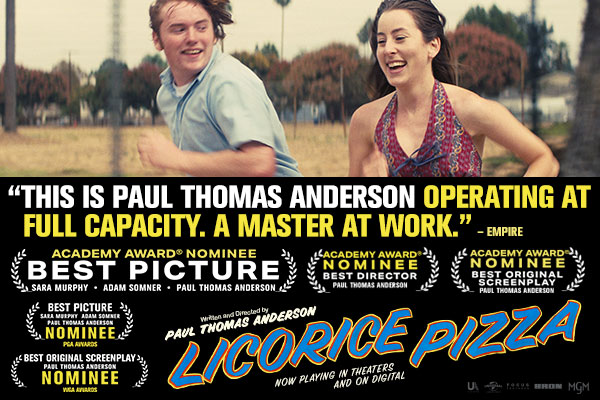
Licorice Pizza is a magical evocation of a time and place, taking audiences on a joyful journey back in time. Learn how the film constantly subverts our genre expectations, mixing poignant encounters with knockabout comedy. It’s a thrilling culmination of Oscar-nominated writer-director-producer Paul Thomas Anderson’s talents and his most tender and optimistic film yet.
Since taking on the C.E.O. role in early 2020, Chapek has often come across as aloof and unfriendly to his creative partners. The Scarlett Johansson lawsuit over Black Widow is the obvious example, but there are others, like squeezing talent on deals, and taking control of distribution away from creative executives. Many Pixar employees were already upset that their past three movies (Soul, Luca, and now Turning Red) went direct to Disney+ without a run in theaters, while Encanto, from Disney Animation, got one. (Though I’m told by a solid source that June’s Lightyear, the Toy Story prequel, is indeed planned as a theatrical exclusive.) Now this, they must have thought. Who the hell is this guy?
Internally, much ire has been directed at Morrell, who has ruffled many Donald Duck feathers since he joined Disney at the start of the year. Part of the challenge is that he replaced a longtime force in Zenia Mucha, who protected the Disney brand (and Iger’s image) with an iron fist. Observers outside and inside the company don’t think Mucha would have allowed Disney to get played by the H.R.C. and dragged into a public war with the governor of Florida. Morrell is said to be heavily influenced by Brunswick, the crisis communications firm that he inherited from Mucha but with which he has had a long relationship stemming from their work with BP. (Brunswick played a role in advising Chapek on the search that led to Morrell’s hiring.)
Morrell hasn’t been great about including his new colleagues in his process, and while he also worked in the Obama administration, Morrell donated to G.O.P. lawmakers Kevin McCarthy, Steve Scalise, David Perdue, Mitch McConnell and Ron Johnson, according to Judd Legum’s Popular Information newsletter. Morrell hasn’t donated to any Democrats in the past five years. Between Morrell and Chapek’s chief of staff, Arthur Bochner, who also served in the Bush administration, there’s a perception, at least, that the new Disney brain trust is conservative and is coming to change the company’s culture.
That’s probably overstating things. (After all, Mucha also came from G.O.P. politics.) And it’s easy to blame the flack, especially a new person. Chapek had media problems before Morrell, and he’s not alone here. Netflix co-C.E.O. Ted Sarandos found himself at the center of a lengthy news cycle over his clumsy defense of Dave Chappelle’s transphobic comedy special—a controversy he finally overcame by apologizing to employees, just like Chapek did. And Spotify’s Daniel Ek still hasn’t totally shaken the outrage over his tolerance of Joe Rogan’s vaccine misinformation and racist language. Culture wars are part of the challenge for media leaders these days.
Iger knows this well, and he probably saw exactly what was coming when he and Willow said hello to Morell and me at dinner. As for Chapek, his deal is up next February, which means he will probably need to start negotiating a renewal in the next few months. That’s if his contract is renewed. Again, I don’t think the Florida flip-flop is fatal, but it’s certainly a bad look—especially as the company deals with the macro-economic impacts of Russia’s war in Ukraine, a slumping stock price, inflation, and questions about the future of its streaming video business. Disney isn’t just any company, and its leader needs to understand that.
More: I discussed the big-picture Chapek problem with Kim Masters on The Business podcast. Listen here.
Quote of the Week
“He was being a little bit of a B-I-T-C-H.” –Jane Campion, responding to actor Sam Elliott calling The Power of the Dog a “piece of shit.”
Runner up: “Never say never.” –Netflix C.F.O. Spencer Neumann, in a slight shift of the company’s previous “never never never” posture, when asked if the service would consider an advertising tier in response to Disney’s shift toward ads.
Second runner up: “It was simply a lucky bet.” –Barry Diller, reacting to regulators looking into moves that he and David Geffen made on Activision Blizzard shares in January, days before it agreed to be acquired by Microsoft.
My Reading List
ADVERTISEMENT 
The Feedback
I got a lot of comments on my Thursday analysis of A24’s $2.5 billion valuation that focused on box office reporting. I noted the rumor that the indie studio pads opening weekend numbers for limited releases with preview screenings and filmmaker Q&As, and a number of readers said it’s “common knowledge” that A24 bulk-buys tickets to generate favorable per-screen averages. I haven’t confirmed that, and A24 declined to comment on the claim. Some other comments:
“Your A24 article was sent around to my company, and I can’t thank you enough for the clear explanation of that deal. Valuing what is essentially a small-movie theatrical distributor at that number when those companies are incredibly challenged seems silly to me, but what do I know!” –An agent
“I’ve worked on a couple A24 movies and it’s a class act organization. Glad to see them succeed.” –An actor
“‘Indie’ is really just a generic catch-all phrase for film ideas that are entirely execution-dependent, and no one was better at that than [producer] Scott Rudin. A24 benefited enormously from working with him, and with Rudin obviously no longer around [thanks to allegations of bullying], good luck to them trying to successfully produce some of these indie films. It is smart of them to now focus on TV and youth-focused genre films because they won’t be able to maintain their indie film success without Rudin.” –Another agent
Have a great week, Matt
Got a question, comment, complaint, or want to call someone a B-I-T-C-H? Email me at Matt@puck.news or call/text me at 310-804-3198. 
You received this message because you signed up to receive emails from Puck.
Was this email forwarded to you?
Sent to {{customer.email}}
Interested in exploring our newsletter offerings?
Puck is published by Heat Media LLC.
For support, just reply to this e-mail. For brand partnerships, email ads@puck.news |


SHARE