 |
 |
|
Welcome back to What I’m Hearing+, coming to you from Auckland, New Zealand, where I’m busy meeting with clients.
This week, a return to everyone’s favorite streaming debate: weekly vs. binge. Instead of focusing on which is unequivocally better, a conversation that will seemingly never be resolved, I’ll delve into how Netflix et al. can use hybrid models to maximize the lifetime value of customers, decrease acquisition costs, and keep those eyeballs engaged.
|
 |
| The Netflix Spike-Slump Effect |
| As Bela Bajaria recently exclaimed, Netflix stands by its binge model. But what if there is data outside its walls that suggests weekly is better? |
|
|
|
| A few weeks ago, at the annual UCLA Entertainment Symposium, Netflix content chief Bela Bajaria turned a few heads when she unequivocally defended the company’s patented binge-drop orthodoxy and declared “there is no data to support that weekly is better.” That’s not exactly true, of course, as my colleague Matt Belloni recently noted, and its veracity is even belied by Netflix’s very own successful strategy of segmenting the seasons of its most popular shows into two or more tranches to ward off churn. But the micro drama over Bejaria’s comment highlights a real and important issue regarding how Netflix is thinking through the evolving cost-benefit analysis of the binge vs. weekly question.
After all, we’ve yet to see that much experimentation in the tempo of streaming releases. A decade after popularizing the single-day full-season drop, Netflix has only recently moved into season splitting. Other streamers have adopted the hybrid model of releasing three episodes and then moving to a weekly cadence—still the best semi-traditional way to release a show when it comes to marketing spend and customer retention.
But there’s still room for new thinking here, especially as everyone pivots their focus from subscription growth to managing costs and minimizing churn. The trouble with the binge model is that it requires an endless firehose of new content to meet expectations and keep subscribers from churning out. So why are Bajaria & Co. so resistant to changing gears? |
|
|
| Perhaps Netflix’s preference for bingeing is sort of a self-fulfilling prophecy. Netflix hasn’t experimented enough with alternate release formats to truly and conclusively determine what does and doesn’t work, and if the only data being sourced is based on original series that have binge releases and licensed library titles, that’s a recipe for confirmation bias.
When new series were predominantly released via linear TV, the weekly schedule benefitted networks that needed to fill 52 weeks on a calendar and, in most cases, create inventory for ads. The binge release model didn’t, and audience behavior followed suit. It wasn’t as if Netflix’s data proved that audiences weren’t interested in weekly television, or that the binge format was better for content longevity; instead, it was simply the format that Netflix used, customers liked it, and everyone else followed suit.
Meanwhile, the company’s internal data, which is organically binge-skewed, can be further skewed. Right now, for instance, Netflix algorithms favor completion rates. On some level, that makes sense: The longer a customer stays with a show, and the stronger the recommendation, the more it rises up the page, and the longer it stays there. As a result, binged series naturally push the data to favor binge models.
We can see this reflected in Nielsen ratings, where Netflix shows routinely dominate the Top 10. Most Netflix content also tends to appear and disappear from these lists quite quickly. Whereas top performing shows (such as Disney+’s The Mandalorian) or even smaller shows (like HBO’s Succession) stick around week after week, the average Netflix original series sits for a couple of weeks before disappearing. It’s a double-edged sword: The binge format creates sharp spikes in viewership, but it’s less effective at drawing out sustained media and fan attention and requires Netflix to constantly generate new content to fill the engagement vacuum left behind.
It’s also costly. Remember when co-C.E.O. Ted Sarandos told analysts that his goal was to produce at least one huge hit a week? Netflix could save itself a lot of money, and a lot of headaches, by leaning on more licensed fare to support more targeted original bets—steady and reliable draws like NCIS and Cocomelon, which repeatedly top the charts on Netflix. But Netflix is still pushing for original shows to comprise a majority of its catalog, even as the audience demand share for originals has been dropping, according to data from Parrott Analytics, where I work as director of strategy. |
|
A MESSAGE FROM OUR SPONSOR
|
 |
| |
|
|
|
|
| For a more holistic view, the fundamental question has to change. Rather than focusing on which release format is more beneficial for general audiences, executives should point their gaze on the goal of each format. We have at least some evidence that Netflix executives see value in drawing out the episode releases for certain high-value projects. Stranger Things’ fourth season was released in two tranches instead of all at once, and the result was longer sustained demand for the show compared to its prior seasons, according to data from Parrot Analytics.
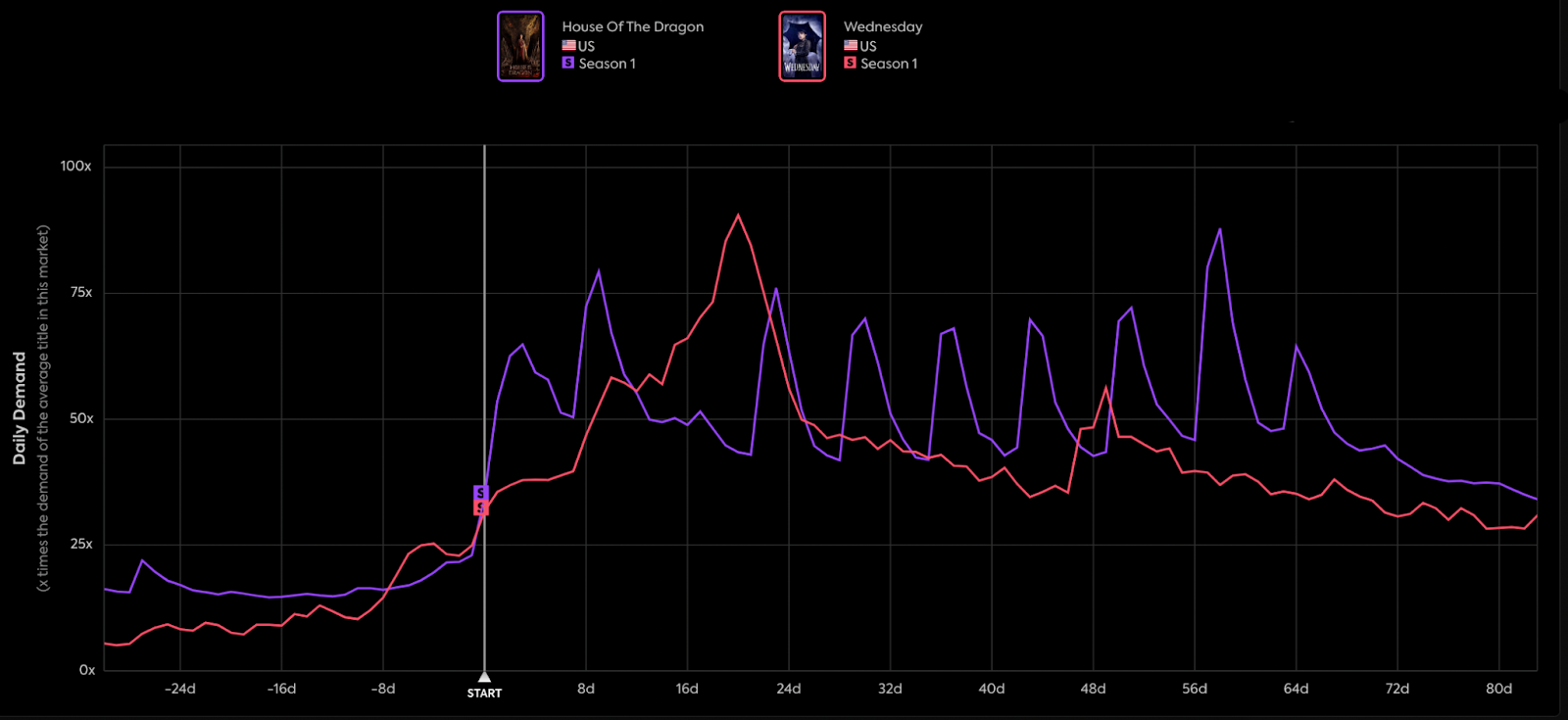
Most importantly, Netflix saw two separate viewership spikes that created sustained momentum for the show, according to research firm Whip Media, rather than just one. In the chart below, we can see that HBO/Max’s House of the Dragon, whose episodes were released weekly, saw demand grow over the course of its season and then decline slowly. By comparison, Netflix’s Wednesday had an initial peak in demand, then another post-viral TikTok dance, before trailing off. |
|
|
| The Netflix Slump Effect—that massive first week spike in viewership, followed by a huge drop-off in the show’s second and third week—is visible in any chart looking at the company’s release data. This is true for even its biggest drama series, like The Night Agent, Dahmer, and Inventing Anna, which are rightfully heralded as huge hits. This seemingly inevitable slump leads to interesting economic questions for a show’s subsequent seasons. If each season also experiences the Netflix Slump Effect, but audience interest nevertheless increases, is it possible to leverage that organic enthusiasm to elongate subscriber attentiveness and prevent churn, while simultaneously lowering the cost of re-acquiring those same customers a few months later? Since Netflix’s current strategy relies on the strength of immediate reception, the bigger opportunity lies in planning for the latter half of a show drop. |
|
|
| Binging is not without its benefits. Sarandos and other executives have rightly pointed out that Squid Game spread like wildfire around the globe due to the series’ momentum. More people binged it, recommended it, and that pushed it to the top of the page (with the help of some editorial curation) for other subscribers globally. Squid Game took advantage of Netflix’s scale, yes, but also Netflix’s core thesis. Other advantages of the binge release are 1) decreased marketing spend required to keep audiences engaged each week; 2) a freer creative approach to episode structure; and 3) mitigated risk of losing an audience.
These net positives are especially evident in the first seasons of shows. New series help bring in customers, or supplement another show that is bringing in subscribers (i.e., watching Squid Game and then tuning into Alice in Borderland). Stronger completion rates can also help determine which shows are worth renewing. While this is only one factor in programming decisions (others include referral capabilities and the potential to reach new demographics), the binge model can theoretically help make that decision a little easier. If more than 80 percent of viewers within the first two weeks don’t get past episode four, is that a show worth supporting? A weekly streaming series has to wait, well, weeks for that determination.
By the show’s second or third season, however, that built-in audience is going to return for the show regardless of how it’s released. Consider Amazon’s The Boys, which went from a binge release to a hybrid model between the first and second season to better drive returns. While some fans complained about it, Prime Video’s strategy team will tell you that people who were upset still showed up weekly to watch. It wasn’t a matter of sticking to one model because it worked, but figuring out how to best monetize an expensive yet popular series so that audiences didn’t just show up for one weekend and then take off. |
|
|
|
|
| Another element of this conversation, of course, is genre. Some genres lend themselves to a weekly release, and vice versa. Prestigious sci-fi dramas that cost $20 million an episode, such as Stranger Things, should be drawn out for better returns. Other genres, however, do lend themselves to the binge release. When comparing new comedies that were released weekly vs new comedies that were released as a binge, the binge portfolio saw 1.5x more demand than weekly, according to Parrot. F/X, for instance, adheres to a hybrid model, especially when it comes to prestige. It is dropping the episodes of The Bear’s second season all at once, this week, as it did for season one.
Former Disney Studios chief Alan Horn noted in a roundtable interview moderated by Matt, a few years ago, that of course audiences want everything available to them in every format, whenever they want, and for as little money as possible. But that doesn’t necessarily make sense for the company. What made Netflix such an incredible offer for consumers, back in those early days, was that it replaced channel-surfing. Everything that people could ever want was in one app for an affordable price and, contrary to what was happening over the course of 22 episodes on linear TV, all episodes were available at once, without ads. This was before competition increased in core markets, demand for Netflix originals fell, and rivals pulled licensed titles.
Some of that is now changing, with streamers like Max willing to license more content again. That ought to help with Netflix’s overall churn reduction. It doesn’t suggest, however, that Netflix should continue leaning on a system that worked during a period of disruption but must work three times as hard in a different market. When it comes to maximizing margins per show, part of Netflix’s strength isn’t just in having the best hits every single month—which any executive will tell you is a near-impossible achievement to maintain—but maximizing hold on customer attention and keeping their credit card active for as long as possible. |
|
|
|
| FOUR STORIES WE'RE TALKING ABOUT |
|
|
|
|
|
 |
|
|
|
Need help? Review our FAQs
page or contact
us for assistance. For brand partnerships, email ads@puck.news.
|
|
You received this email because you signed up to receive emails from Puck, or as part of your Puck account associated with . To stop receiving this newsletter and/or manage all your email preferences, click here.
|
|
Puck is published by Heat Media LLC. 227 W 17th St New York, NY 10011.
|
|
|
|