Welcome back to What I’m Hearing...
And welcome to all the new Puck members that have joined us recently. For those unfamiliar, I’m Matt Belloni, I’m a former entertainment lawyer and editor of The Hollywood Reporter, and my private email, What I’m Hearing, lands in inboxes on Sundays and Thursdays. If you’ve been forwarded this email, become a subscriber by clicking here.
Discussed in today’s email: Reed Hastings, Jennifer Lawrence, Jon Hamm, Ted Sarandos, Chris McCarthy, Brian Roberts, Bradley Cooper, Jason Kilar, and Jackass Forever.
Sponsored by Amazon Studios 
Who Won the Week: David Nevins, Gary Levine and Jana Winograde
The Showtime executives have an HBO-style hit in Yellowjackets, which ended its season with about 5 million viewers per episode and—even rarer for the network, these days—the bicoastal tastemaker fan base.
A little more on Showtime…
Talking about Showtime always begs the question: Why does Showtime still exist? Vulture’s Joe Adalian recently touched on this question, and I’ll go further: Showtime shouldn’t exist. Not as a standalone streaming service, anyway.
The Showtime content offering isn’t all that different from what’s on general-interest streamer Paramount+, the priority for ViacomCBS, which owns them both. And Showtime, which once credibly argued that it was a legit HBO competitor, has been underfunded by its parent company, often going months between high-profile premieres, and often losing A-list TV packages to the deep-pocketed streamers like Netflix, AppleTV+, Amazon and HBO Max. Showtime won only one Emmy at the 2021 televised show, and that was for a Stephen Colbert special.
Overseas, Par+ and Showtime are being integrated into one product. The reason that ViacomCBS C.E.O. Bob Bakish hasn’t done the same in the U.S., of course, is that Showtime still generates tons of cash. Bakish doesn’t want to disturb that revenue, and he has said he thinks having two streaming outlets is additive. Maybe, and he’s been bundling both services as a promotion. But Bakish could keep Showtime as a linear channel and then merge its streaming service into Par+, just as Star has become a branded part of Disney+ overseas. Or, if ViacomCBS is really serious about competing with HBO Max, just beef up Par+ with Showtime shows, similar to how TNT and TBS feed HBO Max.
ViacomCBS’ executive structure also causes an additional layer of complexity. Tom Ryan is C.E.O of streaming, but three TV programming execs—Nevins, George Cheeks and Chris McCarthy—all report to Bakish and vigorously defend their territories. Nevins has Showtime, BET and Par+ scripted content (with Paramount’s TV studio) underneath him; Cheeks has CBS and its studio, which means Nevins decides what to buy from Cheeks; and McCarthy is limited to unscripted and adult animation, except the Yellowstone/Taylor Sheridan universe that originated at Paramount Network, which McCarthy oversees. Confused? Oh, and these three guys don’t particularly like each other, according to sources at the company. Sounds like a place that could use some simplification around one streaming service.
Quote of the Week
“I really have to actively start thinking about other ways of making revenue that have maybe nothing to do with movie making.”
–Bradley Cooper, lamenting on The Business that the days of a robust film business “are completely gone.” Probably not something all those Sundance filmmakers hoping to launch a career want to hear.

The stock price apocalypse is a market problem more than a business problem. Netflix may not be growing fast enough for Wall Street, but what’s wrong with throwing off tens of billions of dollars in cash? Sssh, don’t say this too loudly. What if, just maybe—this is tough—but maybe, stay with me… Netflix is just a regular old entertainment company? I know, that’s blasphemy. Entertainment? What? That’s the Business That Must Not Be Named. Netflix, of course, is a technology company—a truly global, algorithmically driven, product-first engagement machine. It might produce and distribute what Hollywood people call “movies” and “television shows,” but to the stock market, the content is merely a $15 billion a year annoyance. The Netflix platform—and its seemingly unending growth, thanks to its first-mover position in streaming—is what has driven the sky-high valuation.
Not anymore. This week’s wild stock slide—down 20 percent in a day to below $400 a share, and off about 40 percent since the high of nearly $700 just two months ago—is more than merely a correction, or part of an overall NASDAQ retrenchment. Netflix’s subscriber miss and, most alarming, its forecast of just 2.5 million new subs for the current quarter, pissed all over its growth narrative. Instead, with 222 million members, Netflix is now—gasp—a maturing media company, with all the pros and cons that entails. “For now, we're staying calm,” co-C.E.O. Reed Hastings said. Few investors joined in his serenity.
The company’s worst stock drop in a decade is certainly a big deal, so it’s no surprise that the Netflix bears immediately came out of hibernation. That includes the Hollywood traditionalists who have watched in horror as the Los Gatos interloper used its vaulting stock price to remake the industry in its image, devaluing content with its always-on firehose, killing talent backends, maiming movie theaters and the cable bundle, and convincing stars like Leo DiCaprio and Jennifer Lawrence to happily appear in what Spielberg called “TV movies.” Everyone cashes the Netflix checks, of course, but there’s always been a tinge of distrust around town, like maybe co-C.E.O. Ted Sarandos, in his fancy sports car, is driving everyone off a cliff. The stock sell-off has reinforced those doubts.
Netflix caused the entire industry to reorient itself around streaming, yet analyst Michael Nathanson reminded us Friday that the dominance of that model is not preordained. “There’s probably more risk than people realize” he warned on CNBC. Netflix has spent to grow like no outlet in the history of entertainment. But if it added only 8.3 million subscribers in a quarter where it released a crazy-sounding 157 original movies, TV series and new seasons of existing series, according to Wedbush Securities, what might happen if it doesn’t spend like that? And what chances of success are there for everyone else releasing less? Streaming may be the future, but it’s a far tougher business than cable television, which is bundled and difficult to churn in and out. Plus, “the streaming model doesn’t allow those franchises to be built,” Nathanson noted. “There’s a quick decay.”
Comments like that are what drove down Disney (7 percent), Discovery (5 percent) and other media stocks in the Netflix fallout zone. Hastings also admitted that “added competition may be affecting our marginal growth some.” In other words, if everyone eats into everyone else’s numbers, we all suffer, and this whole endeavor needs to be questioned.
Scary stuff. But the Netflix apocalypse, while very real if you are a recent investor, is likely more of a market problem than an actual business problem. I’m not an equities expert, but perhaps a company shouldn’t trade at 95 times its earnings? Maybe Netflix is just an entertainment company, one without a diversified business, so perhaps it shouldn’t have been valued more than the Walt Disney Co? Netflix may have pushed a narrative that it was a tech giant all along, but the market went along willingly. And now, as the Journal noted, “the company’s investors still need to figure out how to price it for a different kind of growth.”
Still, even with a slower trajectory, the Netflix business hasn’t changed, and its fundamentals are pretty solid. Streaming is television, television is one of the best businesses in media history, and Netflix is the global leader in streaming television. Pretty simple. Does anyone think it won’t be a player long term? Plus, those 222 million members, while huge, leaves room for growth, even if sluggish, and the company is aggressively chasing new customers in markets like Korea and India, where it’s considerably ahead of its competitors. So besides not growing fast enough for market analysts, what’s the problem?
Netflix may have positioned itself with Big Tech, and it helped make Hastings and Sarandos very rich, but they have been acting more and more like media managers. Their growth in the U.S. and Canada is pretty tapped out at 75 million subs, so they raised prices in the U.S., just like those evil cable companies that have strong revenue per user. They now have to worry about competition for eyeballs from Disney, WarnerMedia, and the others, so they are spending on originals to distinguish the content. Their top content executives mostly hail from traditional media companies, like NBC and Universal. They’re diversifying into video game publishing and consumer products and, on the horizon, theme parks. Hell, Netflix is even cash flow positive this year, just like the majors.
All of this portends a long, bright future for Netflix. It may not grow like Amazon or Facebook, and yes, the streaming wars are about to get ugly, with many casualties. But becoming the Disney of the 21st century is hardly a consolation prize.
Bonus: I discussed the Netflix stock drop with Kim Masters on The Business this week. Listen here.
ADVERTISEMENT Amazon Studios presents A HERO, from Asghar Farhadi, writer/director of the Academy Award®-winning films A Separation and The Salesman. A HERO follows the story of Rahim – a man in jail for a debt he can’t repay. When a plan to erase his debt goes awry, he unexpectedly gains unwelcome notoriety and must reckon with a misunderstanding that has spiraled out of control. Winner of two National Board of Review Awards for Best Foreign Language Film and Best Original Screenplay, also nominated for a Critics Choice Award for Best Foreign Language Film. "Superb. Farhadi's finest work since his Oscar-winning ‘A Separation’” says The Wall Street Journal. 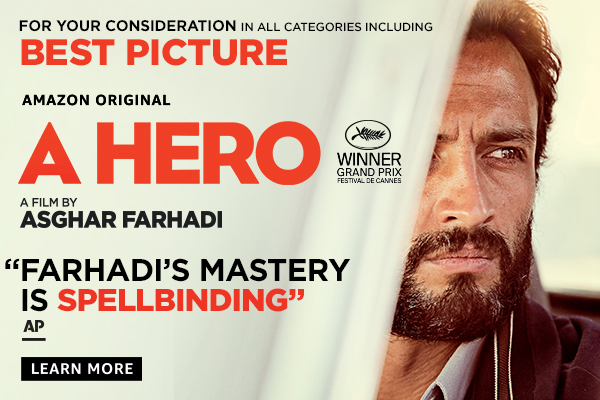
A HERO is streaming now on Prime Video.
My Reading List
With Netflix reeling, who is its biggest emerging rival? Here’s a smart assessment from Julia Alexander, the Puck contributor and streaming video analyst, who dives deep into 2021 data…
HBO Max: The New No. 2? When it first launched, the streamer suffered from bad tech, a mid-market brand, and executive upheaval. But in the span of several months, it has transformed itself from a second-tier player into a credible Netflix challenger in the U.S.
The unique brand value and quintessence of HBO has, until quite recently, always been as much about what it doesn’t offer as what it does. For decades, Richard Plepler preserved the pay-TV service as a highly curated jewel box: a bespoke powerhouse for ambitious programming. It didn’t necessarily matter that Succession wasn’t a red-state ratings bonanza, or that its lauded documentaries seemed to pick up more Emmys than viewers. Part of the network’s identity was wrapped up in its auteur-friendly disposition, and blatant hand-waving at vulgar consumerism. (Plus, Game of Thrones already had that mainstream audience covered.)
But the media landscape was shifting as streaming devoured the cable market. In 2018, AT&T completed its acquisition of HBO’s parent company, TimeWarner, and vowed to significantly increase content production to compete with Netflix. HBO Max, the awkward stepchild of the Dallas-New York-Hollywood marriage, would combine prestige dramas like Six Feet Under with The Big Bang Theory in one middlebrow package.
The cultural tensions were foretold in a reportedly prickly town hall meeting in New York, shortly after the $85.4 billion deal closed, as Plepler sparred onstage with his soon-to-be boss, AT&T executive John Stankey. “We need hours a day … not hours a month,” Stankey told employees. “We’ve got to make money at the end of the day, right?”
We already do that, Plepler shot back. “Yes, you do,” Stankey replied. “Just not enough.” Plepler, exhausted by the Texas country club machers who constituted this new regime, resigned a few months later. And Stankey soon realized that AT&T had made a terrible mistake, compounded by an endless D.O.J. hold-up, in getting into the content business. Last summer, shortly after taking over as C.E.O., he initiated another multi-billion dollar deal to spin off the Warner media assets into a combination with Discovery.
But Stankey and Co. weren’t wrong that HBO needed to scale, and that it could do so without sacrificing quality or losing its highbrow appeal. The latest data reveal that HBO Max has dramatically expanded its audience, to 73.8 million subscribers, up from 38 million paying subscribers last year. Meanwhile, amid the coronavirus pandemic, outgoing WarnerMedia C.E.O. Jason Kilar delivered concrete proof that ending first-run theater exclusivity and placing movies on-demand could juice growth.
In the span of several months, HBO Max has transformed itself from a second-tier player into a credible challenger for on-demand dollars. The “streaming wars” are only just beginning, as Netflix’s disappointing earnings report and muted subscriber forecasts emphasized just this week. But understanding why a service like HBO Max has multiplied while others are still trying to get off the ground is crucial for any executive, director, programmer, or investor looking to avoid getting squashed in the coming years. Here’s how it happened...
ADVERTISEMENT 
The Feedback Thoughtful responses to my Thursday interview about China and Hollywood. (We had hundreds of entrants for the book giveaway; we’ll definitely do another one soon!) Some examples:
“Name me a truly innovative Chinese company to be marched out globally? To your point around letting the wolves in to study Hollywood, it’s been replicated across many industries. Study, mimic, execute, squeeze/regulate out the competitor, repeat. The execution phase is always phenomenal. Time will tell if the innovation side of things will come. What happens then?” –A professor
“Wonder why the U.S. has never gone to the World Trade Organization regarding film releases/streaming services lack of entry. And the Hollywood/China stuff never ends up being discussed in big way in DC too. Seems ripe—either for right wing or left wing. But right wing likely to do more with it.” –A producer
Finally…
I want to incorporate more proprietary data into What I’m Hearing, so today (and periodically, going forward) I’ve included exclusive film tracking info from The Quorum, a new first-party research firm that assesses “awareness” and “interest” in upcoming movies.
Awareness measures how many people know about the movie, and it is expressed as a percentage. Interest measures the degree to which people want to see the film. It is expressed as a score from one to ten. High awareness and low interest means many people know about the film, but they don't necessarily want to see it. Low awareness and high interest means the campaign has reached the core fans, but not many others. The former can spell trouble. The latter can be an opportunity.
The charts published below look at films that are scheduled for theatrical release in the next eight weeks. It does not include films on streaming services, though numbers for those films are available at www.thequorum.com. 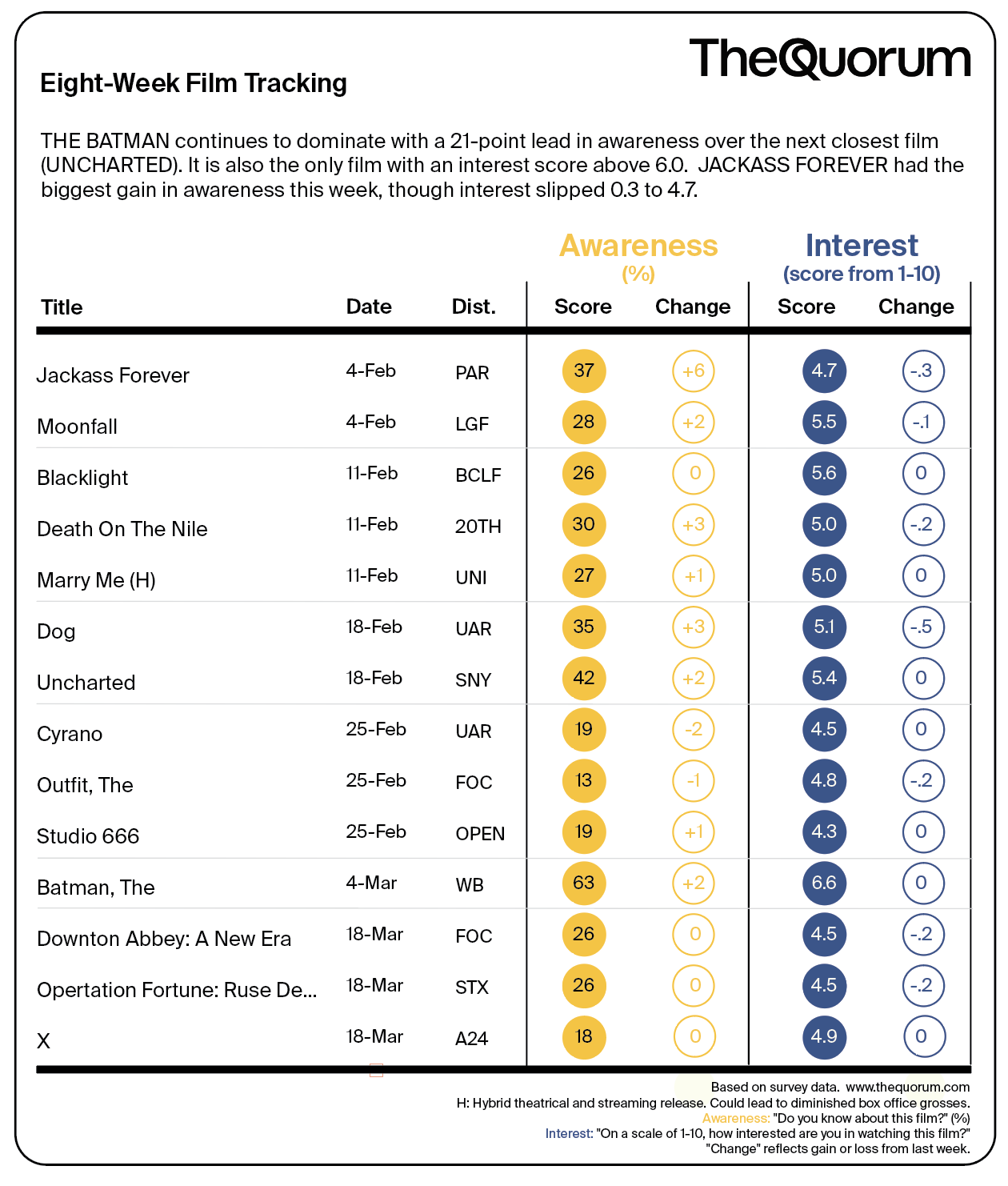
Have a great week, Matt
Got a question, comment, complaint, or an extra ticket for Sunday’s Rams-49ers game? Email me at Matt@puck.news or call/text me at 310-804-3198.
FOUR STORIES WE'RE TALKING ABOUT 
An inside look at Chinese cultural imperialism, the fall of Wang Jianlin, and how Beijing beat Hollywood at its own game. MATTHEW BELLONI 
A conversation with Fiona Hill about the Russia-Ukraine crisis, Putin's next move, and where the White House goes from here. JULIA IOFFE 
How a peace offering from Phil Spencer, Microsoft’s gaming chief, led Activision’s Bobby Kotick to a $69 billion deal. DYLAN BYERS 
Notes on Peloton’s market value collapse, Netflix’s future, M&A arbitrage, and Apollo’s next potential pound of flesh. WILLIAM D. COHAN 
You received this message because you signed up to receive emails from Puck.
Was this email forwarded to you?
Sent to {{customer.email}}
Puck is published by Heat Media LLC.
For support, just reply to this e-mail. For brand partnerships, email ads@puck.news |


SHARE