 |
 |
|
Welcome back to What I’m Hearing+, live from Manhattan, where I’m on my way to catch George Miller’s Furiosa in Imax, my preferred format. Yes, I tend to go to movies midweek, when prices are lower. But the experience always reminds me of Sony Pictures chairman Tom Rothman’s argument that studios are hastening the destruction of theaters by offering them fewer movies, which forces them to jack up prices to account for the loss in volume. Not great!
On a more positive note, yesterday I exchanged notes with my colleague and sports media prophet John Ourand in his fantastic private email, The Varsity. We talked about Netflix and Amazon streaming ambitions, the under-discussed role of Google, and the fate of Warner Bros. Discovery without the NBA. (If you haven’t already, add John to your media diet here.)
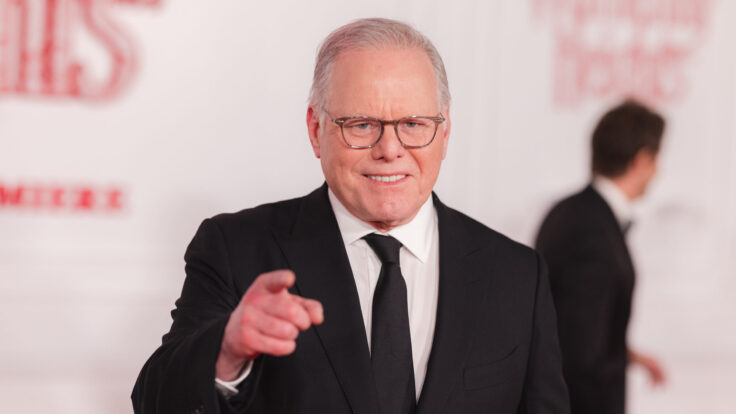
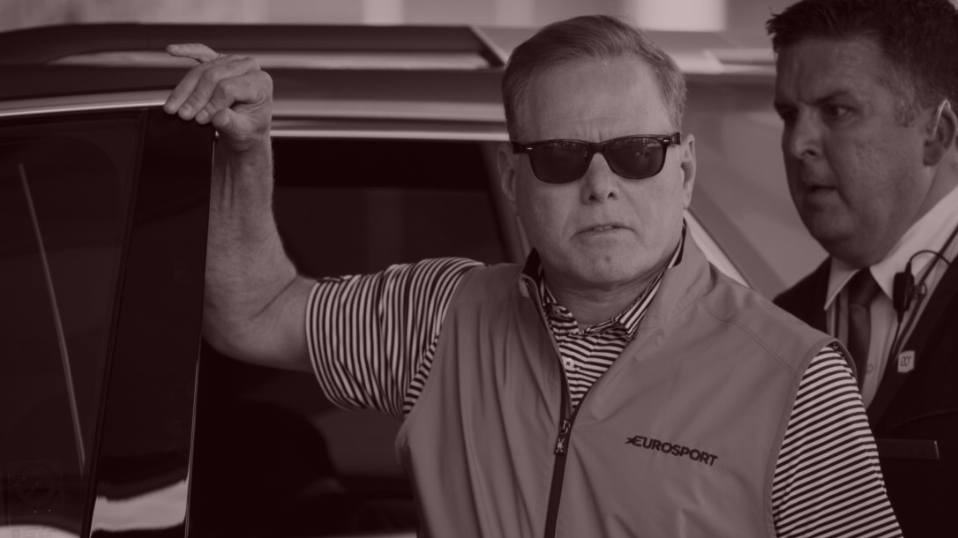
Tonight, I’m offering more thoughts on that final topic. David Zaslav obviously wants the NBA, as my partner Bill Cohan noted yesterday. But, given WBD’s mountainous $39 billion in debt, and rival NBCUniversal and Amazon bids for rights, Zaz must plan for life without the league. Tonight, I put a little structure around that decision architecture and answer related questions, namely: What happens if WBD loses out on those rights, and does Zaslav need the NBA as badly as many think?
But first…
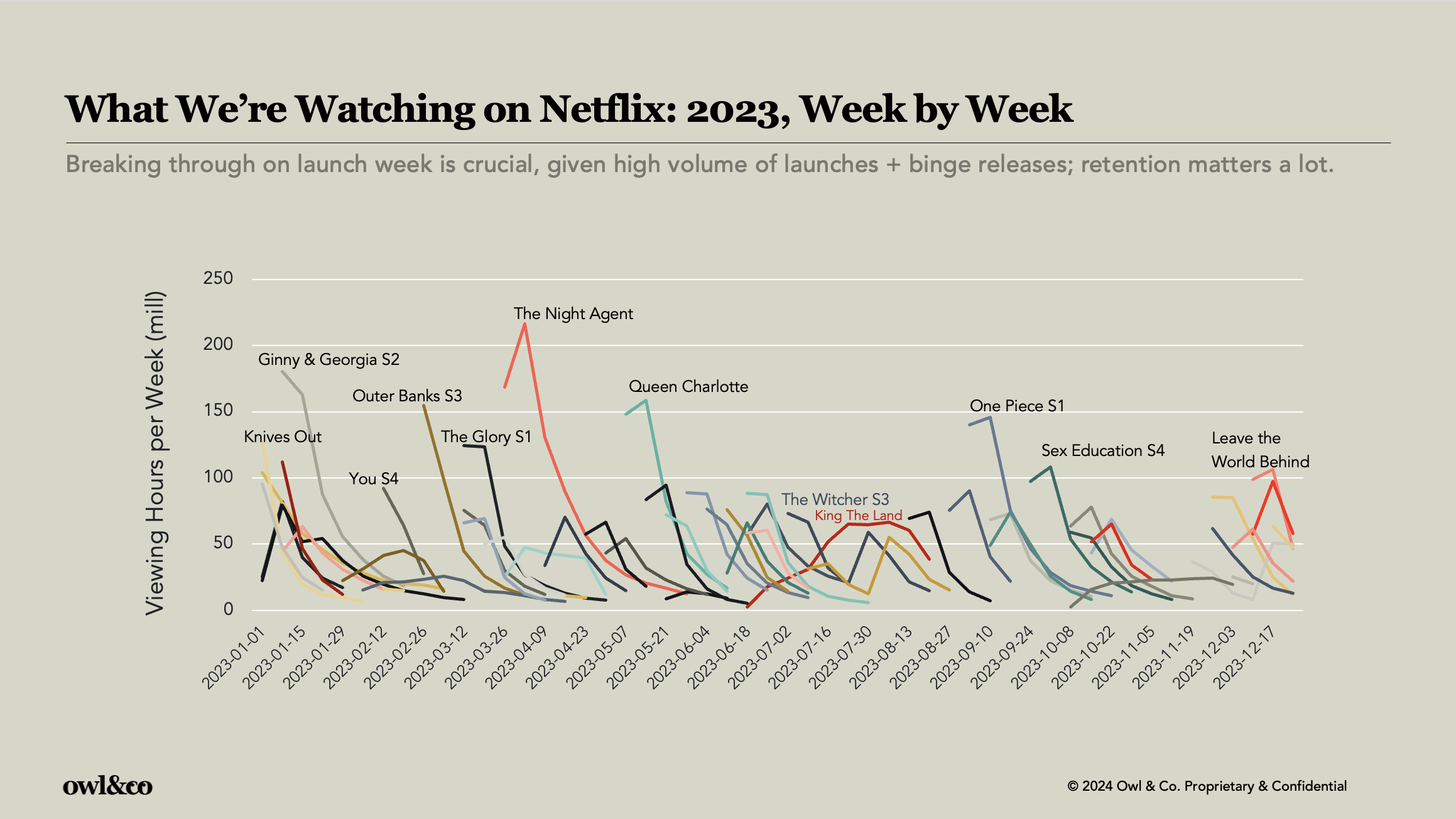
- A quick correction: The wrong chart made its way into the subscriber version of Matt’s What I’m Hearing last night—which was a shame, because it underscored how much Netflix’s top shows generally rack up massive viewership quickly before falling off as members binge and move on. Of course, this contradicts the widely touted supposition that algorithms perfectly pair content with viewers. Apologies! Here’s the correct chart:
|
|
|
- 💼 A personal WIH+ update: Longtime readers know I also have a day job as head of Parrot IQ and V.P. of strategy at Parrot Analytics. Well, perhaps inevitably, I’m changing things up and will be taking a full-time role at a major streaming company. (You’ll know which one soon enough!)
As a result, I’m going to be stepping back from my usual weekly sends. Starting next Tuesday, What I’m Hearing+ will feature contributions from an all-star team of Puck authors, starting with Eriq Gardner’s dispatches on entertainment law… Matt Belloni will oversee it all, and yes, you’ll still get analysis from yours truly, just less frequently.
|
| Okay, let’s get to it… |
 |
| Zaz’s NBA Silver Lining Playbook |
| So far, Warner Discovery’s sports strategy is having “just enough” content to work with partners, negotiate with cable carriers, demand market share, and pay down debt. So what should David Zaslav do if he loses the NBA and “just enough” becomes “not enough”? |
|
|
|
| Last week, during an appearance on The Dan Patrick Show, Charles Barkley spoke for all the David Zaslav truthers when he expressed his own vexation that TNT’s beloved Inside the NBA might vaporize because its parent company had lost the league’s broadcast rights. “These people that I work with, they’ve screwed things up,” Barkley said, essentially re-litigating Zaz’s various self-created micro-scandals from the past two years of the Warner Bros. Discovery journey: CNN’s Chris Licht saga, Batgirl, disappeared content, countless layoffs, etcetera. Indeed, Zaz never should have publicly stated two years ago that his company didn’t “have to have” the NBA, a phrase that pissed off the league and has been weaponized by competitors.
That said, does WBD truly need the NBA? Bankers and investors suggest that Zaslav and C.F.O. Gunnar Wiedenfels should continue deleveraging the company and, eventually, re-rate its $39 billion net debt. And if Zaslav doesn’t end up with the NBA, he’ll have $2.5 billion a year laying around with which to do so. |
|
A MESSAGE FROM OUR SPONSOR
|
 |
|
|
|
| But there’s a significant opportunity cost in not having the NBA for WBD’s domestic and potentially global audience. Media people fear it would further erode the company’s cable business, perhaps tipping it into a terminal decline. Moreover, while ratings have fallen in recent years, NBA games are the most watched American sports content in international territories, and its audience ranks among the youngest of the Big Four pro leagues. So while HBO is great, sports are critical.
If Zaz does have a strategy for transitioning WBD’s audience from linear to streaming, he’s playing it close to the vest. While he has proven he can tear down a streaming ecosystem, he hasn’t demonstrated he can build in this new space. Can he build without the NBA? It’s sorta like trying to climb Everest and tossing half of your oxygen cylinders off the mountain. Not impossible, but why on earth would you do it? |
| Sports Is in the Eye of the Beholder |
|
| Not all media companies are created equal, of course, and they all covet sports for different reasons. Amazon leverages sports for its advertising and e-commerce businesses. Disney needs sports to pull together the full bundle, reduce churn across its entire offering, and create habits. Netflix wants the NFL because it needs a shiny bauble for advertisers to covet—even on the ad-free tier—and it wants large-scale global events. If streamers want to build their brands on scarcity, sports are the most premium and, arguably, safest source of that.
WBD needs sports for ad revenue, yes, but mainly as ballast for its cable business in negotiations over carriage fees. In particular, the WBD sports strategy is just enough. As the company manages its debt, Zaz has made deals that fill his brands with just enough content and just enough leverage to negotiate with the carriers. As part of the recent $7.7 billion NASCAR rights deal—which also included Amazon, Fox Sports, and NBC Sports—WBD will get just five races per year, and their 3 million eyeballs apiece, compared to 14 races each for the senior partners. The company also bought a third of the Bundesliga (German soccer) package, and recently struck a deal to license a few College Football Playoff games from Disney. (WBD also has European rights to the Paris Summer Olympics, which will be carried by NBCUniversal domestically.).
NBA basketball is vital to this strategy. TNT, in particular, makes up nearly 30 percent of all affiliate revenue for Warner Discovery, and is the only reason the company accounts for about 7 percent of live sports viewership in the U.S., according to MoffettNathanson. The NBA also makes up about 50 percent of time spent watching sports on Warner Discovery-owned networks. |
|
|
| Without the NBA, just enough could quickly turn into barely enough. In fact, it’s reasonable to wonder whether an NBA-less WBD would still be vital to the Venu joint venture with Fox and Disney (f.k.a. “Spulu”). The reality, though, is that this bundle makes sense for everyone involved. In bundle economics, the weakest player links itself to stronger players to increase the overall value, even slightly. There’s no doubt that Disney (31 percent of live sports viewing) and Fox (24 percent) are the dominant players in the Venu triad. But if the goal is to create a bundle that can compete with Amazon and the trifecta partnership of Netflix (NFL, WWE), Peacock (Olympics, NFL, NBA, NHL), and Apple TV+ (MLS), any assist from Warner Discovery helps.
Disney and Fox were incentivized to work with WBD because certain rights fill holes in their schedules and audience profiles at certain times. The NBA certainly boosts Fox after the NFL season, and between Disney and WBD they’d have a near monopoly on the NBA. But if other premium sports, like NASCAR and potentially the UFC, can just as capably help Zaslav achieve his apparent goal of re-creating Discovery’s success—i.e., becoming a strong enough player inside a much larger machine—then just enough actually kinda works. He needs just enough to complement other partners.
So, should Zaslav pony up for the NBA, presumably by trying to wrench the “C package” from Amazon for $1.8 billion-plus? It’s within this context that I actually think Zaz and Gunnar should take the L and instead find other hyper-engaged sports audiences to monetize. Attention, the core economic metric in a digital age, is rapidly fragmenting into two sects—implausibly large and targetably small. There is no middle class in media anymore. There is Taylor Swift and the NFL, or there is F1 and UFC. This puts the NBA in an interesting position. Commissioner Adam Silver is able to charge more for less because the playoffs fall into the implausibly large bucket, even if regular season games are getting incrementally smaller. This may be the last round of negotiations that can command this level of interest and cash.
Warner Bros. Discovery may want to compete with the giants, but it has the potential to succeed in leaning into just enough small but highly targeted and highly monetizable buckets. The UFC, which comes up next for bidding, is one of them. (Disney will likely put up a fight to keep it for similar reasons.) NASCAR is another. After the success of Caitlin Clark mania and women's professional soccer, investors are pushing college volleyball as the next potential “big” sport. Cycling, sailing, and tennis are all high-interest, high-income sports that aren’t being targeted by the biggest brands.
If I were advising Zaslav, and I am most certainly not, I’d suggest taking those NBA billions, paying down debt to decrease leverage, and finding smaller—but growing and profitable—sports in the U.S. and abroad that can be monetized through new methods that streaming allows (tiers, add-ons, etcetera). I believe WBD’s best outlook is becoming just sticky enough in the number of bundles it finds itself in. It doesn’t need the NBA to do that; but it does, however, need a strategy, and it needs to communicate that strategy more effectively—even Charles Barkley might agree that it’s not a terrible plan. |
|
|
|
| FOUR STORIES WE’RE TALKING ABOUT |
 |
| Heilemann on ’24 |
| On Trump and R.F.K. Jr.’s forays into Libertarian Land. |
| JOHN HEILEMANN |
|
 |
|
 |
| Wintour Murmurs |
| News and notes on the latest fashion industry trends. |
| LAUREN SHERMAN |
|
 |
|
|
|
|
|
 |
|
|
|
Need help? Review our FAQs
page or contact
us for assistance. For brand partnerships, email ads@puck.news.
|
|
You received this email because you signed up to receive emails from Puck, or as part of your Puck account associated with . To stop receiving this newsletter and/or manage all your email preferences, click here.
|
|
Puck is published by Heat Media LLC. 227 W 17th St New York, NY 10011.
|
|
|
|