 |
| Welcome back to What I’m Hearing+, and hello from New York, where I’m still recovering from that Super Bowl-caliber contest between the Chiefs and the Bills. I’m sensing a Niners-K.C. Super Bowl, even though I’m praying for the Ravens and the Lions. Look, nothing against Mahomes, but I’m getting flashbacks to the Warriors’ run from 2015 to 2019. Let’s shake it up a little.
On Sunday, my Puck partner Matt Belloni considered the Apple Vision Pro’s potential impact on the future of entertainment. I want to follow up by examining the crucial steps that the company needs to take to ensure its V.R. headset becomes an actual platform, not just expensive coffee table art. We’ve seen so many headsets fail—Google Glass, Snap’s Spectacles, the Meta Quest—that we’ve come to doubt the category. But things may be different when the technology is applied to entertainment and gaming—and when the company that created the modern gadget platform (and then continued to iterate on it) is involved.
But first…
- Netflix climbs to the top rope: Today, ahead of its blockbuster earnings report and its announcement of 13 million new subscribers in the fourth quarter (thank you, piracy crackdown and The Crown finale), Netflix announced that it is finally taking its first step into live sports. Or “sports.” The platform has acquired the exclusive U.S. rights to WWE Monday Night Raw, and streaming rights for all WWE content internationally, for the next 10 years. The deal will cost Netflix $5 billion, or $500 million annually, and the streamer has the right to bow out after five years or extend the contract for another 10 years.
The deal has an obvious industrial logic. WWE is a worldwide phenomenon, and Netflix’s growth strategy is built on content that plays globally. The audience also skews young. According to the league, fans from the ages of 8+ who identify as “wrestling lovers” reached nearly 90 million in 2022, the highest since 1994. Attendance for live events is continuing to grow. And perhaps most importantly, WWE is appointment television, which helps fuel the Netflix ad business, as well as brand partnerships and supplementary programming: sports docs, scripted shows, advertising tie-ins, crossover events, etcetera.
Of course, I used “sports” with scare quotes. Not to diminish WWE Monday Night Raw—which still averages around 1.71 million views per episode, on par with the average NBA game—but the programming is really sports entertainment. And that dovetails even more with Netflix’s sports strategy, which remains primarily focused on sports-adjacent content like Quarterback and Beckham. While the WWE partnership moves Netflix closer to live sports, the deal is also more experimental, less committal, and definitely less expensive than the long-term deal that Amazon negotiated with the NFL, or the one that Apple struck with MLS. A weekly WWE show—unlike, say, the more than 1,000 games per NHL season—is the perfect way for Netflix to test these waters.
|
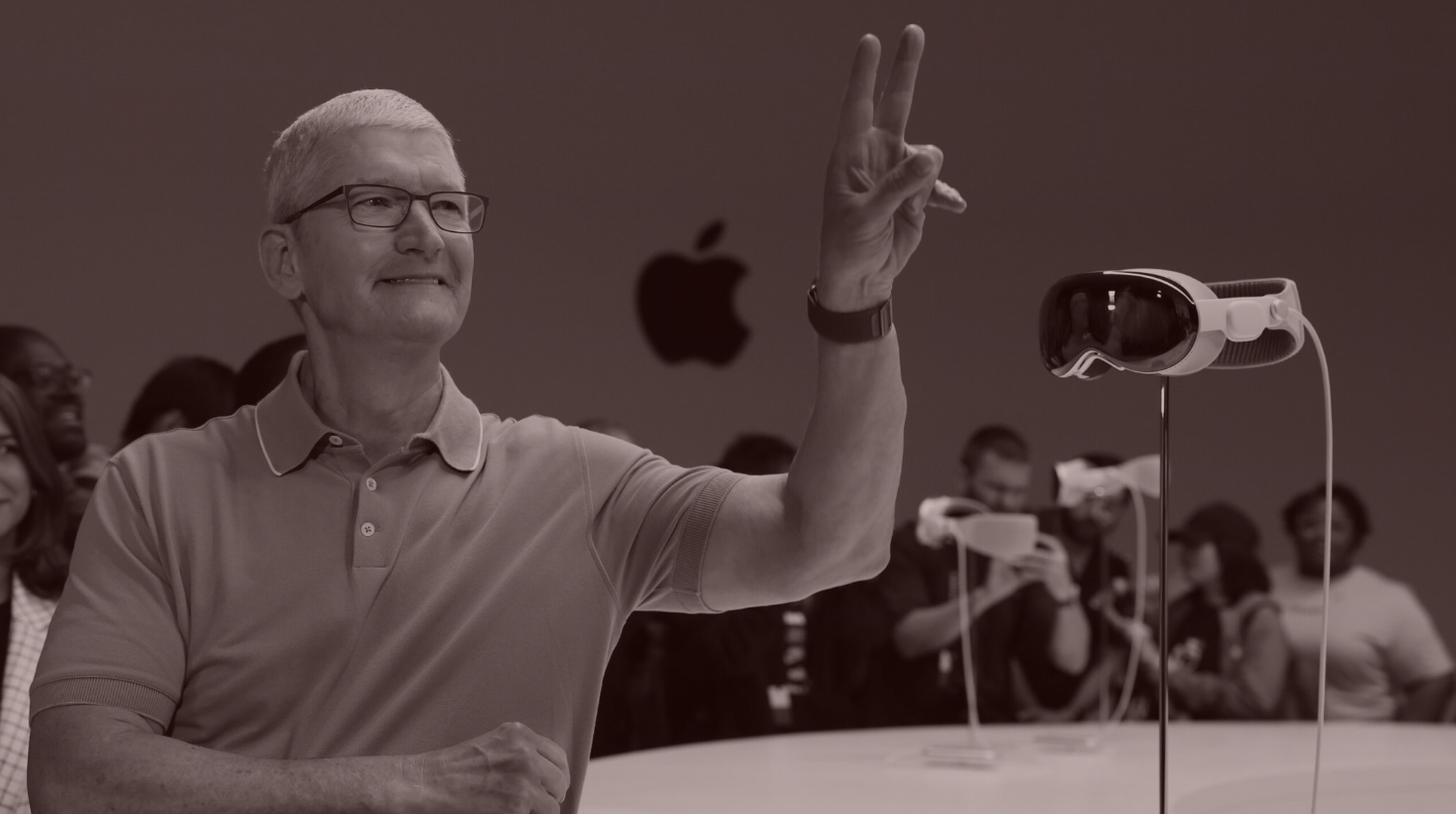 |
| Apple’s V.R. Catch-22 |
| Almost everyone seems to agree that mixed reality devices, like Apple’s new Vision Pro headset, will anchor entertainment platforms of the future. But which comes first, the users or the content? |
|
|
|
| Chat with any Apple executive about the Vision Pro, the company’s new $3,500 virtual reality headset, and they hasten to describe the product not as hardware but, ahem, a platform. The bull case goes something like this: Sure, it’s expensive, and heavy, and a little bit dystopian, but few people predicted the ubiquitous multi-purposing of the iPhone when it launched, either. The device only became central to our daily lives once developers began amplifying its ability to become a walled garden for every need imaginable—Netflix, Twitter, Uber, mobile banking, etcetera.
Apple is betting that augmented reality devices have the same platform potential. The Vision Pro, in particular, certainly has the opportunity to change how we watch content. But Apple can’t pull it all off on its own—the world’s largest company needs substantial buy-in from sports, media, and streaming partners to evolve the V.R. experience from a niche product to mass adoption. As a Meta executive once told me, entertainment is crucial to the success of V.R. since it’s the most accessible entry point for early adopters. Apple, which has patented a new ultra-high-resolution 3D camera that can film in 180 degrees, would seem to agree.
In fact, I’ve learned that Apple is gearing up to promote these new cameras to as many V.R.-curious creators as possible to accelerate the adoption of what the company is calling “immersive video.” But, of course, the upfront expense of Apple’s camera technology is just one consideration for creators, producers, and studios. Shooting in 180 degrees may open up creative opportunities, but there’s an opportunity cost, too—remember when everyone in Hollywood pivoted to shooting films in 3D? It worked for Avatar and a couple others, but it turns out most audiences don’t want to wear plastic glasses at the movies. There might be a lesson in there for Apple, too.
Sports leagues and broadcasters face a similar dilemma: Immersive video could be a game-changer (sorry) for watching Major League Soccer, which has a $2.5 billion, 10-year worldwide deal with Apple. But will the leagues or broadcasters feel compelled to incorporate even more cameras inside already busy arenas, for an initially limited audience? (The NBA, for what it’s worth, already allows fans to watch a number of live games “sitting courtside” via the Xstadium V.R. app.) Or will the immersive experience be limited to additional virtual displays, like in this viral F1 concept video that’s making the rounds? (Probably more like the latter, I’m told.)
There’s also the consumer-side problem: Remember, streaming boomed because it was cheaper, easier, and more accessible than cable. Immersive entertainment may be an upgrade, but it’s also prohibitively expensive for 90 percent of consumers. Hardware costs will need to come down, and the volume of Vision Pro-optimized content will need to go up, before V.R. attains mass appeal.
And herein lies the catch-22 for Apple’s partners: Almost everyone seems to agree that mixed reality will anchor entertainment platforms of the future. But which comes first, the users or the content? |
|
|
| There’s another not-so-small wrinkle for Apple to manage. Around 64 million people in the U.S. reportedly used a V.R. headset in 2022, according to a Statista survey. But a McKinsey survey in that same year revealed most of these users were far more interested in trying the technology to attend a concert, “travel” to another country, or attend a “live learning course” rather than watching a movie or sporting event. In fact, the two categories Apple is betting on didn’t even rank.
At the very least, this suggests that for your average consumer, experiencing movies and sports on a V.R. headset is not a priority. Maybe that’s because the average TV set sold in the U.S.—47.5 inches, according to a retail research firm, and priced around $500—is big, cheap, crystal-clear, and can be augmented with affordable soundbars to create an immersive experience.
And with entertainment companies already focused on creating content tailored to the newly accessible “home theater,” developing content within a niche format for a device that costs as much as seven TVs is not as attractive a proposition. (A small user base and low R.O.I. also explain why most major gaming companies haven’t dedicated full teams to developing V.R. games.) The not-so-secret secret is that, when it comes to V.R., it’s tech companies that need entertainment partners, and not the other way around. Meta has sold more than 20 million Quest units but struggles with consistent engagement due to the lack of entertainment options that most people want.
Take Disney, for example. As one of the many people who received an early Vision Pro demo, I had a blast with Disney+’s immersive take on Star Wars, which involved “sitting” in a pod racer at a drive-in (hover-in?) theater on Tatooine. I was able to see the dual suns and Mos Eisley; like everything else I experienced during the 30-minute demo, it was remarkable. But when the movie started, it just played on a giant screen off in the distance. Cool, but not $3,500 cool. And certainly not $3,500 cool when the nearly 1.5-pound headset began to hurt my face about 30 minutes in. Is that something people actually want, let alone need?
Novel, sure. But that experience didn’t leave me ready to scrap my 55-inch TV and Sonos soundbar, or the ability to curl up in bed with my iPad. (Try getting comfortable under the covers with a Vision Pro strapped to your head.) Perhaps these are unavoidable growing pains for Apple—recall that the iPhone in 2007 didn’t even have apps, per se, whereas now you can shoot and edit an entire movie on the iPhone 15—but it’s hard to see why more entertainment companies should get into V.R. right now.
Several of the most popular streaming services, including Netflix and YouTube, won’t have specialized Vision Pro apps available at launch, although you can still use them inside the web browser. (The apps are available on Meta’s Oculus devices, by comparison.) That’s a huge blow to Apple, given that immersive entertainment is central to the device’s value proposition. While live sports will be available at launch, via services like ESPN+, it’s unclear how many will make use of the same spatial video technology that powered the Star Wars demo, or if it’s just going to be projected onto a virtual screen. Or, as I like to call it, the “Instagram on my iPad” experience.
My bet is the latter—and I don’t think there are many people who crave that experience. So is it worth it for companies that aren’t receiving development support from Apple to throw resources at it right now? |
|
|
| Apple, with its $3 trillion market cap and $170 billion in annual profit, can afford to throw money at unproven categories. Meta, which produces the rival Oculus Quest headset, has invested nearly $50 billion in its reality labs division while generating less than $7 billion to date. Mark Zuckerberg, like Tim Cook, has the financial cushion and approval from investors to play the long game. The bet is that spatial computing won’t just be a buzzword, like mobile technology was in the early 2000s—it will be the dominant form of entertainment and productivity. Those earliest in the development cycle reap the reward at the end of the marathon… hypothetically.
The challenge in the here and now is how to expand the total addressable market beyond tech geeks, high-net-worth households, and other early adopters. Remember, Apple can only do so much to grow the demand for immersive, mixed-reality experiences. It needs to encourage the supply of that content, too.
Of course, live sports is the most obvious entertainment category with V.R. crossover appeal: The audience footprint is massive, and includes plenty of consumers who might be interested in a $3,500 headset. Nearly 50 percent of V.R. users are between 18 and 30, according to metaverse company Atopia, and 60 percent are male. According to the Academy for Animated Art, nearly 40 percent live in households with income north of $100,000 a year. Apple already has exclusive broadcast rights with the MLS, so don’t be surprised to see some kind of Vision Pro integration in the near future.
Other leagues and distributors could also benefit from such a partnership. Imagine, for a moment, an NFL game carried by ESPN, streamed through the Vision Pro, and available to consumers at a slightly higher ESPN Vision Pro tier. Combining resources to produce this tier would reduce the investment risk for all parties, while creating a more enticing viewing experience for consumers. Given the opportunity, Apple would likely offer its own development services to ensure that it came together fast.
But beyond Disney and ESPN, it’s unclear how many companies will view Apple as the right partner when their own futures are so unclear: Will they remain D.T.C. operators, or will they have to remake themselves as pure content suppliers? However, if adoption of the Vision Pro headset does pick up, Hollywood will have to countenance mixed reality as an unavoidable aspect of the entertainment business—yet another wrinkle in a rapidly changing ecosystem. |
|
|
|
| FOUR STORIES WE’RE TALKING ABOUT |
 |
| NYT’s Leak Saga |
| Anticipating the denouement of a legal soap opera. |
| ERIQ GARDNER |
|
 |
|
 |
|
 |
|
|
|
|
|
 |
|
|
|
Need help? Review our FAQs
page or contact
us for assistance. For brand partnerships, email ads@puck.news.
|
|
You received this email because you signed up to receive emails from Puck, or as part of your Puck account associated with . To stop receiving this newsletter and/or manage all your email preferences, click here.
|
|
Puck is published by Heat Media LLC. 227 W 17th St New York, NY 10011.
|
|
|
|