 |
|
Welcome back to What I’m Hearing. I’m finally home in L.A. for the rest of the summer, thanks again to Julia Alexander and Jonathan Handel for driving the party bus this past week.
Programming note: I’m on CNBC at 6:50 a.m. eastern tomorrow discussing the scoops in this email. I joined Kara Swisher, Franklin Leonard and Brooke Hammerling on Kara’s On podcast to debate Barbenheimer lessons (listen here). Plus, this week on The Town: Lucas Shaw and I looked at Sound of Freedom and its “pay it forward” strategy, and Warner Bros. marketer Josh Goldstine revealed the Barbie materials that were most debated internally. Subscribe here and here.
And if you’re still not a Puck member, click here.
Discussed in this issue: Mike Hopkins, Fran Drescher, Tom Staggs, Jimmy Pitaro, Kevin Mayer, Bob Iger, Reese Witherspoon, Oprah Winfrey, Peter Chernin, Mel Gibson, Sarah Silverman, Guillermo del Toro, Duncan Crabtree-Ireland, Jen Salke, Greta Gerwig, Javier Grillo-Marxuach... and Obama’s shady playlists.
But first…
|
| Who Won the Week: Rich Gelfond |
|
| The IMAX C.E.O. bet big on Oppenheimer, taking all his screens and it’s now the second-fastest film to reach $80 million on the format (after Avengers: Endgame). These Oppenheimer numbers are nuts: Domestically, $47.3 million of its $174.6 million total—nearly 30 percent—is coming just from IMAX. Now it’s getting a fourth week of exclusivity, another punch in the face for Tom Cruise and Mission: Impossible.
Side note on box office: With Greta Gerwig’s message-comedy Barbie headed for $1 billion and Disney suffering another disappointment with the bland Haunted Mansion opening to just $24.2 million, it’s worth speculating what might have been if Guillermo del Toro had been allowed to make the Mansion movie he developed in the mid-2010s. Disney’s then-film chief Alan Horn is said to have thought the GdT version was too dark and edgy for the I.P.—but that’s exactly the kind of brand-pushing that seems to be working in theaters this year.
Speaking of Disney, some news… |
| Iger Brings Back His Old Heir Apparents |
|
| Bob Iger signaled a lot about Disney’s future in that CNBC interview from Sun Valley, including that he’s open to selling linear TV networks and that he’s hunting for a strategic partner for ESPN. What Iger didn’t mention is that he’s enlisted two of his former right-hand men to help in that endeavor. I’m told that Kevin Mayer and Tom Staggs have both been engaged individually by Disney to consult with Iger, ESPN chief Jimmy Pitaro, and others on the future of the linear properties and how they intersect with Disney’s streaming strategy. Disney and a rep for Mayer and Staggs declined to comment.
This news will no doubt fire up Disney-watchers because Mayer and Staggs were both positioned previously as Iger successors and have been mentioned as possible C.E.O.s when (if?) Iger finally abdicates the Mouse Throne in 2026. Remember, Mayer was an architect of Disney’s big-ticket M&A portfolio and its direct-to-consumer strategy before bolting for TikTok in 2020; Staggs was Iger’s C.F.O., parks chief and C.O.O. before being passed over for the top job and leaving in 2016.
It’s also interesting because Candle Media, the Blackstone-backed content roll-up company that Mayer and Staggs launched in 2021 and still run, has been acquiring Disney-friendly content studios, including Moonbug Entertainment, purveyor of YouTube and Netflix kids’ sensation Cocomelon, as well as Reese Witherspoon’s Hello Sunshine. Who knows, maybe Iger would even buy Moonbug or all of Candle and bring Mayer and Staggs into the company with it, though Disney doesn’t seem to be in I.P.-acquisition mode these days and Candle’s thesis has come under scrutiny.
Anyway, that’s not this deal. For now, Mayer and Staggs are merely consulting for Disney while continuing to run Candle. It makes sense that as Iger tries to figure out the right mix of assets—whether it’s offloading TV networks, buying out Comcast’s share of Hulu and incorporating it into Disney+, or maybe even bulking up with a gaming company—he would lean on two of the guys who helped him build the company into a juggernaut in the first place. |
| Mike Hopkins’ Elephant-Dodging Town Hall |
|
| Amazon Studios employees looking for answers to the increasing questions hovering over the unit got next to none at the big Prime Video town hall on Thursday. Senior V.P. Mike Hopkins instead shared with the 8,500 employees his ripped-from-a-spreadsheet priorities for the year, including international growth, tech milestones, and other non-content initiatives. (Jen Salke, who runs Amazon Studios, spoke only briefly from New York and mostly answered questions about the strike, per sources familiar.)
Nothing about C.E.O. Andy Jassy’s heightened scrutiny on pricey show budgets… or Salke’s big-picture content strategy after her latest re-org… or the company’s plans for MGM and how that asset is commingling with its other movie studio. Hopkins did shout out the company’s best-ever 68 Emmy nominations, sparking one possibly disgruntled Amazonian to email me with an over-under on how many of those shows Hopkins had actually watched. |
|
|
| “This is why we can’t have nice things.” –Javier Grillo-Marxuach, the Witcher writer-producer, explaining in tweets why he took down posts promoting his show after being accused of scabbing during the strike despite WGA rules specifically saying “it is not a violation to talk about your projects on your own accord or on social media.” 🤦🤦
Now on to more guild strike rule controversy… |
|
|
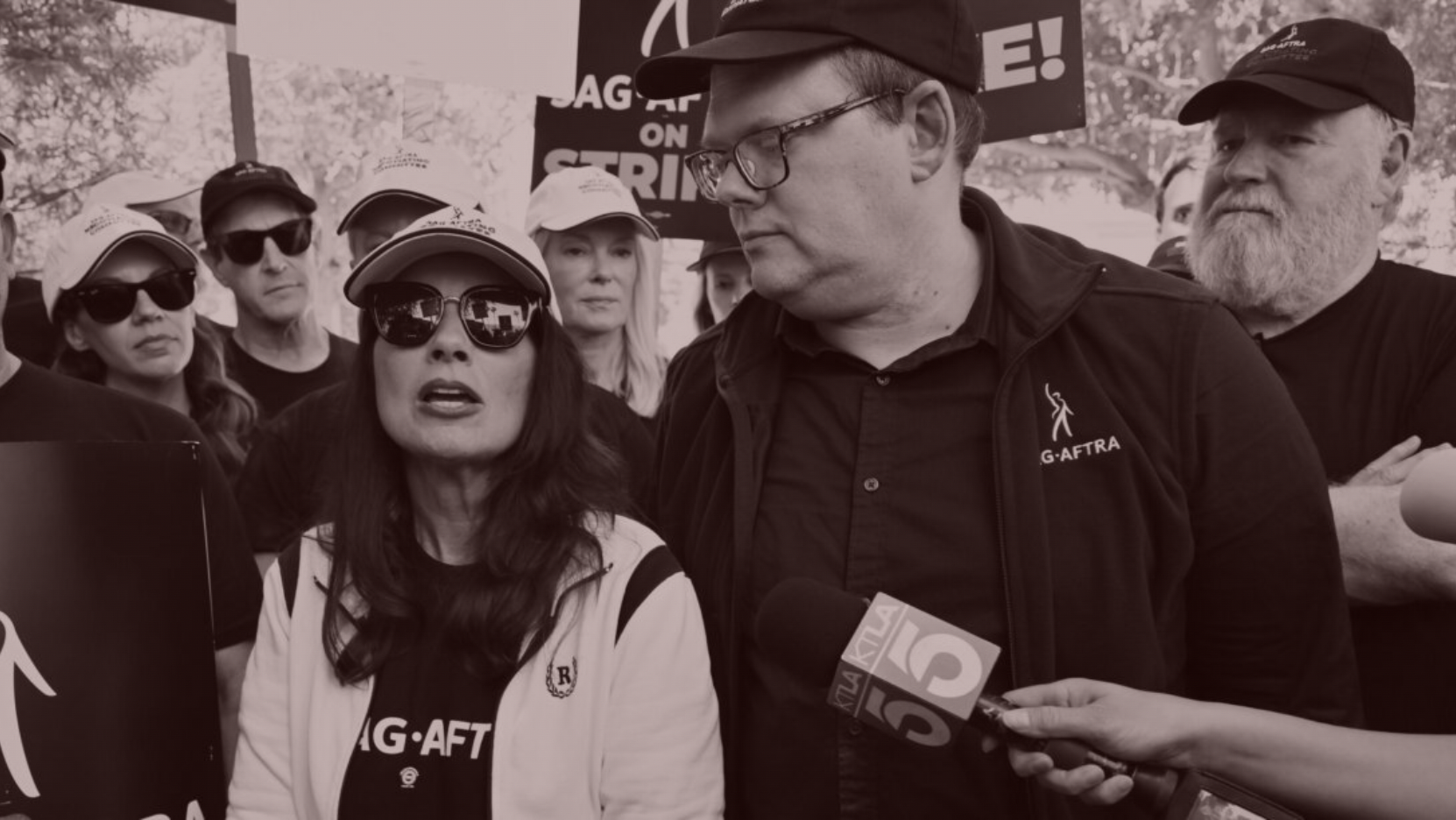
| On Friday, the Hollywood C.E.O.s and key labor executives of the AMPTP got together on a call to figure out their next steps in the labor impasse that has shut down most of the entertainment industry. According to multiple sources familiar with the tone and substance of the meeting, representatives for the studios and streamers expressed a desire to return to the bargaining table. Meanwhile, several participants pressed for the members to better align themselves on the key issues—things like residual rates and data transparency—so that chief negotiator Carol Lombardini would know what was and wasn’t acceptable to the membership. (An AMPTP rep declined to comment on the meeting.)
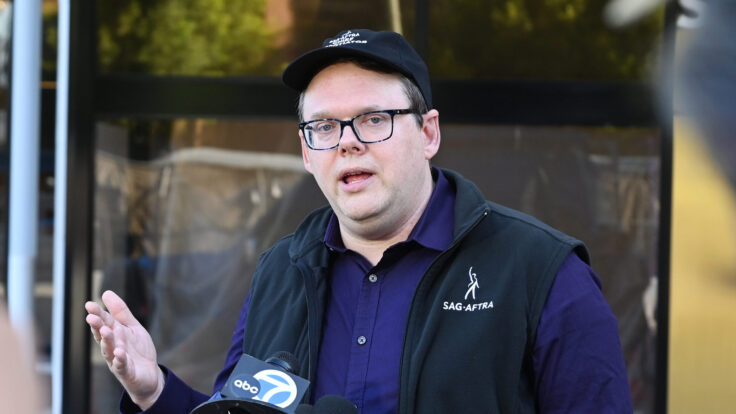
We’ll see how serious the AMPTP is about returning to bargaining, but it’s pretty clear what it won’t agree to: the interim agreements that SAG-AFTRA has been issuing. These 70-page documents have allowed productions small and large for non-struck companies to continue with stars like Glenn Close, Jenna Ortega and Mark Wahlberg. They’ve also become controversial, with some saying they cause confusion and even undermine the strike—so much so that SAG-AFTRA felt the need to defend the deals in an e-mail to its members tonight. So it’s worth examining why the union is issuing the interim agreements, and what they reveal about SAG-AFTRA’s negotiating position with the studios. |
|
|
| Structurally, these agreements give a production company the right to produce a film or television project with union actors during the strike. The form incorporates by reference the existing SAG-AFTRA film and TV collective bargaining agreements and adds dozens of terms that effectively incorporate the union’s most recent demands before talks with the studios and streamers collapsed.
So, on some level, they actually represent SAG-AFTRA’s best case scenario—an indie producer whose low-budget film stopped production when the actors walked out would now be able to restart shooting, and with an increased budget because the cast now makes more in wages and residuals. When SAG-AFTRA and the AMPTP finally reach a deal, that pact will take effect and supersede the interim agreement.
In the meanwhile, though, the interim agreements have become a lightning rod. The union has issued more than 100 of them, and that led comedian-actress Sarah Silverman to excoriate SAG-AFTRA on social media. She partially walked back her criticism after union president Fran Drescher and national executive director Duncan Crabtree-Ireland explained SAG-AFTRA’s rationale for issuing these agreements has been to apply competitive pressure on the studios/streamers and demonstrate that its demands are workable for producers, notwithstanding C.E.O. pushback (we’re looking at you again, Bob Iger).
The interim agreements are intended primarily for producers with no connection to the AMPTP, meaning no financing or distribution deal with the five legacy studios or three pure-play streamers that negotiate across the table from the union. That means that even a large company like Lionsgate is eligible—indeed, a Mel Gibson film, Flight Risk, has an interim agreement and a distribution deal there—as are A24 and its ilk. A Lionsgate picture could do real business while the studios fume, and A24 product would find clearer sailing among the arthouse crowd while studio specialty divisions, like Disney’s Searchlight, are sidelined by the strike.
But the fact that anyone gets to work during the strike doesn’t sit well with some performers, leading Viola Davis, for instance, to step back from G20. And adding to the confusion and dismay, several projects with major streamer distribution actually have received interim agreements: G20 is to be distributed by Amazon; Apple is distributing Tehran and Apex (Brad Pitt stepped away); and Ishana Night Shyamalan’s The Watchers is a pickup for Warner Bros.’ New Line. Why are those projects eligible?
The answer, according to a union source, is that these projects are being produced overseas, which means that SAG-AFTRA has to comply not only with U.S. labor law but also with the laws of the country in which the production is being shot. And in many cases, that legal regime inhibits the union’s ability to strike those productions. So, better to sign them to interim agreements than get involved in a messy transnational fight. |
|
|
| And what, exactly, is in those agreements? We reviewed the form and an actual signed agreement, and saw an 11 percent basic wage increase in the first year, enforceable guardrails around self-tape auditions, streaming video residuals improvements similar to what the Directors Guild achieved, and dozens of other provisions—most notably regarding success-based streaming residuals and restrictions around A.I.
The success-based residual for streaming is structured as an overlay: that is, it’s in addition to the existing streaming residuals formula (as enhanced by the DGA this year). There’s no real detail—the entire substance of the provision is simply this: “Producer will pay to the cast on a pro rata basis an amount equal to 2 percent of the quarterly ‘Revenue Contribution’ as defined and determined by Parrot Analytics, which will be paid in addition to any other payment due.”
That leaves open more questions than it answers, and a couple producers we talked to had no idea how to interpret that provision. They’re assuming that when it finally comes time to pay, there will be a superseding agreement that provides a different, and presumably more understandable, metric. That’s because the studios and streamers have flatly rejected this proposal, objecting that platform revenue is not something the producer controls or shares in. Yet the proposal implicitly assumes that the producer would obtain a so-called assumption agreement from the platform, making the streamer obligated to pay the residual. But will they? Rumors have been flying that Netflix and other streamers have made it clear that they will not acquire any films with such assumption obligations, though a Netflix rep denied that when we asked. In addition, the companies, of course, don’t want to pay more than they’ve already agreed to in the DGA deal. It’s a tough situation. |
|
|
| In contrast, the A.I. provisions in the interim agreement run to 3-1/2 pages of detail. The key points are that, for both principal performers and extras, the interim agreement requires informed consent of the performer and the union at the time that a digital replica is to be used in another project, not at time of employment; informed consent for alteration of the performance; that digital replicas can’t replace union background performers; and that the union’s and performer’s informed consent is required for training an A.I. model on a performance.
Unpacking this reveals a couple of key points. “Informed consent,” according to a union source, means details on the proposed use—such as any nudity, sexual violence, etcetera—that the performer’s replica would be subjected to. And informed consent implies that the performer and union can and would negotiate for compensation. Requiring the consent of the union as well as the performer allows the union to take a harder line position in the case by case negotiations over consent and compensation, reducing the performer’s fear of being blackballed if he or she takes a hard line. And requiring the consent at the time of the later use rather than at the time the performer is employed in the first place significantly increases the performer and union’s leverage, since at that point the performer already has the job.
Interestingly, the AMPTP’s July 17 summary of negotiating status is at first glance not so different in A.I. from what the union is seeking. But the devil-bot is in the details: the studio proposals don’t require union consent; require “consent” rather than “informed consent”; and were made verbally in a sidebar (small meeting) rather than in writing and in the main negotiating session. A SAG-AFTRA source told us that taken together, this amounts to too many loopholes.
And, media reports indicate that several of the companies are now on a hiring spree for A.I. experts. That’s increased the concerns—right or wrong—across Hollywood labor that A.I. is coming for their jobs, and soon. But the parallels between the studio offer on A.I. and the union proposals raise the intriguing prospect that more progress on A.I. than meets the eye might be achievable.
In any case, for now the interim agreements are the most detailed expression of what SAG-AFTRA wants, and that makes them worth looking at. And earlier this evening, the union pushed back forcefully against objections.
“Some have suggested that the interim agreement might prolong the strike, but we disagree,” the negotiating committee told the membership in an email. “We believe the leverage created by increasing competitive pressure on the AMPTP and denying them what they want most will force them back to the table and help bring this strike to an end.”
If Friday’s AMPTP call does indeed foretell a return to the bargaining table, perhaps the SAG-AFTRA leadership is correct. |
|
|
| Scott Galloway argues that the guilds and studios should stop fighting each other and instead sue the crap out of Big Tech companies whose A.I. programs will kill both sides of Hollywood. [No Mercy/No Malice]
Alex Spiro, jackass litigator to Elon Musk, Alec Baldwin, Jay-Z and others who often make poor decisions, gets the New Yorker treatment. [New Yorker]
Antitrust crusader Matt Stoller argues that the striking writers and actors should hold their collective nose and join Ron DeSantis(!) in trying to break up Disney. [Politico]
Pissed about whose story Nolan didn’t tell in Oppenheimer? Adam Kotsko has some choice words for moralists who disguise themselves as cultural critics. [Atlantic]
Twitter C.E.O. Linda Yaccarino, who knows the power of celebrities from her days orchestrating TV upfronts at NBC Universal, is desperately courting talent agencies to get their clients to tweet… or “x”... or whatever it’s called now. [FT]
Maybe, just maybe, President Obama doesn’t personally curate those music and book lists alone. [WSJ] |
|
|
| Recent issues on possible strike saviors, Netflix’s pricing strategy, and publicists begging for an exception to strike rules all sparked interesting feedback. Some examples…
“You and the other pundits are waiting for someone to come in and rescue us. Where is Lew Wasserman? Is it Peter Chernin? Bryan Lourd? As if some Big Daddy will arrive at the dinner table and calm the squabbling children. As Barbie would say, “patriarchy.” What is required is something different this time. Could we not assemble a group of artists who are also business people, who have credibility in both camps, to summit with the guilds and the AMPTP? Just throwing out some names: Steven Spielberg, Reese Witherspoon, Jay-Z, Shonda Rhimes, George Clooney, Oprah Winfrey, Norman Lear. The idea of some sort of steering committee so that we can save ourselves feels more likely to get to some sort of detente and a good result than some Dude sweeping in with a silver bullet.” –A producer
“Shared plans, ad tiers and FAST are all well and good, but without live sports, Netflix has a real cap on how much they can ever charge. And Netflix's upper tier plans, with the added $7.99, are getting close to that cap. Whatever earnings they have now are close to whatever they're going to get, unless they get into big league live sports.” –An agent
“Not mentioned: Now that Netflix is scaled and profitable and pulling away from its streaming rivals, it can exert real pricing power and gradually begin gouging its customers, just like the cable bundles did.” –An executive
“The phrase ‘I feel sorry for the publicists’ was said by nobody in Hollywood ever.” –A journalist
“Please please do not hold my idiot colleagues against me, they mean well but are totally tone deaf to the situation.” –A publicist
“I wonder if these are the same [publicists] who called for a boycott of the Golden Globes, which threatened the livelihoods of many other service providers. They clearly don’t understand how a labor dispute works.” –Another publicist |
|
|
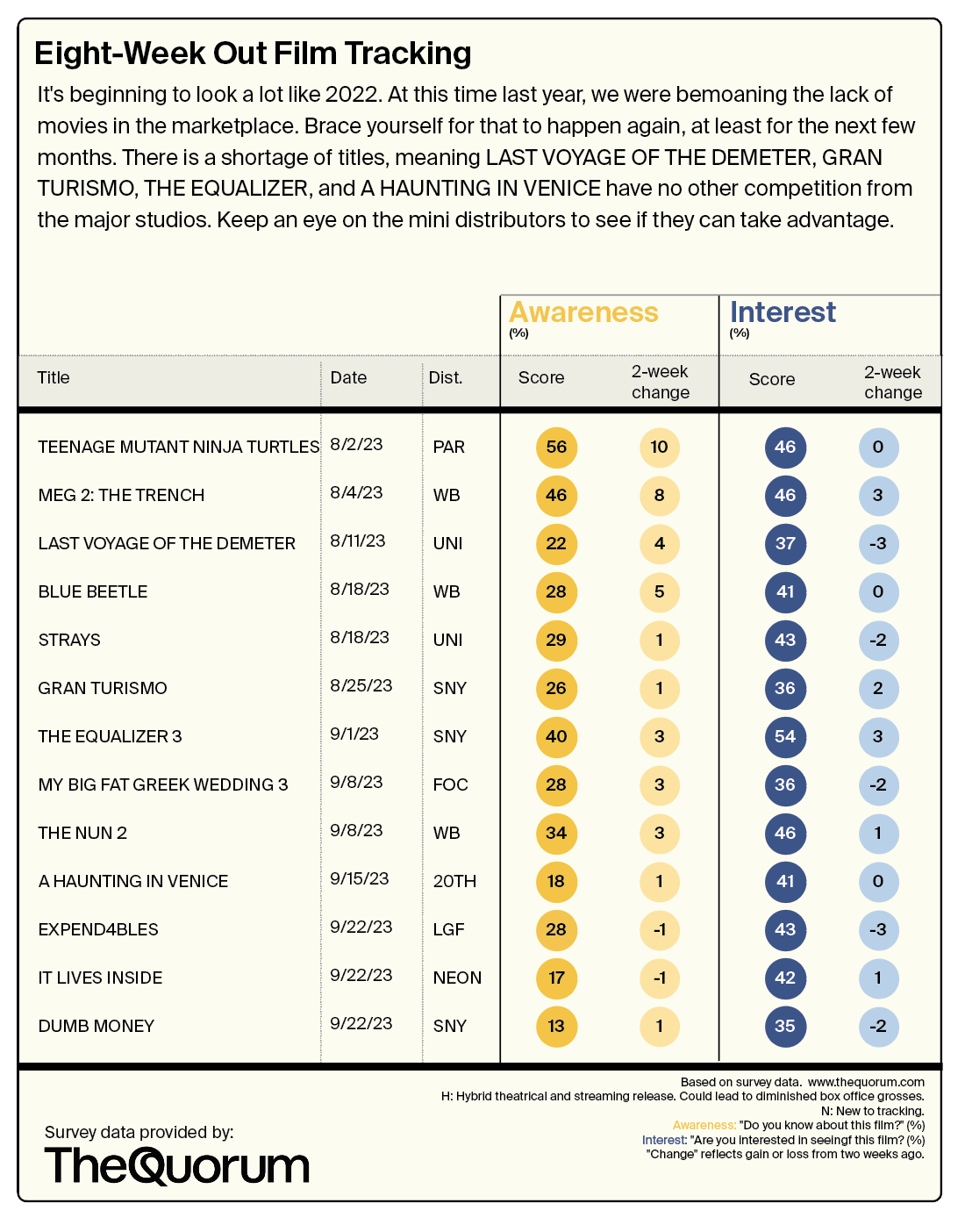
| Barbenheimer notwithstanding, the latest Quorum tracking chart suggests we’re headed into another fallow period for box office, and that’s only partly because of the strikes… |
|
|
|
|
| Sign of the times: Anyone else find it amusing that Soho House, that 2010s bastion of creative community quasi-elitism, is now offering 25 percent discounts on food and beverage to striking guild members? Just me?
Have a great week,
Matt
Got a question, comment, complaint, or a strong parking strategy for Taylor Swift at SoFi Stadium? Email me at Matt@puck.news or call/text me at 310-804-3198. |
|
|
|
| FOUR STORIES WE’RE TALKING ABOUT |
|
|
|
|
|
 |
|
|
|
Need help? Review our FAQs
page or contact
us for assistance. For brand partnerships, email ads@puck.news.
|
|
You received this email because you signed up to receive emails from Puck, or as part of your Puck account associated with . To stop receiving this newsletter and/or manage all your email preferences, click here.
|
|
Puck is published by Heat Media LLC. 227 W 17th St New York, NY 10011.
|
|
|
|