Welcome back to What I’m Hearing. I’m still in full spring break mode, as I hope you are too. But Netflix and its 30 percent profit margins never spend a few days in a lazy river, so Puck’s streaming video guru, Julia Alexander, is here tonight with the real takeaway from today’s earnings and the start of a new era at the company. I’ll be back on Monday.
As always, if you’re somehow still not a Puck member, just click here. Got a news tip or an idea for me? Just reply to this email or message me on Signal at 310-804-3198.
|
|
|
|
Today’s earnings report marked a shift in how the dominant streamer measures its growth—from subscription numbers to monetization. But it also heralds the next phase of the Hollywood content wars, in which Netflix competes with social video platforms more than streamers.
|
|
|
|
Netflix created the premium streaming video industry, and the company has never been shy about dictating its own rules of engagement: binge-watching, the ad-free experience, and super-sized creator deals, among other innovations. Along the way, Netflix also defined the parameters of success in streaming. Thanks to its sky-high stock price, the rest of Hollywood obsessed over subscriber numbers, which led competitors like Disney+, Peacock, and Paramount+ to offer artificially low prices or cut deals with high-churn partners to goose stats. They were just
trying to keep up with Netflix.
Now, the company is attempting to redefine success once again: Today’s quarterly results mark the first time that Netflix has not reported a subscriber growth number. Co-C.E.O.s Greg Peters and Ted Sarandos are trying to convince the market to forget all that came before and focus on what really matters: money. Netflix revenue rose by nearly 13 percent year over year, and operating margin jumped from 22 percent to 32 percent in the first quarter, easily beating estimates. No one mentioned sub numbers, but the stock still gained nearly 5 percent in after-hours trading.
Just like when Netflix first started releasing its weekly top 10 and then its biannual “What We Watched” reports, there is a certain smug flex in this public abandonment of its own most-favored metric. Netflix already has more than twice as many global subscribers as its closest competitor—the combined Disney+ and Hulu—and more than eight times as many as the U.S.-only Peacock. With $10.5 billion in revenue and $3.3 billion in operating income this quarter, Netflix is far ahead of the D.T.C. segments of Disney ($293 million in operating income as of Q1) and Warner Bros. Discovery ($677 million in fiscal year 2024; the WBD streaming segment also includes linear HBO). Peacock and Paramount+ are still in the red (though Paramount executives were confident last quarter that their D.T.C. business would reach full-year domestic profitability in 2025), and many presume they’ll one day unite in a shotgun marriage.
|
|
|
|
A MESSAGE FROM OUR SPONSOR
|
The Emmy award-winning series, Hacks, is back with new episodes streaming now. The new season follows Deborah Vance making a move from her Vegas residency to Hollywood show biz. Tensions rise as Deborah and Ava try to get their late night show off the ground, and make history while doing it. Starring Jean Smart and Hannah Einbinder, watch new episodes of Hacks Season 4, Thursdays at 9pm, exclusively on Max.
LEARN MORE
|
|
|
I’m more interested, however, in what Netflix isn’t saying. Most research firms predict that Netflix’s subscribers likely fell this quarter, with Antenna estimating a loss of 670,000 total subs in the U.S. and Canada region. As I’ve noted before, the company has been maxed out in its home territory for years. Meanwhile, Bernstein analyst Laurent Yoon surmised that Netflix’s average daily engagement per subscriber in the region has remained relatively flat.
No one is worried for Peters or Sarandos, of course. (And not just because their annual pay packages rose to $60 million apiece in 2024, the company disclosed.) Netflix dominates ratings charts, like Nielsen’s Streaming TV Top 10, and boasts a historically low churn rate of around 2 percent in the U.S. The company is hoping to reach 410 million subscribers by 2030, according to a leaked projection, up significantly from the 302 million subs it reported at the end of 2024. And it has proven that it can very effectively monetize that subscriber base. In other words, Netflix doesn’t have to surge its spending to acquire new subscribers to offset disappearing customers.
But this subs reporting pivot is a harbinger of a far more significant transition. While streaming’s first era was defined by a race to scale, its second age will be dictated by maintaining engagement and attention. Netflix is using its massive lead to prepare for that future—investing in more sports like NFL Christmas Day games and licensing YouTube programming like Ms. Rachel and Pop the Balloon LIVE, in recognition that its current general entertainment strategy, especially in highly penetrated markets, isn’t enough. Sarandos said on the earnings call today that some of the top video podcasts, which YouTube currently dominates, will likely “migrate” to Netflix. In the past, the main competition for video attention was between streaming and pay TV. Now, though, the fight is really between premium streaming video and social video.
|
|
Subscriber growth still matters, of course, but the most important metric in the streaming industry is efficiency—defined as the revenue generated per dollar spent on content—something both financial analysts and content teams obsess over. Netflix’s efficiency rate has increased by 35 percent between 2021 and 2024, from 1.7 to 2.3, according to Bernstein, largely due to investment in local-language fare and the high-engagement return on licensed content like Suits and Grey’s Anatomy. Naturally, these two growth areas haven’t gone unnoticed by Netflix’s competitors. Warner Bros. Discovery C.E.O. David Zaslav won’t stop talking about Max’s internationalization strategy, but the focus there is on creating partnerships for Max with companies like Sky, for example, instead of making sizable production investments in various countries. To compare, Netflix is “producing in over 50 countries” as of today, per the company’s report.
Of course, improvements in “efficiency” depend on whether the core business is growing without having to employ aggressive customer acquisition tactics, such as significant discounting and juiced content spend. By comparison, Disney’s net customer additions across Disney+ and Hulu have slowed considerably despite wholesale deals with Charter, bundling with Max, and big discounts like a recent $2.99/month offer. Somehow, Disney+ lost subscribers in its international markets through the first three quarters of 2024, while domestically, Disney+ has struggled to crack more than 1 million new subscribers each quarter—and that’s in quarters where there aren’t sub losses. WBD is aiming for 150 million D.T.C. subscribers by 2026, up from the current 117 million, by leaning on international markets for Max. But again, that number also includes linear HBO customers. As with Disney, much of the Warner Discovery profit is on the back of substantial cuts, not content innovations.
NBCUniversal is still in the red on Peacock, and growth continues to slow. Although Peacock maintains the largest percentage of customers who choose an ad-supported tier in the U.S. (78 percent, per Antenna), its overall engagement is among the lowest, failing to crack 1.5 percent of all time spent with streaming in the U.S. in every non-Olympics month this past year, per Nielsen. The narrative about people signing up for an NFL wild card game and sticking around for Ted and Poker Face is a Hollywood fable. Paramount+, meanwhile, has not-so-quietly reported one of its best years, adding more than 5 million customers in its most recent quarter, and a total of 10 million in 2024. Not to mention that Par+, courtesy of Taylor Sheridan, accounted for five of the 20 most streamed dramas in March of this year, per Luminate. But churn remains a problem that Paramount executives will have to combat as they build toward the profitability levels the Street wants to see.
So the real story behind Netflix’s decision to omit subscriber numbers isn’t about defensiveness. It’s the opposite. Netflix’s competitors keep reporting subscriber growth because they don’t have other good news to share. It’s much easier to cut costs to show profit than to build a global product that hundreds of millions of people are willing to pay for—and extensively use—each month.
|
A Scary, Undeniable Reality
|
|
Unfortunately for the legacy companies, Netflix no longer reporting subscriber numbers points to an even more daunting truth: Sub growth as a metric will matter less and less, in part, because Netflix is no longer the only competition. Free video services, like YouTube and Facebook, were once derided as unprofessional garbage heaps. But now they’re commanding more attention and slowly diluting the value of the content that the premium streaming companies are trying to get people to pay for. Especially with A.I. tools lowering barriers to entry, it’s never been cheaper or easier to produce high-quality content.
|
|
|
|
A MESSAGE FROM OUR SPONSOR
|
The Emmy award-winning series, Hacks, is back with new episodes streaming now. The new season follows Deborah Vance making a move from her Vegas residency to Hollywood show biz. Tensions rise as Deborah and Ava try to get their late night show off the ground, and make history while doing it. Starring Jean Smart and Hannah Einbinder, watch new episodes of Hacks Season 4, Thursdays at 9pm, exclusively on Max.
LEARN MORE
|
|
|
|
Streaming is a complex business, but audience behavior is simple: If someone is engaged, they’re more willing to pay, and less likely to churn. Every hour of engagement that moves to platforms like YouTube—which, per Nielsen, now accounts for 12 percent of all time spent with streaming on televisions in the U.S.—or apps like TikTok and Instagram, is an hour taken from Netflix et al. It’s not quite a zero-sum game—plenty of people are streaming and scrolling simultaneously—but there’s only so much time in the day that can be taken up by screens.
We’re already seeing this transformation begin to play out. The average session times across nearly all major S.V.O.D. services are flat, and churn is increasing, per a March report from Wurl. Time spent with non-premium subscription services, like YouTube, continues to outpace the competition. Meanwhile, Gen Z spends 54 percent more time than other consumers watching user-generated content on short-form video apps, per Deloitte.
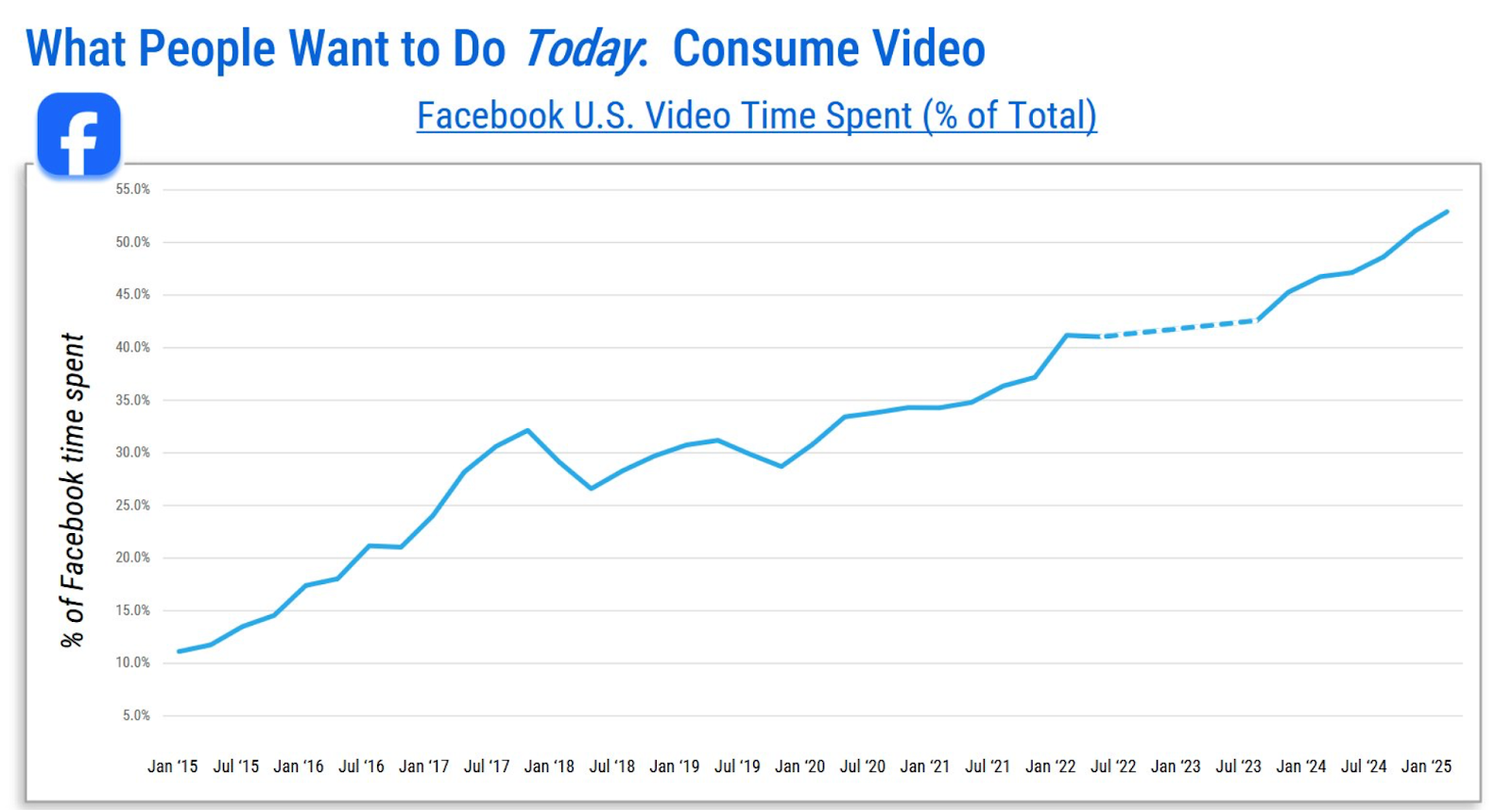
Virtually every analyst I speak to agrees that Netflix has crossed the Rubicon and laid down its moat. The company has pricing power, de minimis churn, and incredible engagement. The problem is for everyone else. And I have one chart to help explain why.
|
|
Facebook—which, alongside sister platforms Instagram and WhatsApp, reaches more than 40 percent of the Earth’s population each month—has seen video in the U.S. go from occupying a small portion of users’ time to the majority of it, per this graph that the company recently disseminated.
And yet, Facebook is just part of the problem. In the U.S., YouTube accounts for more time spent watching content on televisions than Peacock, Max, Paramount+, Tubi, and the Roku Channel combined—and it’s also growing its YouTube Shorts business (for mobile-friendly audiences), and it’s the “new” home of podcasting. If attention is finite, YouTube is capturing an ever-larger slice of the video-watching pie. And unlike these legacy media players, it’s part of a $2 trillion market cap behemoth.
In the battle for video engagement, these tech companies were easy to dismiss at first because they invest practically nothing in their content, which is all generated by users. But that flexible cost model has allowed them to invest heavily in optimizing the user experience, discoverability, and all the algorithmic hacks that keep people addicted to their platforms. Don’t get me wrong: Social video and short-form video won’t replace the need for premium subscription services. But their ascent will hasten a vicious cycle for non-Netflix streamers: more cancellations, fewer advertising dollars, and less room to increase prices to offset new investments. That’s the real story, not whether Netflix tells us how many subscribers it has.
|
Thanks, Julia. I’ll see everyone on Monday. Happy Easter.
Matt
Got a question, comment, complaint, or other franchises for Mikey Madison to pass on? Email me at Matt@puck.news or call/text me at 310-804-3198.
|
|
|
|
Puck founding partner Matt Belloni takes you inside the business of Hollywood, using exclusive reporting and insight to explain the backstories on everything from Marvel movies to the streaming wars.
|
|
|
|
A professional-grade rundown on the business of sports from John Ourand, the industry’s preeminent journalist, covering the leagues, players, agencies, media deals, and the egos fueling it all.
|
|
|
Need help? Review our FAQ page or contact us for assistance. For brand partnerships, email ads@puck.news.
You received this email because you signed up to receive emails from Puck, or as part of your Puck account associated with . To stop receiving this newsletter and/or manage all your email preferences, click here.
|
|
Puck is published by Heat Media LLC. 107 Greenwich St, New York, NY 10006
|
|
|
|