Welcome back to another preview of our special Wednesday offering, starring data analyst Julia Alexander. Remember, these emails will soon go only to Inner Circle members, so click here to upgrade. I.C.-ers also get special intel from Lauren Sherman (fashion) and Marion Maneker (art), so it’s well worth the investment.
Tonight, Julia offers a provocative argument for why traditional studios should expand their YouTube partnerships now, given that the A.I. revolution is arriving imminently.
Take it away, Julia…
|
|
|
 |
Julia Alexander |
|
The Adolescence Advantage
|
|
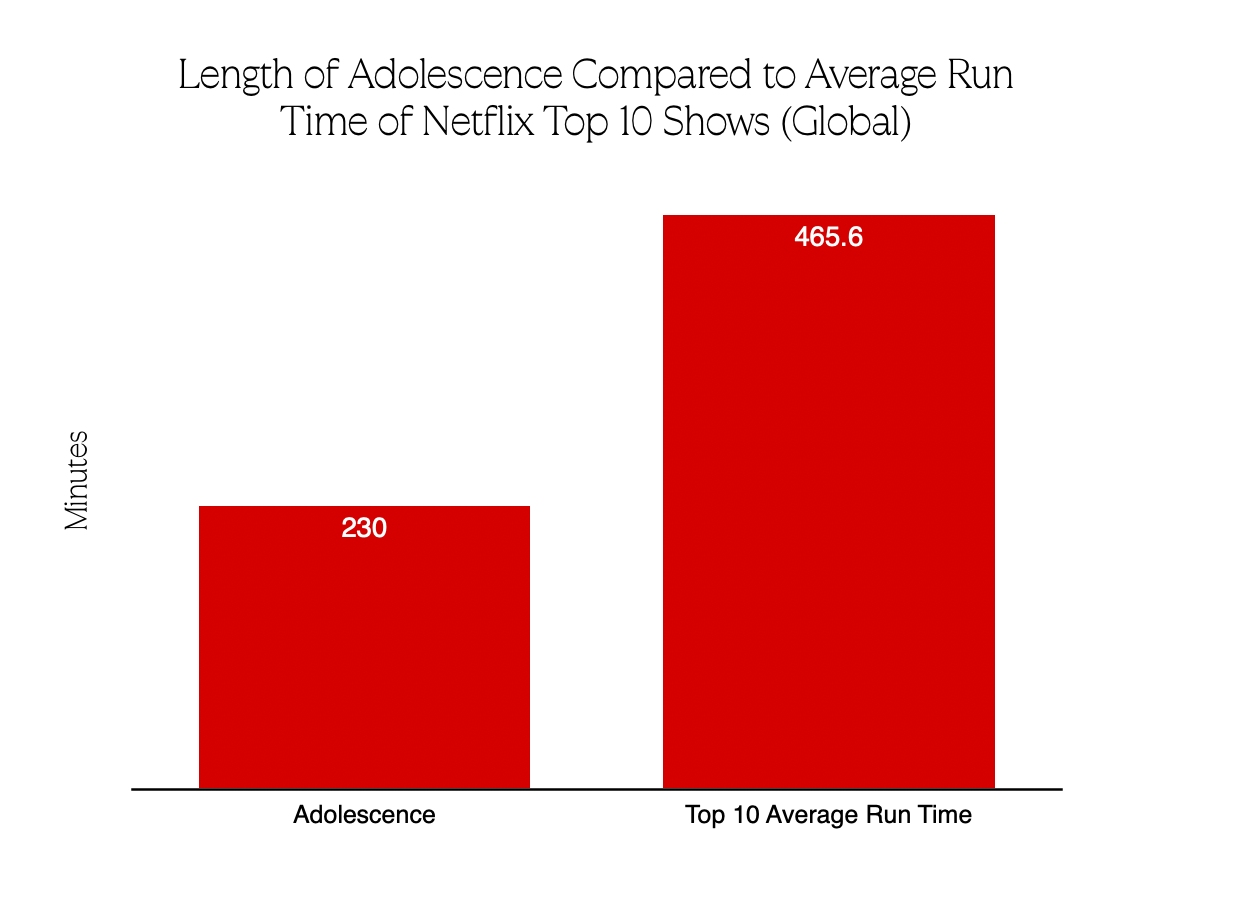
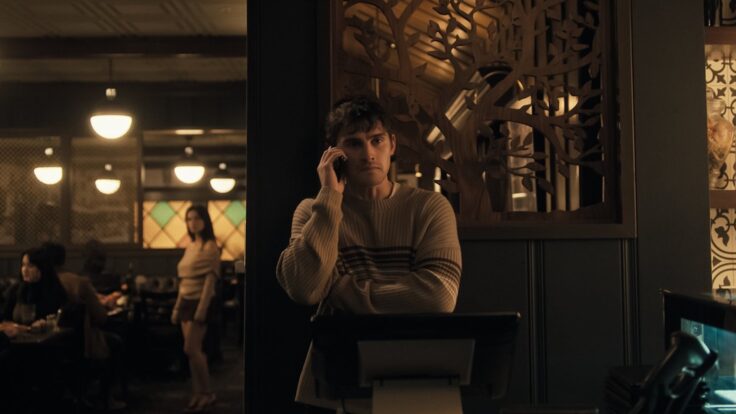
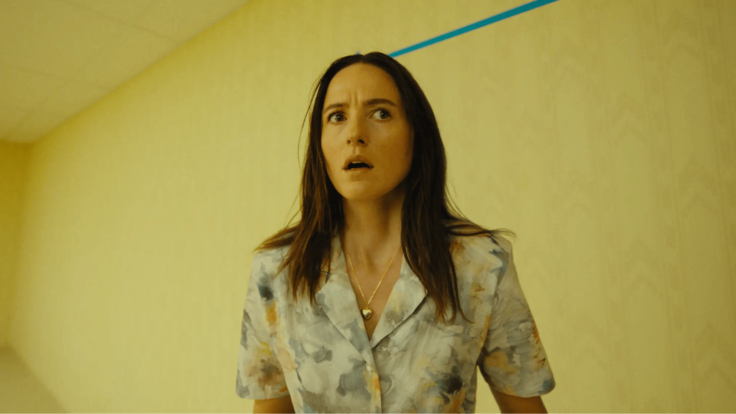
Adolescence, about a 13-year-old boy accused of murder, likely will walk away with an armful of Emmys this September. At just four episodes and 230 minutes, it’s also by far the shortest series in the Netflix all-time top 10. And that duration makes it easier to secure a high completion rate—a metric that Netflix uses to level the playing field among different genres of content.
After all, long-running telenovelas, procedurals, or licensed fare like Grey’s Anatomy always have an hours streamed advantage because they have so many episodes to binge. And, as you can see below, Adolescence averaged around 230 minutes per view, which was considerably less than other shows in the Netflix pantheon—a metric led by Stranger Things. For what it’s worth, though, Adolescence’s brevity may also be a factor in its strong word-of-mouth appeal: While its subject was weighty, it’s not a heavy lift for the commitment-shy. I expect those views to increase throughout awards season, too.
|
- Why your streamer wants a TikTok Feed: Every streamer is trying to solve the problem of “decision paralysis,” wherein viewers become overwhelmed by the glut of available content. After all, it takes the average person more than seven minutes to find something to watch after opening an app. That might be one reason why users return less frequently to S.V.O.D.s each day compared to social-video apps, where videos are simply served up ad infinitum. Indeed, just over half of all streaming users visit a service more than once a day, which is considerably less than the 85 percent of 18-to-34-year-olds who use social video multiple times daily, per Ampere Analysis data. Of course, it’s natural that people would open TikTok more often than Prime Video throughout the day, but the data underscores why everyone from Netflix to Tubi is trying to make their services look more like YouTube—offering more vertical-style entertainment feeds and leaning into the social video aesthetic that’s keeping so many people engaged, and away from other platforms.
- Netflix’s U.K. dominance: Everyone acknowledges Netflix’s international dominance, but the raw numbers are chilling. Barb, the U.K.’s version of Nielsen, just released data showing that Netflix is in about 2.4x as many British homes as Disney+, roughly 5.5x as many as Paramount+, and about 6.5x as many as Apple TV+. Barb notes that Netflix’s ad tier was chosen in 28 percent of U.K. homes, up slightly from last quarter. The only service with a stronger ad tier, as you’d expect, was Prime Video, which opts consumers into the ad experience. About 87 percent of the 13.4 million U.K. households with Prime Video were opted into the tier.
|
|
|
|
Media executives should take a lesson from Netflix and YouTube and embrace generative A.I. with real urgency, or they’ll find themselves once again late to the party, watching other companies eat the new revenue streams.
|
|
|
Even now, more than half a decade after everyone piled into the streaming video race, no company comes close to commanding the level of subscribers, revenue, or engagement that Netflix and YouTube enjoy. Of course, a significant part of that is first-mover advantage. But equally important is that, from the get-go, these companies seemed to grasp that advancing technology would change consumer behavior in transformative ways. And right now, we’re on the precipice of another technological shift: the rise of generative A.I., which is already having an impact on content creation.
Just look at the YouTube channel Yes Neo, which relies heavily on generative A.I. tools, and boasts an average of 3 million views per video less than two years after launching. The channel’s monthly average views skyrocketed from around 40 million in October to nearly 173 million today, per analytics firm SocialBlade. These staggering figures are still the exception, not the rule. But that may not be the case for long. A few weeks ago, Google announced its Veo 3 video generator model, which is largely regarded as the most advanced on the market. Along with its filmmaking app Flow, the Veo 3 tools make it exceptionally easy to make short (for now) videos—with dialogue!—and upload them to YouTube.
|
|
|
|
A MESSAGE FROM OUR SPONSOR
|
AMC and AMC+ presents ANNE RICE'S INTERVIEW WITH THE VAMPIRE starring Jacob Anderson, Sam Reid and Delainey Hayles.
The series is executive produced by award-winning producer Mark Johnson, creator and showrunner Rolin Jones, Mark Taylor, along with Christopher Rice and the late Anne Rice. FOR YOUR EMMY® CONSIDERATION in all categories including OUTSTANDING DRAMA SERIES.
Episodes available to stream now on www.amcnfyc.com
CODE: xb8duofl
|
|
|
|
Of course, generative A.I. won’t displace premium content—the value of a theatrical-quality movie or a $100 million show should increase amidst a sea of slop. A computer model also won’t replace the NFL or Tom Cruise doing something extremely dangerous atop a plane. Generative A.I. video will, however, start to account for a share of the overall time spent on passive entertainment, which impacts engagement, and therefore directly impacts streaming businesses. (How big a share? Who knows! But someone is commenting on those images of Shrimp Jesus on Meta.) The dominance of Netflix and YouTube requires strategies to deal with generative A.I. right now. Those who do will eat up new advertising and revenue streams.
|
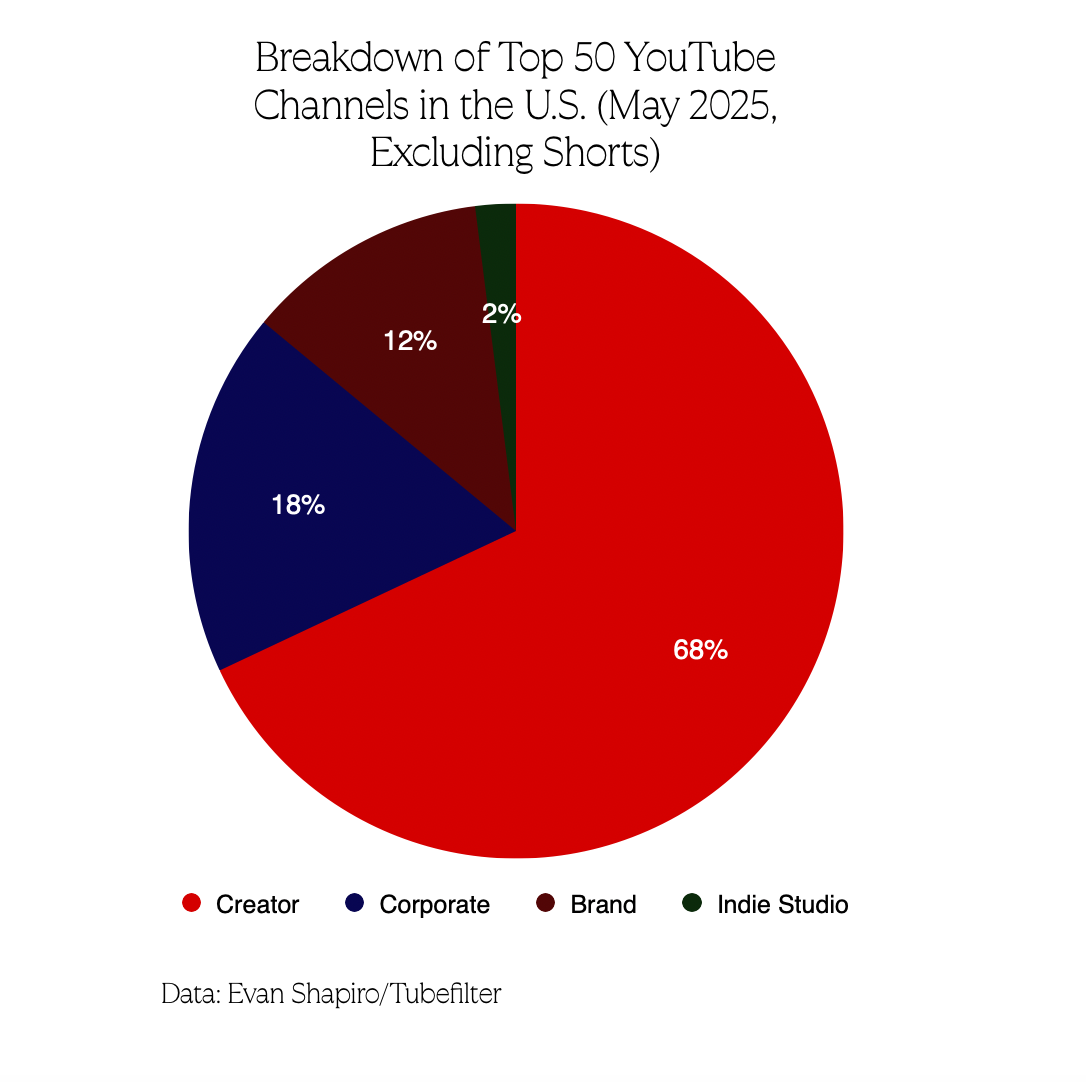
One strategy to avoid missing the moment requires adopting the “If you can’t beat them, join them” mentality. Everyone from Netflix’s Ted Sarandos to Disney’s Bob Iger has talked about how YouTube plays a role in their businesses, albeit for different reasons. Netflix mainly uses YouTube for marketing, while Disney invests in the platform as a business opportunity. Disney U.K., for example, has some of the strongest engagement on YouTube Shorts across all creators and brands in the region, according to new data from analyst Evan Shapiro in partnership with Tubefilter. Meanwhile, legacy media brands are also accounting for larger percentages of consumption time on YouTube, using the platform as another distribution channel as well as a marketing tool. In May, corporate and brand channels, as defined by Shapiro, made up the second-largest share of the top 50 YouTube channels in the U.S., but still lagged far behind creators.
|
|
If streaming upended the traditional power structure of content distribution, generative A.I. will do the same for content creation. More content likely equals more time spent on platforms, which in turn means the opportunity for higher advertising revenue. YouTube C.E.O. Neal Mohan has been explicit about his determination to win this next power struggle, having espoused a series of mantras just this year—that YouTube will remain the epicenter of culture, YouTubers will become the startups of Hollywood, YouTube is the new television, A.I. will make it easier to create on YouTube, etcetera. Unspoken, of course, is the fact that his platform is also free from so much of the legacy costs that impede innovation.
Given all this, traditional media companies should start thinking of YouTube as a proper distribution partner, rather than just a place to drop trailers and clips. YouTube has encouraged this behavior, too, having historically negotiated stronger ad rates with premium partners due to the higher value of their content. Embracing the platform also allows traditional media companies to sell their own ads alongside their YouTube content, as NBCUniversal did back in 2015, when then-ads chief Linda Yaccarino proclaimed, “We are really getting aggressive in terms of getting our content to as many consumers as possible.” A decade ago, that meant simply posting content on YouTube. Now, it’s not enough to just meet audiences where they are; you have to create for them in those realms—ideally as efficiently as possible.
|
|
From my experience consulting many of these companies, I’ve noticed two major barriers preventing traditional media players from fully leaning into YouTube. The first is that they risk losing audience time by pushing people to a different platform—which, obviously, is already happening anyway. Also, the math doesn’t add up: Upfront costs for creating content, even without much of a marketing budget, typically add up to more than what YouTube’s ad revenue split would generate in return.
And yet, generative A.I. tools may help artists and creatives execute on their vision more easily, bringing down the cost and time required for a tedious production process. Right now, this is particularly true of forefront genres like animation, sweetening the prospect of placing bonus content on YouTube (as opposed to, i.e., taking an existing Bluey short and putting it exclusively on YouTube) and bringing in additional revenue that can support work on longer, premium projects.
|
|
|
|
A MESSAGE FROM OUR SPONSOR
|
AMC and AMC+ presents ANNE RICE'S INTERVIEW WITH THE VAMPIRE starring Jacob Anderson, Sam Reid and Delainey Hayles.
The series is executive produced by award-winning producer Mark Johnson, creator and showrunner Rolin Jones, Mark Taylor, along with Christopher Rice and the late Anne Rice. FOR YOUR EMMY® CONSIDERATION in all categories including OUTSTANDING DRAMA SERIES.
Episodes available to stream now on www.amcnfyc.com
CODE: xb8duofl
|
|
|
Even for live-action productions, however, tools like Luma A.I.’s Modify Video feature, announced today, can help create vivid background settings and C.G.I. for a fraction of the time and cost that it requires now. Trying to use these tools for a big Marvel movie will result (and previously has resulted) in negative feedback from audiences. The value expectation of a Marvel movie is that it looks like a $200 million production. On YouTube, however, the value expectation from audiences is much lower, but regular engagement is higher.
Sure, there are obvious reasons why the Disneys and Sonys of the world would choose not to embrace artificial intelligence to power their content: The quality isn’t as good, the unique brand flavor disappears, and talent and guild relationships get tricky… fast (recall the vociferous A.I. debates during the dual 2023 strikes). Not to mention that the studios may very well not be able to do it because of those guild agreements. One could also argue that uploading more content to YouTube could mean more training data for A.I. models—including Google’s—thus aiding the competition. All of which are valid considerations.
But every studio is clearly far more open to A.I. than they were a couple of years ago. A.I. is already being incorporated more frequently into preproduction— e.g., at Lionsgate, which is working with Runway to develop new models that can help with storyboarding and previsualization. Jon Feltheimer, Lionsgate’s C.E.O, has said that entertainment will remain a “creative enterprise, but its future growth will require a combination of art and science.” Very diplomatic. Just today, AMC Networks reportedly inked a deal with Runway, too. None of this is new, but it’s getting more pronounced. Executives clearly feel they can be more open about integrating A.I. into their businesses, and last year, execs across different studios reportedly took meetings with OpenAI’s Sam Altman to learn more about how the technology could improve their workflows.
In short, if generative A.I. can be used to create certain types of content—like the Cocomelons of the world—faster, then there is an opportunity for a company like Disney or Paramount to create additional revenue streams on nonpremium content without devaluing their core brands and properties. Keep the experiment away from the premium platforms, like Disney+ or Paramount+, but don’t just sit on the sidelines completely.
At the same time, when looking at the total hours produced and the number of videos released, YouTube videos outpace content from traditional studios and networks by a rate of 20,000:1 annually, per analyst Doug Shapiro. Inevitably, generative A.I. will kick that ratio up even further, as traditional studios settle into their post–Peak TV era. The natural reaction from content executives like Disney’s Dana Walden or NBCUniversal’s Donna Langley should be to protect the premium fare, the kind that drives people to theaters and encourages them to pay a monthly subscription bill, or spend time with their favorite characters at a theme park.
Brands should think of YouTube in the same terms as the direct-to-video renaissance of the ’90s and early ’00s, when the VHS/DVD market took off. Treating YouTube content as a direct-to-video replacement strategy allows brands to experiment with new technologies and a new distribution partner, and perhaps find a strong revenue stream to backstop declining cable assets. Arguing that A.I. will replace human artistry isn’t just dumb, it’s flat out wrong. But much like how new camera technologies allowed for new types of photography and videography to emerge, generative A.I. is a tool that creators and upstart media companies will use to build new businesses and chase the same audiences legacy media is fighting to keep. After all, it’s easier to use the same tools as individual creators to compete on a platform like YouTube than it is for those creators to become the next Netflix.
|
|
Thanks, Julia. I’ll be back tomorrow.
Matt
|
|
|
|
Puck founding partner Matt Belloni takes you inside the business of Hollywood, using exclusive reporting and insight to explain the backstories on everything from Marvel movies to the streaming wars.
|
|
|
|
A professional-grade rundown on the business of sports from John Ourand, the industry’s preeminent journalist, covering the leagues, players, agencies, media deals, and the egos fueling it all.
|
|
|
Need help? Review our FAQ page or contact us for assistance. For brand partnerships, email ads@puck.news.
You received this email because you signed up to receive emails from Puck, or as part of your Puck account associated with . To stop receiving this newsletter and/or manage all your email preferences, click here.
|
|
Puck is published by Heat Media LLC. 107 Greenwich St, New York, NY 10006
|
|
|
|